Four open slots
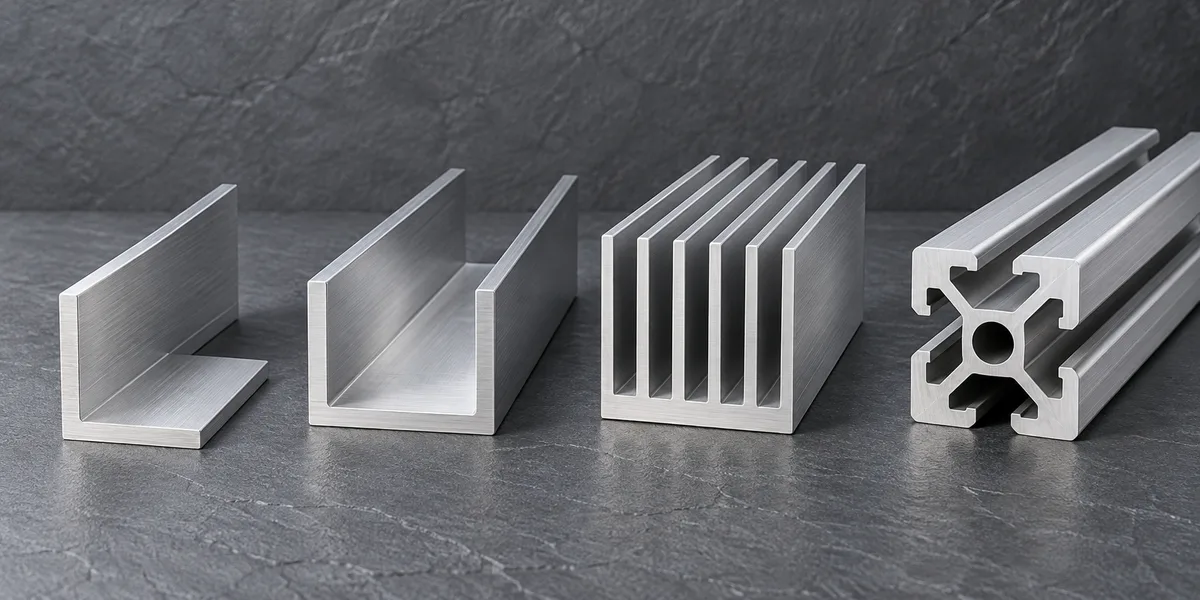
The standard layout: a slot on every face, so brackets and panels can be fixed from any side.



4040 and 4080 are the 40 mm metric T-slot profiles used for machine frames, guarding, workstations and automation cells: a 40 × 40 mm square section and a 40 × 80 mm double section with open slots that take nuts, brackets and panels without welding. Metline supplies both in 8 mm and 10 mm slot versions, light and heavy walls, clear or black anodised, cut to length and shipped worldwide.
The numbers describe the outside section in millimetres: a 4040 profile is 40 × 40 mm, a 4080 is 40 × 80 mm. Both belong to the "40 series", the most widely used size class in metric modular framing, sitting between the light 20 and 30 series and the heavy 45, 50 and 80 series.
Each profile is a hollow extrusion with a central core bore and an undercut T-slot in each face. A T-nut slides or drops into the slot and a bolt passes through a bracket into the nut, so frames go together with hand tools and can be taken apart, extended or rebuilt later. The core bore can be tapped (typically M8 for 8 mm slot profiles and M10 or M12 for heavier 10 mm slot profiles, depending on the design) for end fastening.
A 4040 is the default for frames of moderate size: machine guards, operator workstations, 3D printer and CNC router bases, test rigs and enclosures. A 4080 is two 40 mm modules side by side. Its height on the strong axis gives it far more bending stiffness in that direction, so it is used for long spans, gantry beams, base frames, conveyor side rails and anywhere a single member carries most of the load.
There is no single international standard for T-slot geometry. The two common 40 series families are the "slot 8" system and the "slot 10" system, and within each family the inner shape of the slot, the depth of the undercut and the core bore vary from one system brand to another. Fasteners from one family will not fit the other, and even within a family it is worth checking the slot drawing before mixing brands.
| Feature | 40 series, 8 mm slot | 40 series, 10 mm slot |
|---|---|---|
| Slot opening | 8 mm (often 8.0 – 8.2 mm) | 10 mm (often 10.0 – 10.2 mm) |
| Typical fastener | M4 – M8 T-nuts and hammer nuts | M5 – M8 T-nuts and hammer nuts |
| Common in | European modular systems, machine building | Asian and some European systems, heavier hardware |
| Panel infill | 4 – 6 mm panels in a slot gasket | 4 – 8 mm panels in a slot gasket |
| Best for | Compatibility with existing 8 mm frames | Heavier brackets and larger nuts |
Slot dimensions and fastener sizes above are typical ranges. Send the profile drawing or the system you already use, and we will match the profile to it.
Some systems also use a drop-lock or taper feature: the inner flanges of the slot are angled a few degrees so that tightening the nut pulls the flanges in and locks the joint against vibration. If your frame relies on this, tell us, because a profile without the taper will hold a joint but will not give the same pre-load.
The same 40 × 40 mm outside size is made with very different wall thicknesses and core shapes. Weight and stiffness can differ by 50 % or more between a light and a heavy version, so compare the moment of inertia, not just the nominal size, before you substitute one profile for another.
| Profile | Typical weight (kg/m) | Moment of inertia I (cm4) | Typical use |
|---|---|---|---|
| 4040 light / economy | 1.35 – 1.55 | 6.5 – 7.5 | Guards, light frames, displays |
| 4040 standard | 1.7 – 1.9 | 9 – 10.5 | General frames, workstations, enclosures |
| 4040 heavy | 2.3 – 2.5 | 13 – 14.5 | Machine frames, high-load uprights |
| 4080 light | 2.1 – 2.3 | about 45 (strong axis) | Long light beams, conveyor rails |
| 4080 standard | 2.7 – 2.9 | about 55 – 62 (strong axis); 15 – 17 (weak axis) | Gantries, base frames, beams |
Indicative ranges compiled from published data for common 40 series systems. Exact section properties depend on the die; we supply the drawing and section data for the profile quoted.
The standard layout: a slot on every face, so brackets and panels can be fixed from any side.
Smooth faces where a slot is not needed: cleaner look, easier to wipe in cleanrooms and food areas, and fewer dirt traps.
Rounded or angled corner sections for operator-safe edges, curved enclosures and frames at angles other than 90°.
Double profiles with slots on the narrow faces as well as two slots on each wide face, for mounting rails and guards side by side.
Plastic or aluminium cover strips close unused slots; panel gaskets hold infill panels without rattling.
Tapped core bores, counterbored access holes for anchor fasteners and mitred ends prepared before dispatch.
T-slot profiles are extruded from medium-strength 6xxx alloys that extrude well through complex hollow dies and anodise evenly. The choice affects strength more than stiffness: every aluminium alloy has an elastic modulus close to 69 GPa, so a heavier profile, not a stronger alloy, is the way to reduce deflection.
| Alloy and temper | Min. tensile strength | Min. yield strength (0.2 %) | Standard | Notes |
|---|---|---|---|---|
| 6063-T5 | 175 MPa (wall ≤ 10 mm) | 130 MPa | EN 755-2 | Best surface for anodising; light and standard profiles |
| 6063-T6 | 215 MPa (wall ≤ 10 mm) | 170 MPa | EN 755-2 | Common for general framing |
| 6063-T66 | 245 MPa (wall ≤ 10 mm) | 200 MPa | EN 755-2 | Higher-strength 6063 variant |
| 6105-T5 | 262 MPa / 38 ksi | 241 MPa / 35 ksi | ASTM B221 | Widely used for strong framing profiles in North America |
| 6061-T6 | 260 MPa / 38 ksi | 240 MPa / 35 ksi | ASTM B221 / EN 755-2 | High strength; used for special heavy sections |
Specified minimums are what the standard guarantees; typical values are higher. The mill test certificate for each lot reports actual results.
For T-slot frames, deflection usually decides the profile long before strength does. A quick check uses the beam formula for a simply supported member with a load at mid-span: deflection = F × L³ / (48 × E × I).
Worked example: a 1,000 mm long standard 4040 (I ≈ 9 cm4 = 90,000 mm4, E = 69,000 MPa) carrying 1,000 N (about 100 kg) at the centre deflects 1,000 × 1,000³ / (48 × 69,000 × 90,000) ≈ 3.4 mm. The same load on a standard 4080 with the 80 mm side upright (I ≈ 58 cm4) deflects only about 0.5 mm. Double the span and deflection rises eight times, which is why long beams move up to 4080 or larger sections quickly.
| Span, centre load 500 N | 4040 standard (I ≈ 9 cm4) | 4080 standard, strong axis (I ≈ 58 cm4) |
|---|---|---|
| 500 mm | 0.21 mm | 0.03 mm |
| 750 mm | 0.71 mm | 0.11 mm |
| 1000 mm | 1.68 mm | 0.26 mm |
| 1250 mm | 3.28 mm | 0.51 mm |
| 1500 mm | 5.66 mm | 0.88 mm |
| 2000 mm | 13.42 mm | 2.08 mm |
Calculated for a simply supported beam with a single central load; self-weight and joint flexibility are ignored. Fixed ends roughly quarter the deflection. Use the exact I value from the profile drawing for design.
T-slot profiles are almost always supplied anodised. A clear anodic film (typically 10 – 15 µm for indoor framing, 20 µm or more where the frame faces weather or cleaning chemicals) protects the surface, resists fingerprints and gives the even satin look buyers expect. Black anodising is the next most common choice for machine builders and display frames; colours such as yellow are used for safety barriers.
Standard satin silver. Hard, wear-resistant surface that does not chip because it is part of the metal.
Popular for machines, photography rigs and displays. Slight colour variation between batches is normal; order a frame from one batch where appearance matters.
Any RAL colour. Check slot tolerance: a thick coating inside the slot can stop nuts sliding, so slots are often masked.
Unfinished extrusion for frames that will be painted or hidden. Cheaper, but marks easily in handling.
Remember that saw-cut ends and any machined holes expose bare aluminium after anodising. This is normal and does not affect corrosion resistance indoors; end caps cover the cut face for a finished look and safety.
| Characteristic | Typical requirement |
|---|---|
| Cross-section dimensions | To EN 755-9 or the system drawing; slot opening usually held to about +0.1 / −0 mm |
| Straightness | In the order of 0.5 mm per metre or better on precision framing profiles |
| Twist | In the order of 0.5° per metre or better |
| Cut length | Commonly ±0.2 – 0.5 mm on precision saws |
| End squareness | Square cut within a few tenths of a degree, so joints close without gaps |
Tighter straightness, twist or length tolerances can be agreed per order. State them on the drawing so they appear on the inspection report.
Compared with welded steel frames, an aluminium T-slot frame weighs roughly a third as much for the same outside size, needs no painting, and can be changed on the shop floor. Steel still wins on raw stiffness per section size, which is why heavily loaded machine beds often combine a steel base with an aluminium superstructure.
A 4040 is a metric T-slot framing profile with a 40 × 40 mm square section and a T-slot on each face, usually extruded in 6063 or 6105 aluminium and anodised. It is the standard size for machine guards, workstations, enclosures and medium-duty frames.
Between about 1.35 and 2.5 kg per metre, depending on whether it is a light, standard or heavy profile. A standard 8 mm slot 4040 weighs around 1.8 kg/m and a standard 4080 around 2.8 kg/m.
No. The two slot systems use different nut widths and slot undercuts. Choose one system for the whole frame, and check the slot drawing even within the same slot width if you mix brands.
In bending about its strong axis a 4080 is roughly five to six times stiffer than a 4040, because stiffness rises with the cube of section height. About its weak axis it is only modestly stiffer. Always orient a 4080 with the 80 mm side in the direction of the load.
With T-nuts and bolts through corner brackets, gussets and joining plates, or with internal anchor fasteners that pass through a drilled access hole into a tapped core bore. Internal fasteners give a clean look; gussets give the most rigid corners.
Yes. Metline can cut profiles to your list, tap core bores, drill access holes and pack each frame as a labelled kit with brackets and fasteners, ready to assemble on arrival.
Send the drawing or cut list, slot system and finish. We will reply with the profile data, a full kit price and delivery to your site.





