Joining plates and gussets
Larger plates with more bolts per joint. Use gussets on both faces of heavily loaded corners.



15 series is the heavier inch T-slot system, built on a 1.5-inch module with a 0.320 in slot opening on 1.5-inch centres. Its base 1515 profile is about six times stiffer than a 1010, so it is the usual choice for machine bases, workstations, robot cells and guarding. Metline supplies 15 series profiles in 6105-T5, cut, machined and anodised, with matching fittings, worldwide.
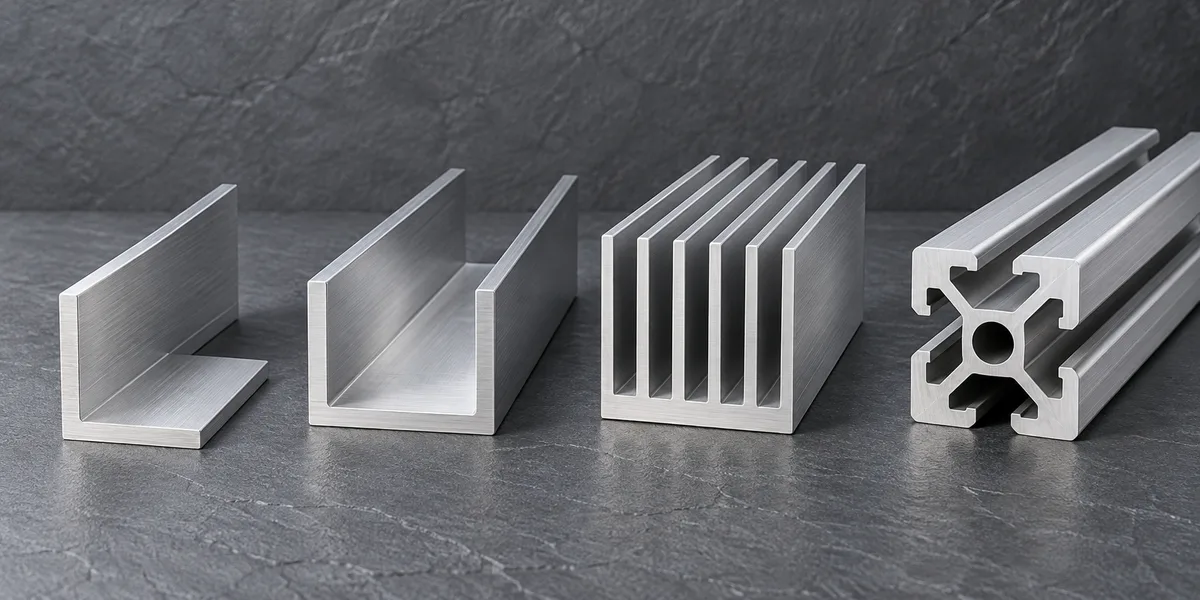
15 series profiles are built on a 1.5-inch square. A 1515 is 1.5 × 1.5 in, a 1530 is 1.5 × 3 in, a 1545 is 1.5 × 4.5 in and an inch 3030 is 3 × 3 in. Slot centrelines sit 3/4 inch from each edge and 1.5 inches apart, so every profile and fitting in the series lines up on the same grid.
The larger section brings a step change in stiffness. Moment of inertia grows roughly with the fourth power of section size, so going from 1 inch to 1.5 inch multiplies stiffness by about six while weight rises by about two and a half. Larger slots also take 5/16-18 bolts, so joints carry more clamping force and resist slipping under vibration.
That is why 15 series is the default for frames that people lean on, that carry motors and moving axes, or that span more than about a metre. 10 series remains the lighter choice for desktop equipment and small enclosures; many plants use both, with 15 series for the base and posts and 10 series for light panel framing.
| Profile | Section (in) | Section (mm) | Typical use |
|---|---|---|---|
| 1515 | 1.5 × 1.5 | 38.1 × 38.1 | Posts, frames, bench legs |
| 1530 | 1.5 × 3.0 | 38.1 × 76.2 | Beams, conveyor side frames |
| 1545 | 1.5 × 4.5 | 38.1 × 114.3 | Long beams, gantry rails |
| 3030 (inch) | 3.0 × 3.0 | 76.2 × 76.2 | Heavy posts, machine bases |
| 3060 (inch) | 3.0 × 6.0 | 76.2 × 152.4 | Main beams on large structures |
| 0715 / 0730 | 0.75 × 1.5 / 0.75 × 3.0 | 19.1 × 38.1 / 19.1 × 76.2 | Panel framing, trim, door frames |
Variants include standard, light and very light profiles (thinner walls for lower weight and cost), grooved faces, smooth faces, quarter-rounds and 45° profiles for angled members. The light versions save material where the frame is governed by geometry rather than load.
As with 10 series, an inch "3030" (3 × 3 in) is not the metric 3030 (30 × 30 mm). State the unit system on every order.
Light and grooved variants have lower values; ask for the data sheet for the exact profile.
As a worked illustration, a 1515 beam simply supported over 1 m with a 500 N central load deflects about 1.4 mm (δ = PL³ / 48EI). Over 1.5 m the same load gives about 4.8 mm, because deflection rises with the cube of span. Turning to a 1530 on edge cuts deflection by roughly a factor of five to six, at about double the weight.
15 series profiles are normally extruded in 6105-T5. Its strength margin over 6063 matters more here, where bolted joints and long beams carry higher stresses.
| Alloy and temper | Min. tensile strength | Min. yield strength | Character |
|---|---|---|---|
| 6105-T5 | 262 MPa / 38 ksi | 241 MPa / 35 ksi | Usual North American T-slot alloy: strong, extrudes well, good anodising |
| 6063-T5 | 152 MPa / 22 ksi | 110 MPa / 16 ksi | Lowest cost, best surface; adequate for light frames |
| 6063-T6 | 207 MPa / 30 ksi | 172 MPa / 25 ksi | Common for metric profiles; the 25 ksi yield figure often quoted in catalogues |
| 6061-T6 | 262 MPa / 38 ksi | 241 MPa / 35 ksi | Highest strength of the group; harder to extrude in thin, complex sections |
Minimum values from ASTM B221 for sections up to about 12.7 mm wall; EN 755-2 gives similar figures for EN AW-6063 and EN AW-6005A. Stiffness (E ≈ 69 GPa) is the same for all four alloys, so alloy choice changes strength but not deflection.
Larger plates with more bolts per joint. Use gussets on both faces of heavily loaded corners.
Concealed joints for clean frames; reinforce with gussets where moment loads are high.
Bearing pads and roller carriages that run on the profile itself, giving simple sliding doors and adjustable stops.
Base plates, levelling feet and castors sized for the heavier 15 series loads.
Panel retainers, hinges, latches and handles for guards and enclosures.
Slide-in, drop-in and economy nuts for 5/16-18 or M8 bolts.
The standard finish: a hard, transparent oxide layer (typically 10 – 15 µm) that resists corrosion and scuffing and keeps a clean satin look.
Black is popular for optical, laser and display equipment because it cuts reflections. Other dyed colours can be quoted for safety or brand colour coding.
A thicker, coloured coating for washdown areas or where a specific RAL colour is required. Slots may need masking so T-nuts still slide freely.
Any cut, drilled or tapped surface made after anodising shows bare aluminium. It is cosmetic only, as aluminium forms its own thin oxide film, but specify machining before finishing if appearance matters.
Matching 15 series fittings (brackets, gussets, joining plates and T-nuts) can be supplied in the same finish so the assembled frame looks uniform.
| Feature | 10 series | 15 series | Metric 45 mm system |
|---|---|---|---|
| Base profile | 1010 (25.4 mm) | 1515 (38.1 mm) | 4545 (45 mm) |
| Slot opening | 0.256 in | 0.320 in | Typically 10 mm |
| Typical bolt | 1/4-20 | 5/16-18 | M8 |
| Base profile weight | About 0.76 kg/m | About 2.0 kg/m | Roughly 1.8 – 2.5 kg/m depending on design |
| Relative stiffness (base profile) | 1 | About 6 | Higher still |
If your plant already runs on metric fasteners, the 45 series or 40 mm metric systems give similar load capacity with M8 hardware.
10 series uses a 1-inch module with 0.256 in slots on 1-inch centres; 15 series uses a 1.5-inch module with 0.320 in slots on 1.5-inch centres. 15 series is heavier and roughly six times stiffer in the base profile.
Typically 5/16-18 bolts with matching T-nuts; M8 nuts made for the 15 series slot are also available.
The standard 1515 weighs about 1.35 lb/ft (2.0 kg/m). Light versions weigh less.
Yes, when the frame is designed for it. Size members on deflection, brace frames against racking, use gussets at load-bearing joints and check fastener capacity.
Clear anodising is standard; black anodising and powder coating are available.
Yes. We cut and machine profiles to your list and pack them as labelled kits with brackets, T-nuts and feet.
Send your drawing, cut list and fittings. We will quote profiles, machining and hardware together.





