Joining plates and gussets
Flat plates with 3, 5 or 6 holes, and inside corner gussets, bolted across a joint with T-nuts. Fast and adjustable; good for most static frames.



10 series is the inch-based T-slot framing system built on a 1-inch module: profiles are 1 × 1 in, 1 × 2 in, 2 × 2 in and so on, with a 0.256 in slot opening on 1-inch centres. Metline supplies 10 series profiles in 6105-T5 and 6063 alloys, anodised clear or black, cut to length and machined to your drawing, with matching fittings, to builders and OEMs worldwide.
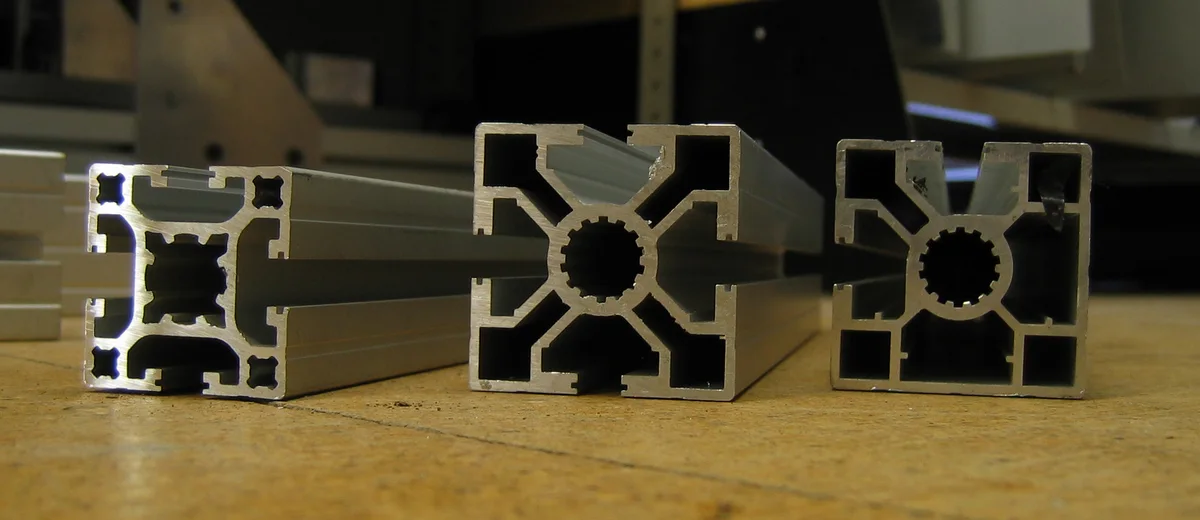
"10 series" names a family of fractional (inch) T-slot profiles whose basic unit is a 1-inch square. Every larger profile is a multiple of that square, so a 1020 is 1 × 2 in, a 1030 is 1 × 3 in and a 2020 is 2 × 2 in. Slot centrelines sit 1/2 inch from each edge and 1 inch apart, which keeps hole patterns and fittings interchangeable across the whole range.
The appeal is speed. A frame is designed on a simple grid, the profiles are cut to length, and the joints are made with bolts and T-nuts that slide into the slots. No welding, no painting and no specialist tools are needed, and the frame can be taken apart, changed or extended later. That makes 10 series a natural choice for desktop machines, test rigs, guards and display structures where loads are light to moderate and the design is likely to change.
In naming, "10 series" refers to the module, while the four-digit numbers describe the section. A metric equivalent exists in the 20 mm system, but the two are not interchangeable: a 1-inch profile is 25.4 mm wide and its slot is shaped for inch fasteners (typically 1/4-20 bolts).
| Profile | Section (in) | Section (mm) | Typical use |
|---|---|---|---|
| 1010 | 1.0 × 1.0 | 25.4 × 25.4 | Light frames, 3D printer frames, enclosures |
| 1020 | 1.0 × 2.0 | 25.4 × 50.8 | Longer spans, rails, bench frames |
| 1030 | 1.0 × 3.0 | 25.4 × 76.2 | Beams with better stiffness in one direction |
| 2020 (inch) | 2.0 × 2.0 | 50.8 × 50.8 | Corner posts and heavier members within the 10 series |
| 2040 (inch) | 2.0 × 4.0 | 50.8 × 101.6 | Main beams on larger 10 series frames |
| 0510 / 0520 | 0.5 × 1.0 / 0.5 × 2.0 | 12.7 × 25.4 / 12.7 × 50.8 | Panel retainers, trim, light rails |
Each size is commonly offered in variants: standard (four open slots), smooth-sided or "light" versions with less material, single-slot (monoslot) profiles, grooved faces for panel insertion, and quarter-round shapes for rounded corners. Tell us the variant you use today, or send the cross-section, and we will match it.
Do not confuse an inch "2020" (2 × 2 in, 10 series) with the metric 2020 profile (20 × 20 mm). Always state the unit system on your enquiry.
Published section data for the standard 1010 profile are summarised below. Light and grooved variants have lower area and inertia, so check the data for the exact variant.
Stiffness, not strength, usually limits a T-slot frame. For a simply supported beam with a central load P, deflection is PL³ / 48EI. A standard 1010 spanning 1 metre with a 500 N load at mid-span deflects roughly 8 mm; a 1515 profile under the same load deflects about 1.4 mm, and a 1020 turned on edge sits between the two. If a 10 series beam deflects too much, the cheapest fix is often to turn a 1020 on edge, add a support or shorten the span before moving up a series.
Most 10 series profiles are extruded in 6105-T5, an alloy that combines good strength with a surface that anodises evenly. 6063 is used for lighter profiles and metric-market equivalents.
| Alloy and temper | Min. tensile strength | Min. yield strength | Character |
|---|---|---|---|
| 6105-T5 | 262 MPa / 38 ksi | 241 MPa / 35 ksi | Usual North American T-slot alloy: strong, extrudes well, good anodising |
| 6063-T5 | 152 MPa / 22 ksi | 110 MPa / 16 ksi | Lowest cost, best surface; adequate for light frames |
| 6063-T6 | 207 MPa / 30 ksi | 172 MPa / 25 ksi | Common for metric profiles; the 25 ksi yield figure often quoted in catalogues |
| 6061-T6 | 262 MPa / 38 ksi | 241 MPa / 35 ksi | Highest strength of the group; harder to extrude in thin, complex sections |
Minimum values from ASTM B221 for sections up to about 12.7 mm wall; EN 755-2 gives similar figures for EN AW-6063 and EN AW-6005A. Stiffness (E ≈ 69 GPa) is the same for all four alloys, so alloy choice changes strength but not deflection.
Flat plates with 3, 5 or 6 holes, and inside corner gussets, bolted across a joint with T-nuts. Fast and adjustable; good for most static frames.
Concealed connectors that fit into a counterbored hole near the profile end, giving a clean joint. They require a machined access hole.
A bolt passes through the crossing profile into a tapped centre bore in the end of the other. Strong and cheap, but needs end tapping.
Slide-in, drop-in and spring-loaded T-nuts for 1/4-20 or metric bolts. Drop-in nuts allow fittings to be added without disassembly.
Acrylic, polycarbonate and composite panels sit in the slot with panel retainers or rubber gasket; hinges and handles fix to the slot.
Swivel castors, levelling feet and floor mounting plates for carts and machine bases.
The standard finish: a hard, transparent oxide layer (typically 10 – 15 µm) that resists corrosion and scuffing and keeps a clean satin look.
Black is popular for optical, laser and display equipment because it cuts reflections. Other dyed colours can be quoted for safety or brand colour coding.
A thicker, coloured coating for washdown areas or where a specific RAL colour is required. Slots may need masking so T-nuts still slide freely.
Any cut, drilled or tapped surface made after anodising shows bare aluminium. It is cosmetic only, as aluminium forms its own thin oxide film, but specify machining before finishing if appearance matters.
Matching 10 series fittings (brackets, gussets, joining plates and T-nuts) can be supplied in the same finish so the assembled frame looks uniform.
| Feature | 10 series | 15 series | Metric 20 mm system |
|---|---|---|---|
| Base module | 1.0 in | 1.5 in | 20 mm |
| Slot centre from edge | 0.5 in | 0.75 in | 10 mm |
| Slot opening | 0.256 in | 0.320 in | Typically 5 or 6 mm |
| Typical bolt | 1/4-20 | 5/16-18 | M4 or M5 |
| Base profile I (approx.) | 1.8 cm⁴ (1010) | 10.6 cm⁴ (1515) | 0.7 – 0.9 cm⁴ (2020) |
| Best for | Light to medium frames | Medium to heavy frames | Very light, compact builds |
Mixing systems in one frame is possible with adapter plates, but it complicates fastener stock. Pick one system for the project; move to 15 series when spans exceed about a metre under real load or when the frame carries people, motors or heavy panels.
The base profile (1010) is 1 × 1 in (25.4 mm square). Larger profiles are multiples of 1 inch, and slots are 1 inch apart on centres with a 0.256 in opening.
No. The dimensions, slot shape and fasteners differ. Use adapter plates if you must connect the two systems.
Typically 1/4-20 bolts with matching T-nuts. Some fittings use #10-32 or metric M6 nuts designed for the 10 series slot.
It depends on span and support. As an illustration, a 1 m simply supported 1010 deflects about 8 mm under a 500 N central load. Size frames on allowable deflection, then check fastener capacity.
Usually 6105-T5 (minimum yield 241 MPa / 35 ksi). 6063-T5 or T6 is used for some light profiles.
Yes. We supply cut-to-length profiles with end taps, counterbores and access holes, and can pack them as labelled kits with fittings.
Send your cut list or frame drawing, finish and fittings. We will reply with a complete quotation for profiles and hardware.





