Aluminum Association (AA) standard channel
Structural channels with radiused fillets, designated by depth and weight per foot, e.g. 4 × 1.74. Normally 6061-T6 to ASTM B308.



Aluminium C channel is an extruded section with a web and two flanges, used as a lightweight structural member, a frame edge or a track for sliding parts. Metline supplies standard structural channels from 2 to 12 inches deep in 6061-T6, small C and slide-track channels in 6063, and custom channel profiles to drawing, finished and cut to length for customers worldwide.
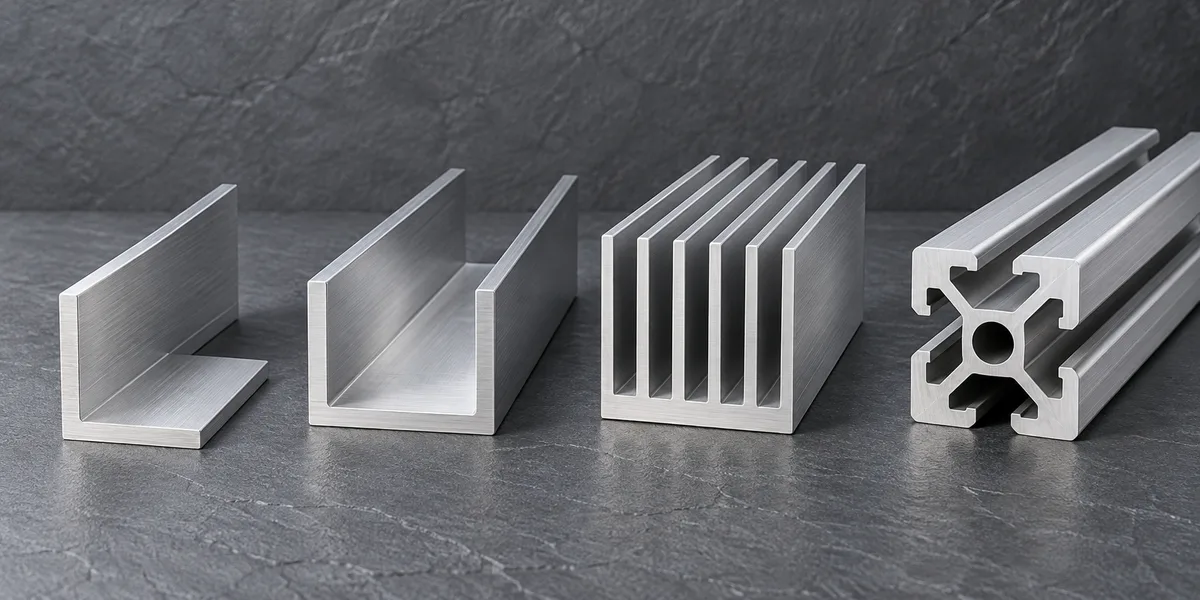
A C channel has a flat web joined at each edge by a flange running the same way, giving a C-shaped cross-section. Structural channels have flanges that are thicker at the root and taper or radius into the web; small commercial and track channels usually have uniform walls and sharp or lightly radiused corners.
The terms C channel and U channel are often used for the same shape. In practice, buyers tend to say "C channel" for structural sections where the web is deeper than the flanges are wide, and "U channel" for sections with legs as long as or longer than the base, used for edging and glazing. Some C profiles also have small inward lips on the flange tips; these lipped channels hold sliding parts or fasteners and are often called C track or strut channel.
Channels are efficient in bending about the strong axis (load applied in the plane of the web) and are easy to bolt or rivet through the flat web. Because the shear centre lies outside the web, a channel loaded through its web tends to twist, so long channels are braced, used in back-to-back pairs or replaced by I-beams or box sections when loads are high.
Structural channels with radiused fillets, designated by depth and weight per foot, e.g. 4 × 1.74. Normally 6061-T6 to ASTM B308.
Older structural series with sloped inner flange faces, matching steel channel dimensions. Used where a steel section is being replaced.
Uniform wall thickness with sharp corners, from small trim sizes up to about 150 mm, usually 6063-T5 or T6.
Small channels for sliding doors, windows, drawers and panels, often 6063 anodised, from about 6 × 9 mm upward.
Flanges with inturned lips that retain nuts, rollers or panels, used for cable supports and adjustable framing.
Any channel geometry with grooves, screw ports or snap features, extruded from a die made to your drawing.
AA channels are designated by depth (in) × weight (lb/ft). Dimensions below are nominal; the metric weight is calculated from the published weight per foot.
| Designation | Depth d (in / mm) | Flange width b (in / mm) | Flange tf (in) | Web tw (in) | Area (in²) | Weight (kg/m) |
|---|---|---|---|---|---|---|
| 2 × 0.577 | 2.00 / 51 | 1.00 / 25.4 | 0.13 | 0.13 | 0.49 | 0.86 |
| 3 × 1.14 | 3.00 / 76 | 1.50 / 38.1 | 0.20 | 0.13 | 0.965 | 1.70 |
| 3 × 1.60 | 3.00 / 76 | 1.75 / 44.4 | 0.26 | 0.17 | 1.36 | 2.38 |
| 4 × 1.74 | 4.00 / 102 | 2.00 / 50.8 | 0.23 | 0.15 | 1.48 | 2.59 |
| 4 × 2.33 | 4.00 / 102 | 2.25 / 57.1 | 0.29 | 0.19 | 1.98 | 3.47 |
| 5 × 2.21 | 5.00 / 127 | 2.25 / 57.1 | 0.26 | 0.15 | 1.88 | 3.29 |
| 5 × 3.09 | 5.00 / 127 | 2.75 / 69.8 | 0.32 | 0.19 | 2.63 | 4.60 |
| 6 × 2.83 | 6.00 / 152 | 2.50 / 63.5 | 0.29 | 0.17 | 2.41 | 4.21 |
| 6 × 4.03 | 6.00 / 152 | 3.25 / 82.5 | 0.35 | 0.21 | 3.43 | 6.00 |
| 8 × 4.15 | 8.00 / 203 | 3.00 / 76.2 | 0.35 | 0.19 | 3.53 | 6.18 |
| 8 × 5.79 | 8.00 / 203 | 3.75 / 95.2 | 0.41 | 0.25 | 4.92 | 8.62 |
| 10 × 6.14 | 10.00 / 254 | 3.50 / 88.9 | 0.41 | 0.25 | 5.22 | 9.14 |
| 12 × 8.27 | 12.00 / 305 | 4.00 / 101.6 | 0.47 | 0.29 | 7.04 | 12.31 |
Nominal dimensions as listed for Aluminum Association standard channels (ASTM B308 for 6061-T6 structural shapes). Section properties such as I and S are given in the Aluminum Design Manual; we provide the drawing for the section quoted.
Weight in kg/m equals the designation weight in lb/ft × 1.488. For any other channel use the channel weight calculator.
Small channels are specified by outside width, height and wall thickness, and track channels by the size of the panel or roller they must take. Common sizes include:
| Typical size (W × H × t) | Metric equivalent | Typical use |
|---|---|---|
| 3/8 × 1/4 in × about 0.05 in | about 9.5 × 6.4 × 1.3 mm | Small slide track, display panels |
| 1/2 × 1/2 in × 1/16 in | 12.7 × 12.7 × 1.6 mm | Trim, edging, light frames |
| 1 × 1/2 in × 1/16 in | 25.4 × 12.7 × 1.6 mm | Panel edging, drawer runners |
| 1 × 1 in × 1/8 in | 25.4 × 25.4 × 3.2 mm | Brackets, light framing |
| 1-1/2 × 3/4 in × 1/8 in | 38.1 × 19.1 × 3.2 mm | Frames, rails, shelving |
| 2 × 1 in × 1/8 in | 50.8 × 25.4 × 3.2 mm | Structural trim, trailer and van fit-out |
| 3 × 1-1/2 in × 3/16 in | 76.2 × 38.1 × 4.8 mm | Medium framing, supports |
| Sliding window / door tracks | single, double and triple track profiles | Sliding sashes, screens, cabinet doors |
For a slide track, give the thickness of the sliding panel and the clearance you need. A track for 6 mm panels, for example, usually has an internal opening of 6.5 – 7 mm so the panel slides freely without rattling; a nylon or felt insert can be added for smoother motion.
| Alloy and temper | Min. tensile | Min. yield | Best for |
|---|---|---|---|
| 6061-T6 | 260 MPa (38 ksi) | 240 MPa (35 ksi) | Structural channels, frames, platforms, trailers |
| 6063-T5 | 150 – 175 MPa | 110 – 130 MPa | Trims, slide tracks, furniture and architectural channels |
| 6063-T6 | 205 – 215 MPa | 170 MPa | Architectural channels needing more strength |
| 6082-T6 | 295 – 310 MPa | 250 – 260 MPa | Structural channels to European standards |
| 7075-T6 | about 540 MPa | about 480 MPa | Small, highly loaded channels in aerospace and motorsport |
Minimums for thin walls per ASTM B221 / EN 755-2; values depend on wall thickness. Mill certificates report actual results.
All aluminium alloys have an elastic modulus of about 69 – 72 GPa, roughly one-third that of steel. An aluminium channel replacing a steel one of the same size therefore deflects about three times as much; the usual fix is a deeper section, which aluminium extrusion makes easy because any shape can be produced.
Standard for structural channels that are hidden or will be painted after fabrication.
Clear satin, black, bronze or gold. The hard surface suits slide tracks, which wear against panels or rollers.
White and RAL colours for architectural trims, awnings and furniture.
Square or mitred cuts to length, with typical length tolerances of ±0.5 – 1.5 mm.
Hole patterns for bolted frames, cable trays and adjustable shelving.
Channels can be roll-bent to arcs; welding uses ER4043 or ER5356 filler with an allowance for weld-zone strength loss.
Typical example: a pedestrian platform may use 6061-T6 AA 6 × 2.83 channels as stringers with bolted cross members, while a sliding display cabinet uses a 6063-T5 anodised double slide track to carry 4 – 6 mm glass or acrylic doors.
They are the same basic shape. C channel usually refers to structural sections with a deep web and narrower flanges, often with radiused or tapered flanges; U channel usually describes uniform-wall sections with legs as long as the base, used for edging and glazing.
It is an Aluminum Association designation: 4 inches deep and 1.74 lb per foot (about 2.59 kg/m). That channel has 2-inch flanges, a 0.15-inch web and a 0.23-inch flange thickness.
6061-T6 for structural use, 6063-T5 or T6 for architectural channels and slide tracks where finish matters, and 6082-T6 for structures designed to European standards.
6061-T6 has a minimum yield strength of 240 MPa, similar to mild steel, at about one-third of the weight. It is about one-third as stiff, so a deeper channel is used to match steel deflection.
Yes. Channels can be roll-bent into arcs or bent in a press brake, with softer tempers allowing tighter radii. Bending about the weak axis is easier than about the strong axis.
Yes. Slide tracks are usually supplied clear or black anodised in 6063, cut to length, with matching panels or inserts on request.
Send the designation or drawing, alloy, finish and quantities. We will reply with availability and a delivered price.





