O / H111
Annealed; most formable and toughest. Standard for cryogenic tanks and AMS 4056 orders.



5083 plate is the strongest non-heat-treatable aluminium plate in general supply, with excellent weldability, seawater resistance and toughness at cryogenic temperatures. In aerospace it is used for cryogenic tanks, launch and test-site structures, ground support equipment, shelters and tooling plate. Metline supplies 5083 sheet and plate in O, H111, H116, H321 and H32 to AMS 4056, ASTM B209 and B928, worldwide.
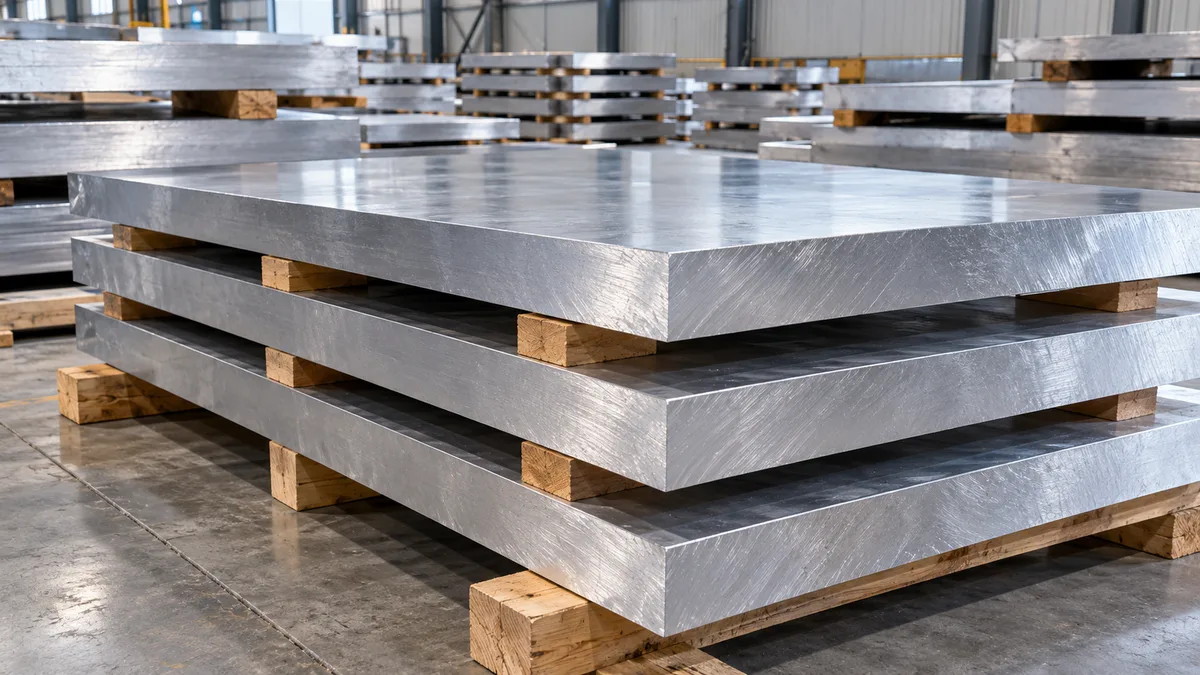
5083 is an aluminium-magnesium-manganese alloy with about 4.4 % magnesium. It reaches the highest strength of the non-heat-treatable alloys, keeps that strength well after welding and is one of the few aluminium alloys qualified for service down to liquid-gas temperatures.
Aircraft primary structure uses 2xxx and 7xxx plate; statements that 5083 forms fuselages, wings or tail surfaces are not borne out by airframe practice. 5083 plate is used where welded, corrosion-resistant plate is needed: cryogenic propellant and storage tanks, launch pads and test stands, ground support equipment, air-transportable shelters and containers, ramp and deck structures on ships that operate aircraft, and cast or rolled tooling plate for jigs and fixtures.
Outside aerospace, the same plate is the default for ship hulls, LNG tanks, road tankers and armour, which keeps it widely available in a broad range of sizes and tempers.
| Element | Minimum | Maximum | Role in the alloy |
|---|---|---|---|
| Silicon (Si) | — | 0.40 | Impurity |
| Iron (Fe) | — | 0.40 | Impurity |
| Copper (Cu) | — | 0.10 | Kept low for seawater resistance |
| Manganese (Mn) | 0.40 | 1.0 | Adds strength and refines grain |
| Magnesium (Mg) | 4.0 | 4.9 | Main strengthening element |
| Chromium (Cr) | 0.05 | 0.25 | Grain control, stress-corrosion resistance |
| Zinc (Zn) | — | 0.25 | Impurity |
| Titanium (Ti) | — | 0.15 | Grain refiner in the cast ingot |
| Others, each / total | — | 0.05 / 0.15 | |
| Aluminium (Al) | Remainder | About 92.4 – 95.6 % |
Registered Aluminum Association limits. 5083 has no registered zirconium requirement; Zr is covered by "others".
AMS 4056 covers 5083 in the O temper only, from about 1.3 mm to 203 mm thick. Strain-hardened tempers are bought to ASTM B209, ASTM B928 (marine H116 and H321) or EN 485-2. Minimums fall slightly for thicker plate.
| Temper | Specified tensile | Specified yield (min) | Typical tensile | Typical yield | Typical elongation |
|---|---|---|---|---|---|
| O / H111 | 275 – 350 MPa (40 – 51 ksi) | 125 MPa (18 ksi) | 290 MPa | 145 MPa | 22 % |
| H116 / H321 | ≥ 305 MPa (44 ksi) | 215 MPa (31 ksi) | 317 MPa | 228 MPa | 16 % |
| H32 | 305 – 385 MPa (44 – 56 ksi) | 215 MPa (31 ksi) | 317 MPa | 228 MPa | 12 % |
Some published tables list H32, H111, H112 and H116 values "to AMS 4056"; AMS 4056 is an O-temper specification, so those figures should be checked against ASTM B209 or B928.
Annealed; most formable and toughest. Standard for cryogenic tanks and AMS 4056 orders.
Strain-hardened with controlled processing and tested for exfoliation and intergranular corrosion (ASTM B928). The marine and exposed-structure tempers.
Strain-hardened and stabilised; similar strength to H321 without the corrosion testing.
As rolled for thick plate; properties guaranteed at a lower level than H116.
Cast and precision-milled 5083 plate for flat, stress-free jigs and fixtures.
H131 and related tempers to MIL-DTL-46027 for armoured structures.
| Specification | Scope |
|---|---|
| SAE AMS 4056 | 5083-O sheet and plate, about 1.3 – 203 mm |
| ASTM B209 / ASME SB-209 | Sheet and plate, all tempers |
| ASTM B928 | High-magnesium plate for marine service (H116, H321) with G66 and G67 corrosion testing |
| MIL-DTL-46027 | Weldable aluminium armour plate (5083 and 5456) |
| QQ-A-250/6 (cancelled) | Superseded by AMS 4056, ASTM B209 and B928 |
| EN 485-2 / EN 573-3 | EN AW-5083 (AlMg4.5Mn0.7), Werkstoff 3.3547 |
Weight is 2.66 kg per square metre per millimetre of thickness: a 1250 × 2500 × 10 mm plate weighs about 83 kg, and a 2000 × 6000 × 20 mm plate about 638 kg. See the plate weight calculator.
MIG and TIG with ER5183; as-welded joints reach about the O-temper minimum strength.
O and H111 form well; H321 and H116 need larger bend radii.
Gummy; use sharp, polished tools and coolant. Cast tooling plate machines cleanly and stays flat.
Avoid sustained service above about 65 °C, where sensitisation can cause intergranular and stress corrosion.
Strength rises and toughness is retained at −196 °C; 5083-O is a standard LNG and liquid-oxygen tank alloy.
For exposed structure, order H116 or H321 to ASTM B928, which requires G67 mass-loss and G66 exfoliation tests.
AMS 4056 covers 5083 sheet and plate in the annealed O temper, about 1.3 to 203 mm thick. Other tempers are ordered to ASTM B209, B928 or EN 485.
No. Airframe structure uses heat-treatable 2xxx and 7xxx alloys. 5083 is used for cryogenic tanks, ground equipment, shelters and tooling.
Both are strain-hardened tempers with the same minimum strength and are tested for exfoliation and intergranular corrosion under ASTM B928; they differ in processing route.
It becomes stronger and stays tough at very low temperature, and it welds well, so large tanks can be fabricated and used safely.
Sustained service above about 65 °C is not recommended because of sensitisation; 5454 is the usual alternative for warm service.
Yes. Metline ships 5083 plate cut to size worldwide with EN 10204 3.1 certificates and export packing.
Send temper, thickness, size and quantity. We will reply with availability, certification and a delivered price.





