Thin sheet and coil
About 0.7 – 3.5 mm for panels, tanks and pressed brackets, in O, H111 or H32.



5083 is the strongest of the common non-heat-treatable aluminium alloys, with 4.0 – 4.9 % magnesium. It keeps most of its strength after welding and resists salt and moisture, which makes it the standard choice for welded truck and trailer bodies, tankers, tipper bodies, chassis members and armoured vehicles. Metline supplies 5083 sheet and plate in O, H111, H32 and related tempers to ASTM B209, EN 485 and GB/T 33227, worldwide.
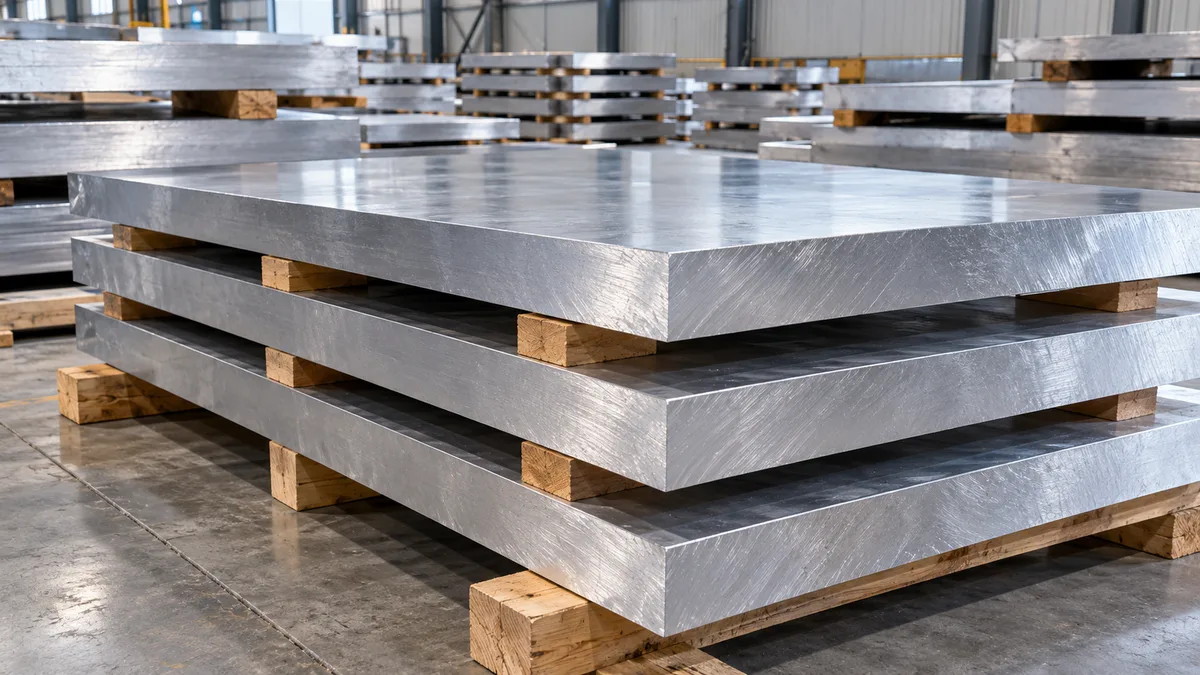
5083 combines high magnesium with manganese and a little chromium. In the annealed state it is about 60 % stronger than 5052, and because its strength does not depend on heat treatment, welded joints keep close to the strength of annealed parent metal. Few other aluminium alloys combine that strength, weldability and corrosion resistance.
Those properties point 5083 towards heavy, welded vehicle structures rather than pressed car-body panels. Typical uses are tipper and dump bodies, tanker shells for fuel and bulk liquids, flatbed and trailer floors and side walls, chassis cross members for lightweight trucks, rail and bus structures, and armour plate for military vehicles. In passenger cars it appears mainly in specialised parts such as fuel tanks, reinforcement plates and some structural brackets.
For visible, deep-drawn car panels 5083 is less suitable. High-magnesium alloys show stretcher-strain markings (Lüders bands) after forming, and alloys above about 3 % magnesium can become sensitised to intergranular corrosion after long exposure above roughly 65 °C. That is why car inner panels use the specially processed 5182 or the leaner 5754, and outer panels use 6xxx alloys.
Limits follow the Aluminum Association registration, used by ASTM B209, EN 573-3 (EN AW-5083) and GB/T 3190.
| Element | Minimum | Maximum | Role in the alloy |
|---|---|---|---|
| Silicon (Si) | — | 0.40 | Impurity |
| Iron (Fe) | — | 0.40 | Impurity |
| Copper (Cu) | — | 0.10 | Kept low for corrosion resistance |
| Manganese (Mn) | 0.40 | 1.0 | Strength and grain control |
| Magnesium (Mg) | 4.0 | 4.9 | Main strengthening element |
| Chromium (Cr) | 0.05 | 0.25 | Grain control, stress-corrosion resistance |
| Zinc (Zn) | — | 0.25 | |
| Titanium (Ti) | — | 0.15 | Grain refiner |
| Others, each / total | — | 0.05 / 0.15 | |
| Aluminium (Al) | Remainder | About 92.4 – 95.6 % |
Specified ranges below follow EN 485-2; ASTM B209 values are very close. O and H111 are annealed; H32 is strain-hardened and stabilised to quarter-hard; H116 and H321 are special tempers with tested resistance to exfoliation and intergranular corrosion, used where class approval or corrosion testing is required.
| Temper | Tensile strength Rm | Yield strength Rp0.2 (min) | Elongation A50 (min, typical band) |
|---|---|---|---|
| O / H111 | 275 – 350 MPa | 125 MPa | 11 – 16 % |
| H32 | 305 – 380 MPa | 215 MPa | 5 – 10 % |
| H116 / H321 | 305 MPa min | 215 MPa | 10 – 12 % |
Values vary with thickness band; the certificate for each lot shows the measured results. Typical 5083-O shows about 290 MPa tensile and 145 MPa yield.
About 0.7 – 3.5 mm for panels, tanks and pressed brackets, in O, H111 or H32.
From about 4 mm upward for tipper floors, chassis members and tanker heads, typically H111, H32 or H116.
Extra-wide plate reduces longitudinal welds in trailer floors and tank shells; widths are confirmed per order.
Patterned 5083 for steps, floors and load beds where slip resistance is needed.
Cast and milled 5083 plate is a dimensionally stable material for fixtures, jigs and vacuum tables used in vehicle plants; it is not used for engine parts.
5083-H131 to MIL-DTL-46027 for protected vehicles, supplied against the defence specification.
Widths, coil weights and surface combinations are confirmed against your press-line and blanking requirements at quotation.
5083 weighs 2.66 kg per square metre for each millimetre of thickness:
| Thickness (mm) | kg per m² | 1250 × 2500 mm (kg) | 1500 × 3000 mm (kg) |
|---|---|---|---|
| 0.5 | 1.33 | 4.2 | 6.0 |
| 0.7 | 1.86 | 5.8 | 8.4 |
| 0.8 | 2.13 | 6.7 | 9.6 |
| 1 | 2.66 | 8.3 | 12.0 |
| 1.2 | 3.19 | 10.0 | 14.4 |
| 1.5 | 3.99 | 12.5 | 18.0 |
| 2 | 5.32 | 16.6 | 23.9 |
| 2.5 | 6.65 | 20.8 | 29.9 |
| 3 | 7.98 | 24.9 | 35.9 |
A body sheet is judged on more than tensile strength. Automotive sheet standards such as GB/T 33227 and the OEM material specifications that sit above them add forming, surface and processing requirements. The table summarises the points that are usually written into the purchase order.
| Requirement | What it controls | How it is specified |
|---|---|---|
| Hemming / flanging grade | Whether the edge can be folded flat (hemmed) around an inner panel without cracking | Grade agreed on the order; checked with flat-hem or bend tests |
| Paint-brush lines | Fine streaks that become visible after painting on outer panels | Grade agreed on the order for exposed parts |
| Forming limit (FLD) | The strain combinations the sheet can survive before necking | Forming limit curve supplied when the buyer requests it |
| Dent resistance | Resistance of finished panels to local denting | Test data supplied on request |
| High-strain-rate tensile data | Behaviour in crash simulation | Supplied on request for crash-relevant parts |
| Oil amount | Lubricant weight for pressing and corrosion protection in transit | g/m² per side, agreed on the order |
| Passivation / conversion film | Bonding and paint adhesion | Coating type and weight agreed on the order |
| Appearance | Scratches, roll marks, colour variation | Stricter for outer panels; minor marks that do not affect forming are acceptable on inner and structural parts |
The body-panel thickness tolerances commonly applied to 0.7 – 1.5 mm automotive sheet are tighter than general-engineering tables, because thickness variation changes draw-die clearance and springback. Typical values:
| Thickness (mm) | Width 800 – 1,600 mm | Width > 1,600 – 1,800 mm | Width > 1,800 – 2,400 mm |
|---|---|---|---|
| 0.70 – 1.00 | ±0.03 mm | ±0.05 mm | ±0.08 mm |
| > 1.00 – 1.20 | ±0.04 mm | ±0.06 mm | ±0.09 mm |
| > 1.20 – 1.50 | ±0.05 mm | ±0.07 mm | ±0.10 mm |
MIG and TIG with ER5183 filler, which matches the strength of 5083. Welded O-temper joints retain close to full parent strength; H32 joints soften to about O-temper level in the heat-affected zone.
O and H111 bend to about 1 – 1.5 × t in thin gauges; H32 needs larger radii. Expect Lüders bands on stretched surfaces.
Avoid long service above about 65 °C, for example next to exhaust systems or in hot-asphalt bodies; 5454 is the usual alternative for warm service.
Moderate. Use sharp carbide tools; chips are long and stringy in O temper.
Paint and powder coat after conversion coating; anodising gives a slightly grey film.
Isolate from steel fasteners and frames with insulating washers, sealants or coatings.
Wheel hubs and engine blocks are sometimes listed for 5083 in sales literature. Wheels are cast (A356) or forged (6061/6082), and engine blocks are cast; 5083 sheet and plate are not used for them.
| Property | 5083-H111 | 5182-O | 5454-H111 | 6061-T6 |
|---|---|---|---|---|
| Typical tensile strength | about 290 MPa | about 275 MPa | about 250 MPa | about 310 MPa |
| Weld strength retention | Excellent | Very good | Very good | Reduced |
| Warm service (above 65 °C) | Not recommended | Not recommended | Suitable | Suitable |
| Deep drawing | Fair | Very good | Good | Poor |
| Typical vehicle use | Heavy welded bodies | Car inner panels | Hot tankers, wheels | Machined parts, frames |
Rarely for passenger-car panels, because of stretcher-strain marks and warm-service sensitisation. It is the standard alloy for welded truck, trailer, tipper and tanker bodies.
O and H111 are annealed (275 – 350 MPa tensile). H32 is strain-hardened and stabilised to 305 – 380 MPa tensile with a much higher yield strength of at least 215 MPa.
Long exposure above about 65 °C can sensitise 5083 to intergranular corrosion. Use 5454 or another lower-magnesium alloy for warm service.
ER5183 is standard because it matches 5083 strength; ER5356 is also used where slightly lower weld strength is acceptable.
No. Cast 5083 tooling plate is used for fixtures, jigs and machine tables because it is flat and stable. Engine blocks are cast in foundry alloys.
Yes. Metline supplies 5083 sheet and plate worldwide from Mumbai with EN 10204 3.1 certificates, on EXW, FOB, CIF or DAP terms.
Send the temper, size, quantity and destination. We will reply with availability, certification and a delivered price.





