Filler
ER5183 is the preferred filler: it gives weld metal that matches the strength of 5083-O. ER5356 is acceptable for lower-stressed welds. Avoid 4xxx fillers, which form brittle Mg2Si with high-magnesium alloys.



5083 is the strongest common non-heat-treatable aluminium alloy, and it keeps its weld strength, resists salt spray and actually gets tougher as temperature falls. That makes 5083 plate a standard choice for road fuel tanker shells on coastal routes and for cryogenic tanks down to LNG temperature (−162 °C). Metline supplies 5083-O, H111 and H321 tanker plate, 3 – 12 mm and wider, to EN 14286 and ASTM B209, cut to drawing and shipped worldwide.
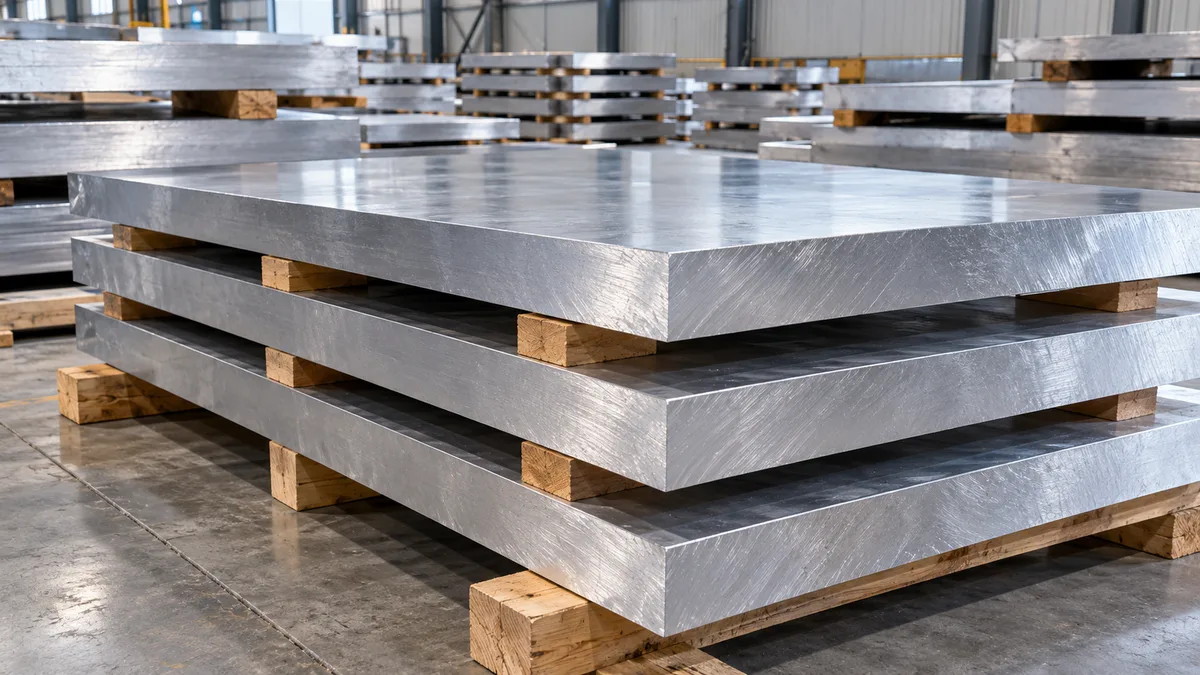
A tanker shell is a long welded pressure envelope that carries sloshing liquid, road loads and, for hazardous cargo, crash requirements set by ADR and national rules. The material must be strong after welding, ductile enough to absorb impacts, formable for heads and baffles, and resistant to the cargo and the road environment.
5083 meets those needs better than most aluminium alloys. Its strength comes from magnesium and manganese in solid solution rather than heat treatment, so the heat-affected zone of a weld keeps almost all of the annealed parent strength. A 5083-O shell welded with 5183 filler can be designed close to the O-temper allowable stress, whereas a heat-treated 6xxx structure loses roughly half its strength at the weld.
Compared with the other tanker alloys, 5083 offers the highest strength, which allows thinner walls and lower tare weight, plus outstanding resistance to salt spray. Its limit is temperature: with about 4.5 % magnesium, 5083 can become sensitised if it is held above roughly 65 °C for long periods, so hot cargo such as bitumen calls for 5454 instead.
| Element | Limit (%) | Role |
|---|---|---|
| Magnesium (Mg) | 4.0 – 4.9 | Main strengthening element |
| Manganese (Mn) | 0.40 – 1.0 | Strength and grain control |
| Chromium (Cr) | 0.05 – 0.25 | Grain control, stress-corrosion resistance |
| Silicon (Si) | 0.40 max | Impurity |
| Iron (Fe) | 0.40 max | Impurity |
| Copper (Cu) | 0.10 max | Kept low for corrosion resistance |
| Zinc (Zn) | 0.25 max | Impurity |
| Titanium (Ti) | 0.15 max | Grain refiner |
| Others, each / total | 0.05 / 0.15 | |
| Aluminium (Al) | Remainder |
Registered limits for 5083 / EN AW-5083 (AlMg4.5Mn0.7), as used in ASTM B209, EN 573-3 and EN 14286.
Values below summarise the specified limits of EN 485-2 and ASTM B209 for plate in the 3 – 12 mm wall-thickness range. EN 14286 adds tank-specific requirements; the certificate for each lot shows the actual results.
| Temper | Tensile strength | Yield strength (0.2 %) | Elongation (min) | Typical use on tanker |
|---|---|---|---|---|
| O / H111 | 275 – 350 MPa | ≥ 125 MPa | about 15 – 16 % | Shell, heads, baffles, bulkheads |
| H116 | ≥ 305 MPa | ≥ 215 MPa | about 10 – 12 % | Flat, highly stressed panels |
| H321 | ≥ 305 MPa | ≥ 215 MPa | about 10 – 12 % | Flat panels, sub-frames |
Because welding anneals the area next to the weld, the design strength of welded H116 or H321 drops back towards O-temper values at the seam. That is why most tanker builders use O or H111 for welded shells and reserve H116 / H321 for unwelded or lightly welded parts.
| Temperature | Tensile strength | Yield strength | Elongation |
|---|---|---|---|
| +20 °C | ≈ 290 MPa | ≈ 145 MPa | ≈ 22 % |
| −196 °C | ≈ 405 MPa | ≈ 165 MPa | ≈ 36 % |
Typical values for 5083-O (ASM data), showing the gain in strength and ductility at cryogenic temperature.
| Part | Common temper | Typical thickness | Notes |
|---|---|---|---|
| Shell (barrel) | 5083-H111 or O | 5 – 6 mm for many road tankers | Rolled to shape; long seam and circumferential welds |
| Heads (end caps) | 5083-O | equal to or above shell | Spun or pressed; O temper gives the forming margin |
| Baffles and surge plates | 5083-O | often about 1 mm less than shell | Pressed and flanged; damp sloshing |
| Compartment bulkheads | 5083-O | 5 – 8 mm | Dished; separate products |
| Manhole and fittings | 5083-O / H111 | per design | Formed rings and collars |
| Sub-frames, stiffeners | 5083-H321 or extrusions | per design | Higher strength where welding is limited |
Thicknesses are indicative only. Minimum wall thickness for dangerous-goods tanks is set by ADR chapter 6.8 and the tank design standard (for example EN 13094), based on the reference steel thickness and the aluminium properties.
| Standard | What it covers |
|---|---|
| EN 14286 | Weldable rolled aluminium products (3 – 12 mm) for tanks storing and transporting dangerous goods: properties, tolerances, inspection |
| EN 485-1/-2/-3/-4 | General delivery conditions, mechanical properties and tolerances for aluminium sheet and plate |
| ASTM B209 / B209M | Aluminium sheet and plate in the US system, including 5083 tempers |
| EN 13094 / EN 14025 | Design and construction of metallic tanks for dangerous goods (low-pressure and pressure tanks) |
| ADR chapter 6.8 | European regulations for tank vehicles carrying dangerous goods |
| IGC Code | IMO rules for ships carrying liquefied gases, under which 5083-O is an accepted cryogenic tank material |
Meeting EN 14286 does not by itself prove compliance with every regulation; the tank designer confirms the full design basis with the notified body.
5083 weighs about 2.66 kg per m² for each millimetre of thickness.
| Thickness (mm) | kg per m² | 2000 × 6000 mm plate (kg) | 2500 × 8000 mm plate (kg) |
|---|---|---|---|
| 3 | 8.0 | 96 | 160 |
| 4 | 10.6 | 128 | 213 |
| 5 | 13.3 | 160 | 266 |
| 6 | 16.0 | 192 | 319 |
| 8 | 21.3 | 255 | 426 |
| 10 | 26.6 | 319 | 532 |
| 12 | 31.9 | 383 | 638 |
ER5183 is the preferred filler: it gives weld metal that matches the strength of 5083-O. ER5356 is acceptable for lower-stressed welds. Avoid 4xxx fillers, which form brittle Mg2Si with high-magnesium alloys.
Remove oil, then oxide by stainless wire brushing just before welding. Keep wire and plate dry to avoid hydrogen porosity.
Use moderate heat input and limit interpass temperature; excessive heat widens the softened zone and raises distortion.
O temper allows spinning and pressing of heads. Form at room temperature; hot forming of 5083 risks sensitisation if done slowly in the 100 – 200 °C range.
Penetrant, radiographic or ultrasonic testing of seams as required by the tank code, plus leak and pressure tests.
No internal coating is needed for most fuels. Check compatibility for specific chemicals and avoid copper or mercury contamination.
See our guide to ER5183 and ER5356 tanker welding wire for filler selection in more detail.
| Factor | 5083 | 5182 | 5454 | 5754 |
|---|---|---|---|---|
| O-temper tensile (approx.) | 275 – 350 MPa | 255 – 315 MPa | 215 – 285 MPa | 190 – 240 MPa |
| Best suited cargo | Ambient fuels, cryogenic liquids | Ambient fuels, ADR goods | Hot cargo (bitumen, heated chemicals) | Food, water, general |
| Long service above 65 °C | Not advised | Not advised | Suitable | Generally acceptable |
| Salt-spray resistance | Excellent | Very good | Very good | Very good |
| Relative wall thickness | Thinnest | Thin | Thicker | Thickest |
In short, choose 5083 for maximum strength, coastal routes and cryogenic service; 5182 for ADR fuel tankers that value very high elongation; 5454 for hot cargo; and 5754 for general and food-grade tanks.
Yes. 5083-O has no ductile-to-brittle transition; at −196 °C its tensile strength rises to around 400 MPa with higher elongation than at room temperature. It is an accepted material for liquefied gas cargo tanks under the IMO IGC Code.
Not for long-term hot service. Above about 65 °C its high magnesium content can lead to sensitisation and intergranular corrosion. Use 5454 for bitumen and heated cargo.
ER5183 is the usual choice because its weld metal matches 5083-O strength. ER5356 is acceptable for lower-stress joints. Never use 4043 on 5083.
Welding softens the heat-affected zone back towards O-temper strength, so the extra strength of H321 is largely lost at the seams. O and H111 also form more easily into shells and heads.
Many road tanker shells use plate around 5 – 6 mm, with heads at or above shell thickness, but the minimum is set by ADR and the tank design standard for each vehicle.
An EN 10204 3.1 mill certificate with chemistry and tensile results for each lot. NAMLT corrosion test reports and third-party inspection can be arranged.
Send the thickness, sizes, tempers and quantities, or your shell and head drawings. We will reply with availability, certification and a delivered price.





