O / H111
Annealed (H111 has a slight strain from flattening). The most formable condition, used for discs that will be spun, pressed or dished into tank heads, and for parts that will be welded heavily.



5083 aluminium circles are round blanks cut from 5083 sheet or plate, the aluminium-magnesium alloy specified for ships, pressure vessels and cryogenic tanks because it combines high non-heat-treatable strength with excellent seawater resistance and weldability. Metline supplies 5083 discs and round plates in O/H111, H116 and H321 tempers, cut to diameter from thin sheet up to heavy plate and certified to ASTM and EN standards, worldwide.
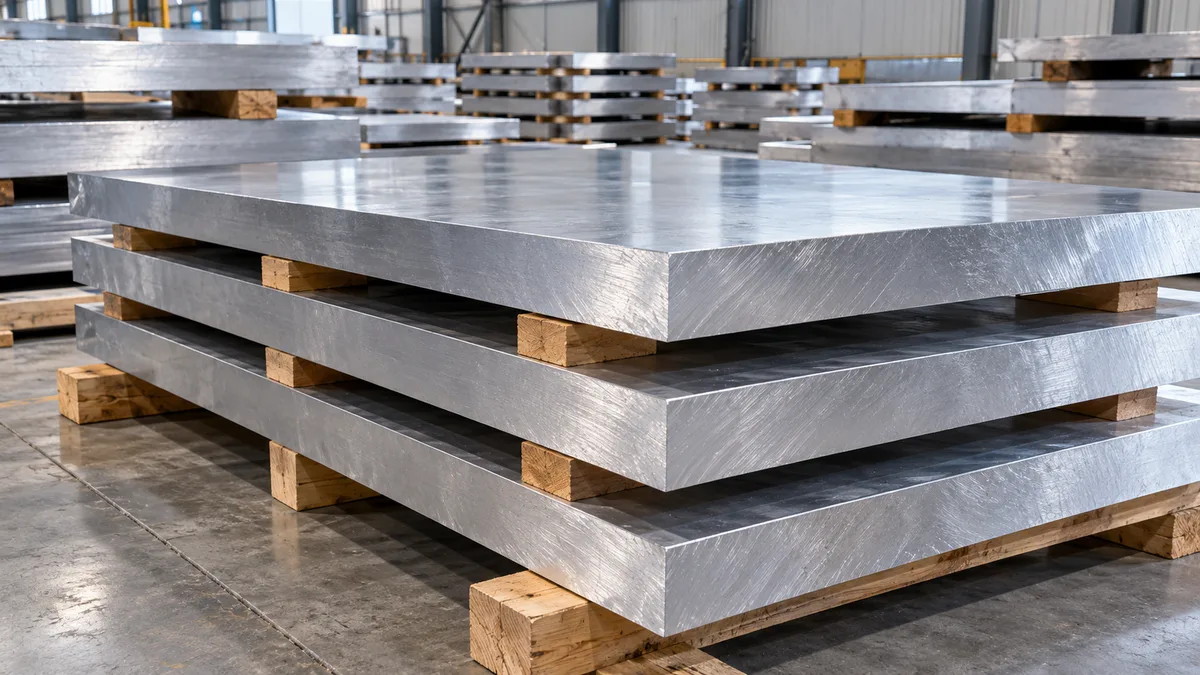
A 5083 circle is not a separate product so much as 5083 plate in a round shape. Buyers order discs when the finished part is round, such as a flange, tank head, hatch, valve body or machined end plate, so they pay for less scrap and less machining.
5083 contains about 4.5 % magnesium with manganese and chromium. It gains its strength from solid-solution hardening and cold work rather than heat treatment, so it keeps most of its strength after welding: in the O/H111 condition the weld zone is essentially as strong as the parent metal. It also resists seawater, marine atmospheres and many industrial chemicals, and it becomes stronger and tougher at cryogenic temperatures, which is why it is used for LNG tanks.
The main limitation is temperature. Alloys with more than about 3 % magnesium can become sensitised to intergranular corrosion and stress-corrosion cracking if held for long periods above roughly 65 °C. 5083 is therefore not recommended for parts that run hot in service, such as heater housings or cooking surfaces; 5754 or 5052 are safer choices there.
| Element | Minimum | Maximum |
|---|---|---|
| Silicon (Si) | — | 0.40 |
| Iron (Fe) | — | 0.40 |
| Copper (Cu) | — | 0.10 |
| Manganese (Mn) | 0.40 | 1.0 |
| Magnesium (Mg) | 4.0 | 4.9 |
| Chromium (Cr) | 0.05 | 0.25 |
| Zinc (Zn) | — | 0.25 |
| Titanium (Ti) | — | 0.15 |
| Others, each / total | — | 0.05 / 0.15 |
| Aluminium (Al) | Remainder |
Registered Aluminum Association limits, also used by ASTM B209 and EN 573-3 (EN AW-5083 / EN AW-AlMg4.5Mn0.7). The actual analysis of each lot is shown on the mill test certificate.
| Temper | Tensile strength | Yield strength (0.2 %) | Elongation | Basis |
|---|---|---|---|---|
| O / H111 | 290 MPa | 145 MPa | 22 % | Typical |
| O / H111, sheet and plate | 275 – 350 MPa | ≥ 125 MPa | ≥ 11 – 16 % (by thickness) | EN 485-2 specified range |
| H116 / H321 | 317 MPa | 228 MPa | 16 % | Typical |
| H116 / H321, 4 – 40 mm | ≥ 305 MPa | ≥ 215 MPa | ≥ 10 – 12 % | ASTM B928 specified minimum |
Specified values depend on thickness band and are stated on the certificate. Typical values are for comparison only and are not design allowables.
Annealed (H111 has a slight strain from flattening). The most formable condition, used for discs that will be spun, pressed or dished into tank heads, and for parts that will be welded heavily.
Strain-hardened and tested for resistance to exfoliation and intergranular corrosion under ASTM G66 and G67, as ASTM B928 requires for marine hulls. Order H116 for discs going into ship structures.
Strain-hardened and thermally stabilised. Similar strength to H116, also covered by ASTM B928 with the same corrosion tests when ordered for marine use.
Quarter- and half-hard tempers for general engineering where a little more strength than H111 is wanted and marine corrosion testing is not required.
| System | Designation | Typical product standard |
|---|---|---|
| Aluminum Association / ASTM | 5083 | ASTM B209 (sheet and plate); ASTM B928 (marine H116/H321) |
| UNS | A95083 | — |
| European (EN) | EN AW-5083 / EN AW-AlMg4.5Mn0.7 | EN 485-1/-2, EN 573-3 |
| German Werkstoff | 3.3547 | DIN EN 485 |
| ISO | AlMg4.5Mn0.7 | ISO 6361 |
| Japan (JIS) | A5083P | JIS H4000 |
| China (GB) | 5083 | GB/T 3880 |
| India (IS) | 54300 | IS 736 |
For marine projects, classification societies such as DNV, ABS, Lloyd's Register and Bureau Veritas approve the producing mill and witness testing. If your discs must carry a class certificate, state the society on the enquiry so that material can be sourced and certified accordingly.
Tolerances on diameter are agreed per order; waterjet and CNC cutting hold tighter limits than sawing or shearing.
A 5083 disc weighs π/4 × D² × t × 2.66 g/cm³. The table gives approximate weights in kilograms; use the circle weight calculator for other sizes.
| Thickness (mm) | Ø 100 mm | Ø 200 mm | Ø 300 mm | Ø 500 mm | Ø 800 mm | Ø 1000 mm |
|---|---|---|---|---|---|---|
| 2 | 0.04 | 0.17 | 0.38 | 1.04 | 2.67 | 4.18 |
| 3 | 0.06 | 0.25 | 0.56 | 1.57 | 4.01 | 6.27 |
| 5 | 0.10 | 0.42 | 0.94 | 2.61 | 6.69 | 10.4 |
| 6 | 0.13 | 0.50 | 1.13 | 3.13 | 8.02 | 12.5 |
| 10 | 0.21 | 0.84 | 1.88 | 5.22 | 13.4 | 20.9 |
| 20 | 0.42 | 1.67 | 3.76 | 10.4 | 26.7 | 41.8 |
| 30 | 0.63 | 2.51 | 5.64 | 15.7 | 40.1 | 62.7 |
| 50 | 1.04 | 4.18 | 9.40 | 26.1 | 66.9 | 104.5 |
Softer tempers are gummy; use sharp, polished, high-rake carbide tools, high speeds and plenty of coolant. H116/H321 and stress-relieved cast 5083 tooling plate machine more cleanly.
O/H111 discs can be spun or pressed into tank heads and domes. Allow for springback and work-hardening between stages.
MIG and TIG with ER5183 filler for the highest weld strength, or ER5356. The weld zone keeps close to O-temper strength, so welded structures are designed on annealed values.
Anodises to a protective but slightly grey finish; paints and powder-coats well after proper pre-treatment. Often left bare in marine service.
| Property | 5083 H111 | 5052 H32 | 6061 T6 | 1050 / 3003 O |
|---|---|---|---|---|
| Typical tensile strength | 290 MPa | 230 MPa | 310 MPa | 75 – 110 MPa |
| Seawater resistance | Excellent | Very good | Fair | Good |
| Weld strength retained | High | High | Low (HAZ softens) | High |
| Deep drawing / spinning | Moderate | Good | Poor in T6 | Excellent |
| Typical disc use | Marine, pressure parts | General, marine fittings | Machined parts | Cookware, lighting, signs |
For cookware and lighting, a softer 1xxx or 3003 disc draws far better. For machined parts out of the water, 6061 is cheaper to machine. 5083 earns its place where strength, weldability and corrosion resistance all matter together.
No. 5083 is too strong to deep-draw easily and is not recommended for parts held above about 65 °C, where high-magnesium alloys can become sensitised. Use 1050, 1100 or 3003 circles for cookware.
H111 is essentially annealed and best for forming and welding. H116 is strain-hardened for higher strength and is corrosion-tested under ASTM B928 for marine structures.
Weight = π/4 × diameter² × thickness × 2.66 g/cm³. A 500 mm disc 10 mm thick weighs about 5.2 kg; a 1000 mm disc 20 mm thick about 41.8 kg.
Yes. Annular blanks save material on flanges and rings; send the outside and inside diameters and the tolerance on each.
Yes, very. Use ER5183 or ER5356 filler. Strength in the weld zone stays close to the annealed value, so no post-weld heat treatment is needed.
Yes. Metline ships from Mumbai worldwide with mill certificates and export packing on EXW, FOB, CIF or DAP terms.
Send diameter, thickness, temper, quantity and destination. We will confirm cutting method and certification and quote a delivered price.





