Bending
Pure grades bend to tight radii without cracking. Use O or H112 tube for complex bends, with a mandrel or sand fill on thin walls.



Tubular bus pipe in 1060 or 1070 aluminium is chosen when conductivity matters more than span strength: about 61 – 62 % IACS, compared with roughly 52 – 57 % for the 6063 and 6101 alloys used on long outdoor spans. Pure-grade pipe suits high-current indoor runs, short substation connections, jumpers and DC equipment. This guide covers properties, sizes, resistance, tolerances and how to choose.
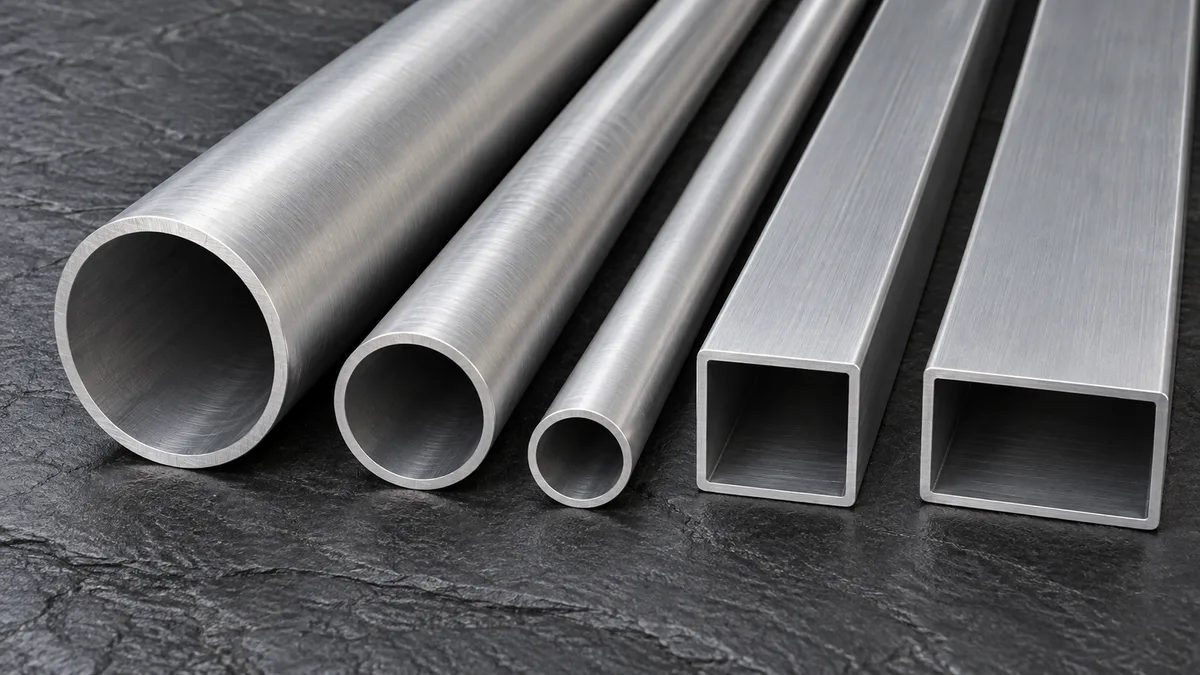
A bus pipe (tubular busbar) is a rigid, hollow aluminium conductor used to carry large currents between equipment, mainly in substations and heavy-current installations. It replaces flat bars, channels or flexible strung conductors where a stiff, compact and low-loss conductor is wanted.
The round hollow section has three electrical and mechanical advantages. For alternating current, the current crowds towards the outer surface of a conductor (skin effect), so metal at the centre of a solid bar does little work; a tube puts the metal where the current flows, giving a lower AC resistance for a given weight. The smooth, large-diameter surface spreads the electric field, raising the corona inception voltage at high voltage. And a tube has a high stiffness-to-weight ratio, so it can span between support insulators with limited sag.
Most outdoor substation tubes are made from heat-treatable 6063-T6 or 6101-T6, which are much stronger. Pure 1060 and 1070 are used when the conductor is short or well supported and the extra 5 – 10 points of conductivity reduce losses and temperature rise, or when the tube must be bent and welded extensively.
| Property | 1060 | 1070 | 6101-T6 | 6063-T6 |
|---|---|---|---|---|
| Minimum aluminium | 99.60 % | 99.70 % | Al-Mg-Si alloy | Al-Mg-Si alloy |
| Conductivity (typical) | ≈ 61 – 62 % IACS | ≈ 61 – 62 % IACS | ≈ 55 – 57 % IACS | ≈ 52 – 53 % IACS |
| Tensile strength (typical) | 70 MPa (O) – 130 MPa (H18) | ≈ 65 – 125 MPa | ≈ 220 MPa | ≈ 240 MPa |
| Bending and welding | Excellent | Excellent | Good; weld loses temper | Good; weld loses temper |
| Best for | Short, supported runs; indoor high current | Highest-conductivity runs and jumpers | High-conductivity outdoor spans | Long outdoor spans, standard substation bus |
Typical values from Aluminum Association and ASM data. Conductivity and strength of heat-treatable alloys vary with temper.
Between the two pure grades, the practical difference is small: 1070 is slightly purer and marginally more conductive, 1060 slightly stronger and often cheaper. Choose 1060 as the economical default, 1070 where your specification sets a minimum conductivity close to 62 % IACS. For long spans, calculate sag and short-circuit forces first; if a pure-grade tube would need a larger diameter or more supports than the alloy tube, 6101 or 6063 is usually the better overall choice.
| Property | 1060-H18 / H112 | 1070-O / H112 |
|---|---|---|
| Tensile strength | ≈ 110 – 150 MPa | ≈ 60 – 95 MPa |
| Elongation | ≈ 6 – 10 % | ≈ 25 – 35 % |
| Electrical conductivity | ≈ 61 % IACS | ≈ 62 % IACS |
| Resistivity at 20 °C | ≈ 0.0282 Ω·mm²/m | ≈ 0.0278 Ω·mm²/m |
| Temperature coefficient of resistance | ≈ 0.0040 – 0.0042 /°C | ≈ 0.0040 – 0.0042 /°C |
| Density | 2.705 g/cm³ | 2.70 g/cm³ |
| Coefficient of thermal expansion | 23.6 × 10⁻⁶ /°C | 23.6 × 10⁻⁶ /°C |
| Elastic modulus / Poisson's ratio | 69 GPa / 0.33 | 69 GPa / 0.33 |
Approximate values for guidance; tube produced by extrusion and drawing reaches its strength through cold work. The certificate states the actual tensile and conductivity results.
Thermal expansion matters in design: a 15 m aluminium tube grows about 18 mm between 0 °C and 50 °C, so long runs need expansion joints or flexible connectors at one end.
The table gives cross-section, weight and calculated DC resistance at 20 °C for common metric sizes in 1060 (ρ ≈ 0.0282 Ω·mm²/m). AC resistance is higher, especially for thick walls at 50/60 Hz, so use the AC value from your bus design method for ampacity.
| OD × wall (mm) | Area (mm²) | Weight (kg/m) | DC resistance (µΩ/m) |
|---|---|---|---|
| 60 × 5 | 864 | 2.34 | 32.6 |
| 80 × 6 | 1395 | 3.77 | 20.2 |
| 100 × 6 | 1772 | 4.79 | 15.9 |
| 100 × 8 | 2312 | 6.25 | 12.2 |
| 120 × 8 | 2815 | 7.61 | 10.0 |
| 130 × 10 | 3770 | 10.20 | 7.5 |
| 150 × 8 | 3569 | 9.65 | 7.9 |
| 150 × 10 | 4398 | 11.90 | 6.4 |
| 170 × 10 | 5027 | 13.60 | 5.6 |
| 200 × 10 | 5969 | 16.15 | 4.7 |
| 250 × 12 | 8972 | 24.27 | 3.1 |
| 300 × 15 | 13430 | 36.33 | 2.1 |
North American projects often specify bus tube in iron-pipe sizes (IPS). Schedule 40 dimensions and calculated weights for pure aluminium:
| Nominal size (in) | Outside diameter | Wall | Area (in²) | Weight (lb/ft) |
|---|---|---|---|---|
| 2 | 2.375 in (60.3 mm) | 0.154 in (3.91 mm) | 1.075 | 1.26 |
| 2½ | 2.875 in (73.0 mm) | 0.203 in (5.16 mm) | 1.704 | 2.00 |
| 3 | 3.500 in (88.9 mm) | 0.216 in (5.49 mm) | 2.228 | 2.61 |
| 4 | 4.500 in (114.3 mm) | 0.237 in (6.02 mm) | 3.174 | 3.72 |
| 5 | 5.563 in (141.3 mm) | 0.258 in (6.55 mm) | 4.300 | 5.04 |
| 6 | 6.625 in (168.3 mm) | 0.280 in (7.11 mm) | 5.581 | 6.54 |
Extruded and drawn bus tube is normally supplied to the tolerance tables of EN 755-8 (extruded tube) or ANSI H35.2 for ASTM B241 pipe, at standard or precision level. As an example of scale, standard wall tolerances on extruded tube are a few tenths of a millimetre for walls around 5 – 8 mm, rising to about ±1 mm or more on 12 – 15 mm walls, and diameter tolerances grow from about ±0.3 mm at 60 – 80 mm OD to over ±1 mm above 250 mm OD.
Pure grades bend to tight radii without cracking. Use O or H112 tube for complex bends, with a mandrel or sand fill on thin walls.
TIG or MIG with 1100 or 4043 filler. Because pure grades are not heat-treated, welds do not suffer the large strength drop seen in 6063-T6.
Welded or bolted couplers, expansion fittings and support clamps should be aluminium or bimetallic to avoid galvanic corrosion.
Tin, silver or nickel plating, or copper cladding, improves contact resistance at bolted joints and connections to copper equipment.
Saw cutting, drilling and punching of terminal flats to drawing.
Long outdoor tubes may need internal damping conductors to control aeolian vibration.
Alternating current concentrates near the conductor surface, so a tube uses its metal more effectively than a solid bar of the same weight. Tubes are also stiff, cool well and raise the corona inception voltage.
6063-T6 is about three times stronger and is the usual choice for long outdoor spans. 1060 conducts about 15 % better, so it suits short or well-supported runs where lower losses and easier bending and welding matter.
About 61 – 62 % IACS, a resistivity of roughly 0.028 Ω·mm²/m at 20 °C. Hard tempers are slightly lower than annealed.
Yes. Pure grades bend and weld easily, and because they are not heat-treated, welds keep most of the parent strength. Plating or cladding can be added at contact surfaces.
Yes. Metline supplies bus pipe worldwide with mill certificates and export crating, on EXW, FOB, CIF or DAP terms.
Send the grade, OD, wall, lengths and processing needs. We will confirm availability, testing and a delivered price.





