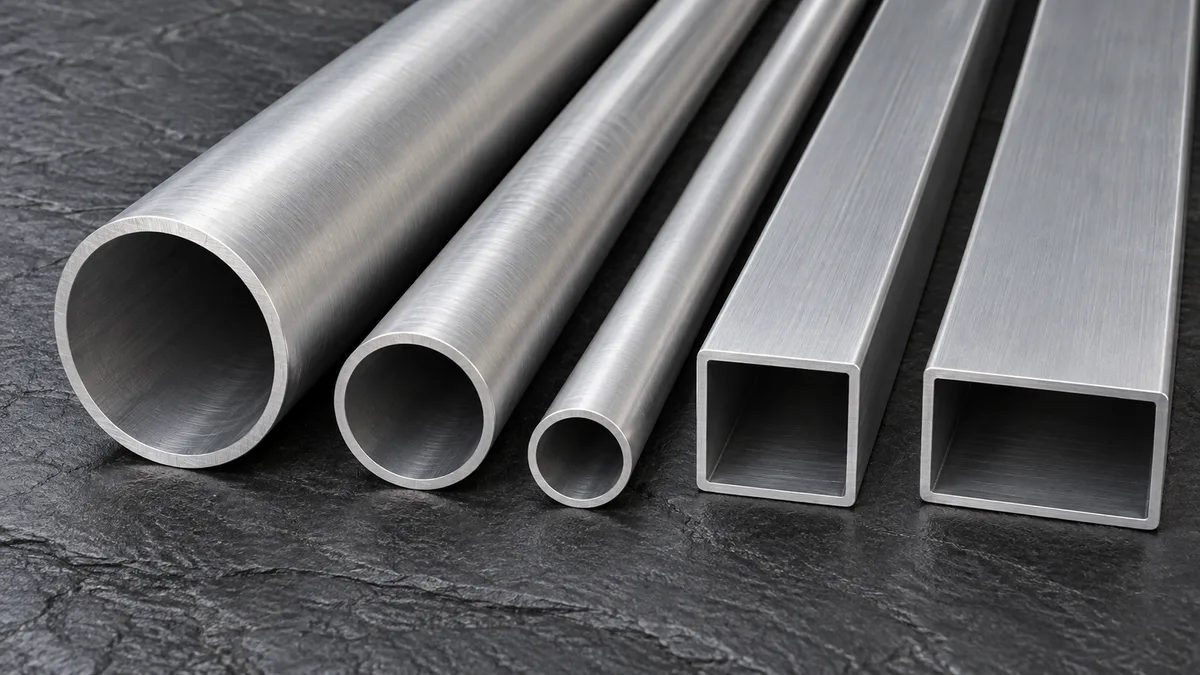
Aluminium Round Tube: Alloys, Types, Sizes and Standards
Aluminium round tube is hollow cylindrical stock made by extrusion, cold drawing or seam welding, in alloys from 1100 to 7075. For most structural and general uses 6061-T6 or 6063-T5/T6 extruded tube is the right choice; seamless drawn tube is used where pressure, tight tolerance or a fine surface matters, and welded tube where low cost per metre counts. This guide explains how to choose between them, and gives size, weight and standards data for ordering.
Round tube looks like a simple product, but four choices determine whether it suits the job: the alloy and temper, the manufacturing route (seamless, porthole extruded, cold-drawn or welded), the outside diameter and wall thickness, and the standard that governs tolerance and testing. Most problems with tube, such as splits during bending, leaks under pressure or poor anodising, trace back to one of these choices rather than to the supplier.
Round tube is used across almost every industry: frames, handrails and furniture; hydraulic and pneumatic lines; heat-exchanger and HVAC tubing; masts, antenna and telescopic poles; bicycle, motorsport and aircraft structures; and conveyor rollers and machine guards. Its circular section gives equal stiffness in every direction and the best torsional stiffness per kilogram of any open or closed shape, which is why it is preferred for shafts, struts and members that twist.
For a short product specification of the tube Metline supplies, see the round tube specification page. Pipe in nominal pipe sizes and schedules is covered separately on the aluminium pipe page.
Manufacturing routes
Seamless, porthole, drawn and welded tube compared
Type
How it is made
Strengths
Limitations
Typical standards
Seamless extruded
Hollow or pierced billet extruded over a mandrel, so the wall has no joint
Uniform wall properties, suitable for pressure and critical service
Higher cost; thicker minimum walls than porthole
ASTM B241, EN 755-7
Porthole (structural) extruded
Solid billet splits around the bridges of a porthole die and re-welds in the welding chamber
Lower cost, thin walls, long lengths; most structural tube
Longitudinal extrusion seam welds; not normally accepted for pressure duty
ASTM B221, B429, EN 755-8
Cold-drawn seamless
Seamless extruded tube drawn over a plug or mandrel at room temperature
Tight tolerance, thin walls, fine surface, higher strength in H tempers
Smaller diameters; extra process cost
ASTM B210, B483, EN 754-7
Welded
Strip roll-formed into a tube and seam-welded by high-frequency or TIG welding
Lowest cost per metre, very thin walls, coils for heat exchangers
Weld seam affects properties and appearance
ASTM B313, EN 1592
The distinction between seamless and porthole tube matters most. Porthole tube contains seam welds formed in the solid state as the metal rejoins inside the die. Modern practice makes those welds sound for structural use, and porthole tube is the bulk of tube sold for frames and furniture. Pressure-vessel codes and many aerospace specifications, however, require seamless tube. If a drawing says "seamless", order to ASTM B241, B210 or EN 755-7 and check that the certificate states it. More detail is in our guides to seamless tube, drawn tube and welded tube.
Alloy selection
Round tube alloys and their typical properties
Alloy and temper
Typical tensile strength
Typical yield strength
Character
Typical uses
1100-H14
125 MPa
115 MPa
Pure, very ductile, high conductivity
Ducting, chemical lines, signage
3003-H14
150 MPa
145 MPa
Formable, corrosion resistant
HVAC, heat exchangers, bent tube
5052-H32
228 MPa
193 MPa
Good strength, excellent corrosion resistance
Fuel and hydraulic lines, marine parts
5083-O / H111
290 MPa
145 MPa
High strength 5xxx, keeps properties when welded
Marine and offshore structures
5086-H32
290 MPa
207 MPa
Similar to 5083 with slightly better formability
Boat fittings, marine piping
6063-T5
186 MPa
145 MPa
Best surface and anodising response
Architecture, furniture, handrails
6063-T6
241 MPa
214 MPa
Stronger architectural grade
Railings, frames, light structures
6061-T6
310 MPa
276 MPa
All-round structural grade, weldable
Frames, masts, machine and vehicle parts
6082-T6 (EN 755-2 min.)
290 – 310 MPa min
250 – 260 MPa min
European structural grade
Structures, trailers, scaffolding
2024-T3
483 MPa
345 MPa
High strength and fatigue resistance
Aircraft structures, fittings
7075-T6
572 MPa
503 MPa
Highest strength common tube
Aerospace, sports equipment, high-load struts
Typical values from Aluminum Association and ASM data, except 6082 which shows EN 755-2 minimums, which depend on wall thickness. Tempers such as 6063-T832 (drawn and aged) and 7005 or 7020 (weldable Al-Zn-Mg tube for frames) are also available; their properties are reported on the mill certificate.
Two common mistakes: choosing 6063 for a load-bearing frame because it is the cheapest extruded tube, and choosing 7075 for a welded structure. 6063 has only about two thirds of the yield strength of 6061, and 7075 is not suitable for fusion welding. For welded high-strength frames, the Al-Zn-Mg alloys 7005 and 7020 are the usual answer because they recover much of their strength by natural ageing after welding.
Size chart
Metric round tube sizes and weights
The table lists commonly produced metric outside diameter × wall combinations. Weights are theoretical at 2.70 g/cm³; for 2024 and 7075 multiply by about 1.03 – 1.04. Standard lengths are usually 3 m, 5.8 m or 6 m, with cut lengths to order.
OD × wall (mm)
ID (mm)
kg per metre
kg per 6 m length
10 × 1
8
0.076
0.46
10 × 1.5
7
0.108
0.65
10 × 2
6
0.136
0.81
12 × 1
10
0.093
0.56
12 × 1.5
9
0.134
0.80
12 × 2
8
0.170
1.02
16 × 1
14
0.127
0.76
16 × 1.5
13
0.184
1.11
16 × 2
12
0.238
1.43
20 × 1
18
0.161
0.97
20 × 1.5
17
0.235
1.41
20 × 2
16
0.305
1.83
20 × 3
14
0.433
2.60
25 × 1.5
22
0.299
1.79
25 × 2
21
0.390
2.34
25 × 3
19
0.560
3.36
30 × 2
26
0.475
2.85
30 × 3
24
0.687
4.12
30 × 4
22
0.882
5.29
32 × 2
28
0.509
3.05
32 × 3
26
0.738
4.43
40 × 2
36
0.645
3.87
40 × 3
34
0.942
5.65
40 × 4
32
1.221
7.33
40 × 5
30
1.484
8.91
50 × 2
46
0.814
4.89
50 × 3
44
1.196
7.18
50 × 5
40
1.909
11.45
60 × 2
56
0.984
5.90
60 × 3
54
1.450
8.70
60 × 5
50
2.333
14.00
63 × 3
57
1.527
9.16
63 × 5
53
2.460
14.76
70 × 3
64
1.705
10.23
70 × 5
60
2.757
16.54
80 × 3
74
1.959
11.76
80 × 5
70
3.181
19.09
80 × 10
60
5.938
35.63
100 × 3
94
2.468
14.81
100 × 5
90
4.029
24.17
100 × 10
80
7.634
45.80
120 × 5
110
4.877
29.26
120 × 10
100
9.331
55.98
150 × 5
140
6.150
36.90
150 × 10
130
11.875
71.25
150 × 15
120
17.177
103.06
200 × 5
190
8.270
49.62
200 × 10
180
16.116
96.70
200 × 20
160
30.536
183.22
Size availability depends on alloy and route; very thin walls on large diameters are normally porthole or welded tube, while thick walls and small IDs are seamless.
Size chart
Inch aluminum round tube sizes and weights
Inch tube is ordered by outside diameter and wall in decimal inches. Wall thicknesses such as 0.035, 0.049, 0.065 and 0.083 in come from the traditional gauge series (20, 18, 16 and 14 gauge). Standard lengths are typically 12 ft or 20 ft.
OD × wall (in)
Metric equivalent (mm)
lb per foot
kg per metre
0.5 × 0.035
12.70 × 0.89
0.060
0.089
0.5 × 0.049
12.70 × 1.24
0.081
0.121
0.5 × 0.065
12.70 × 1.65
0.104
0.155
0.75 × 0.049
19.05 × 1.24
0.126
0.188
0.75 × 0.065
19.05 × 1.65
0.164
0.244
0.75 × 0.083
19.05 × 2.11
0.203
0.303
1 × 0.049
25.40 × 1.24
0.171
0.255
1 × 0.065
25.40 × 1.65
0.223
0.332
1 × 0.125
25.40 × 3.17
0.402
0.598
1.25 × 0.065
31.75 × 1.65
0.283
0.421
1.25 × 0.125
31.75 × 3.17
0.517
0.769
1.5 × 0.065
38.10 × 1.65
0.343
0.510
1.5 × 0.125
38.10 × 3.17
0.632
0.940
1.5 × 0.250
38.10 × 6.35
1.149
1.709
2 × 0.065
50.80 × 1.65
0.462
0.688
2 × 0.125
50.80 × 3.17
0.861
1.282
2 × 0.250
50.80 × 6.35
1.608
2.393
2.5 × 0.125
63.50 × 3.17
1.091
1.624
2.5 × 0.250
63.50 × 6.35
2.068
3.077
3 × 0.125
76.20 × 3.17
1.321
1.966
3 × 0.250
76.20 × 6.35
2.527
3.761
4 × 0.125
101.60 × 3.17
1.780
2.650
4 × 0.250
101.60 × 6.35
3.446
5.128
6 × 0.250
152.40 × 6.35
5.284
7.863
6 × 0.500
152.40 × 12.70
10.108
15.043
Weight calculation
How to calculate round tube weight
Round tube weight formulas
Metric
kg/m = 0.0084823 × wall (mm) × (OD − wall) (mm), density 2.70 g/cm³
Imperial
lb/ft = 3.676 × wall (in) × (OD − wall) (in), density 0.0975 lb/in³
Worked example, metric
50 × 3 mm: 0.0084823 × 3 × 47 = 1.196 kg/m; a 6 m length weighs about 7.2 kg
Worked example, inch
2 × 0.125 in: 3.676 × 0.125 × 1.875 = 0.862 lb/ft; a 20 ft length weighs about 17.2 lb
Alloy correction
Multiply by about 1.03 for 2024, 1.04 for 7075 and 0.985 for 5083
Tube weight rises almost in proportion to wall thickness, while bending stiffness rises with roughly the cube of the diameter. Increasing diameter at the same wall is therefore usually the most weight-efficient way to make a tube stiffer, as long as the wall does not become so thin that it dents or buckles locally. Use the tube weight calculator for other sizes.
Standards
Standards for aluminium round tube
Standard
Scope
ASTM B221
Extruded bars, rods, wire, profiles and tubes, including porthole tube
ASTM B241 / B241M
Seamless pipe and seamless extruded tube
ASTM B429 / B429M
Extruded structural pipe and tube
ASTM B210 / B210M
Drawn seamless tube
ASTM B483 / B483M
Drawn tube for general purpose applications
ASTM B313 / B313M
Welded round tube
ASTM B491 / B491M
Extruded round tube for general purpose applications
AMS-QQ-A-200 / AMS-WW-T-700
Aerospace extruded and drawn tube by alloy, replacing federal QQ-A-200 and WW-T-700
Cold-drawn tube: mechanical properties and tolerances for seamless and porthole drawn tube
Tolerances on OD, wall, ovality, straightness and length are set by the standard named on the order. EN 755-7 and EN 755-8 have different tables for seamless and porthole tube, and ASTM orders take tolerances from ANSI H35.2. If concentricity or wall uniformity is critical, for example for telescopic poles or tube that will be bored, say so: seamless drawn tube holds wall thickness more evenly than as-extruded tube.
Working with round tube
Bending, welding, joining and finishing
Bending
Soft tempers (O, T4) and 3003, 5052 or 6063 bend most easily. As a starting point, mandrel bending of 6061-T6 needs a centre-line radius of several times the OD; thin walls need a mandrel and wiper die to prevent wrinkling. For tight bends, bend in T4 or O and heat-treat afterwards.
Welding
6061, 6063, 6082 and the 5xxx alloys weld by TIG or MIG with 4043 or 5356 filler. Heat-treated 6xxx tube loses strength in the heat-affected zone, so welded frames are designed to reduced allowable stresses.
Mechanical joining
Swaging, flaring, crimping and compression fittings suit 3003, 5052 and 6061 in softer tempers. Avoid galvanic contact with copper and plain steel fittings in wet service.
Machining
Tube is turned, bored and threaded like bar; support thin walls to prevent chatter and distortion, and use sharp tools with high positive rake.
Anodising
6063 and 6060 give the most uniform decorative anodising; 6061 anodises well; 2024 and 7075 take hard anodising but look darker.
Corrosion
5xxx and 6xxx tube resists the weather and seawater well; 2024 and 7075 should be anodised or painted in damp or marine service.
Ordering
How to order round tube from Metline
Define the tubeAlloy and temper, OD and wall (or OD and ID), length and length tolerance, and quantity.
Define the routeSeamless, porthole, drawn or welded, and the standard that governs it (ASTM B241, B221, B210, EN 755 or EN 754).
Add requirementsTight tolerance, eddy-current or pressure testing, cut lengths, end finishing, anodising or other surface finish.
DocumentsMill test certificate to EN 10204 3.1 with chemistry and mechanical results, plus test reports where specified.
Packing and deliveryTubes bundled with end protection, packed in wooden cases or crates, and shipped on EXW, FOB, CIF or DAP terms worldwide.
What is the difference between seamless and structural aluminium tube?
Seamless tube is extruded over a mandrel and has no joint in the wall. Structural (porthole) tube is extruded through a bridge die, so the metal splits and re-welds inside the die, leaving longitudinal seam welds. Both are strong enough for structures, but pressure applications normally require seamless tube.
Which is better for a frame, 6061 or 6063 tube?
6061-T6 for anything load-bearing: its typical yield strength is about 276 MPa against 214 MPa for 6063-T6 and 145 MPa for 6063-T5. 6063 is better where appearance and anodising matter more than strength, such as handrails and furniture.
How do I calculate aluminum tube weight?
Weight in kg/m = 0.0084823 × wall × (OD − wall), with dimensions in millimetres. A 50 × 3 mm tube weighs about 1.20 kg/m. In inches, lb/ft = 3.676 × wall × (OD − wall).
Can 7075 aluminium tube be welded?
Not for structural joints: 7075 is prone to hot cracking and loses strength when fusion-welded. Use 6061 or the weldable 7xxx alloys 7005 and 7020 for welded frames.
What is the difference between tube and pipe?
Tube is ordered by actual outside diameter and wall thickness. Pipe is ordered by nominal pipe size and schedule (for example NPS 2 Schedule 40), where the OD is fixed for each size and wall varies with schedule.
Which standards apply to aluminium round tube?
In the US, ASTM B221 for extruded tube, B241 for seamless tube, B210 and B483 for drawn tube and B313 for welded tube. In Europe, EN 755 for extruded and EN 754 for cold-drawn tube.
Need aluminium round tube?
Tell us the alloy, temper, OD, wall, length and whether seamless is required. We will confirm the right tube type, certification and a delivered price.