Compression and push-fit fittings
Mechanical fittings with seals that grip the pipe outside diameter. Standard in modular compressed-air systems, where pipe is often blue anodised for identification, and in light gas and vacuum lines.



Aluminium pipe fittings are the elbows, tees, reducers, caps, couplings and flanges that change direction, branch, reduce, join or close an aluminium piping system. Most are made from 6061, 6063, 3003 or 5083 by forging, machining from bar or forming from seamless tube, and welded fittings follow ASTM B361 with ASME B16.9 dimensions. This guide explains each fitting type, how to match alloy and joining method to the service, and how aluminium compares with stainless steel.
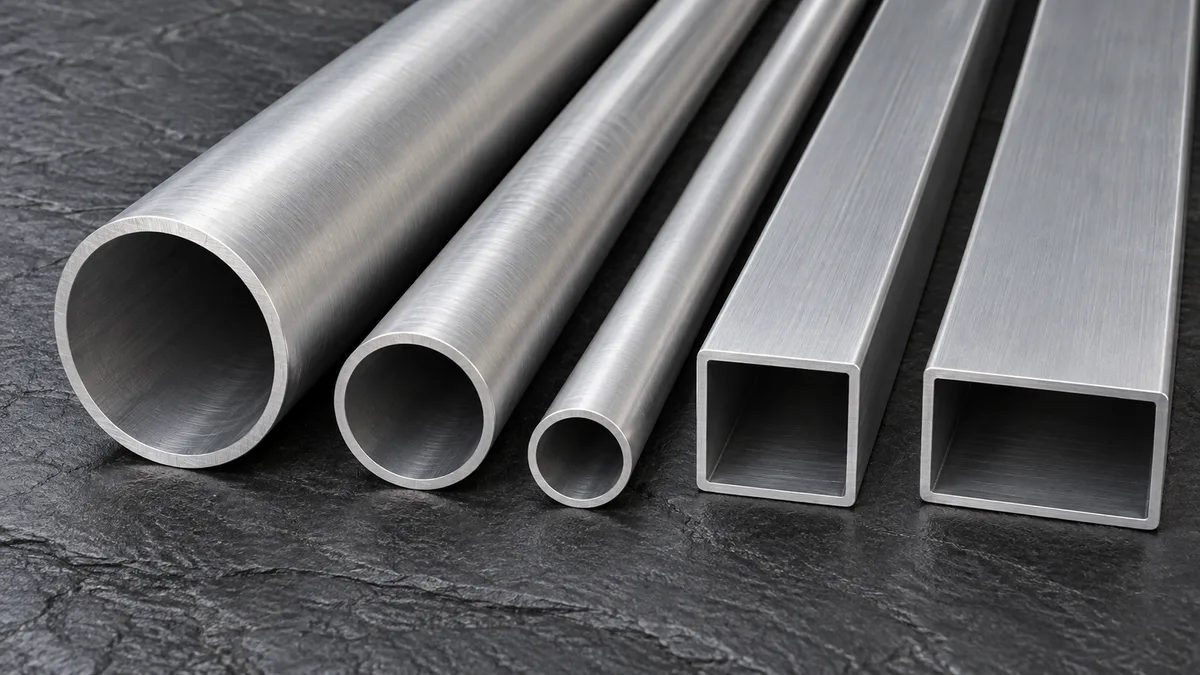
An aluminium pipe system is only as good as its fittings. Elbows, tees and reducers carry the same pressure as the pipe but concentrate stress at bends and branches, and every joint is a possible leak path. Fittings in the same or a compatible aluminium alloy avoid galvanic corrosion, keep the system light and allow it to be welded or anodised as one.
Aluminium piping is chosen where weight, corrosion resistance or cleanliness matter more than very high pressure or temperature: compressed-air networks, cryogenic and LNG lines, chemical and food plant, irrigation, ship systems, vacuum and gas lines in semiconductor plants, and structural handrails. In each case the fittings must match the pipe size and wall, the joining method and the service conditions.
There are two broad families. Welding fittings (butt-weld and socket-weld) become a permanent part of a welded pipeline and follow pressure-piping standards. Mechanical fittings (threaded, flanged, compression, push-fit and slip-on) allow assembly and dismantling without welding and are common in compressed-air, irrigation and structural systems. Choosing between them is the first decision in any aluminium piping design.
| Fitting | Function | Common variants | Typical notes |
|---|---|---|---|
| Elbow | Changes direction | 90°, 45°, 180° return; long radius (1.5 D) and short radius (1 D) | Long radius gives lower pressure drop; short radius saves space |
| Tee | Branches or combines flow | Equal, reducing, threaded, lateral (45°) | Branch outlet is a stress concentration; check reinforcement in high-pressure lines |
| Reducer | Changes pipe size | Concentric, eccentric, reducing coupling | Eccentric reducers keep the bottom (or top) flat to avoid trapped liquid or air |
| Cap and plug | Closes a pipe end | Butt-weld cap, threaded cap, plug | Butt-weld caps are dished for pressure; plugs suit threaded ends |
| Coupling | Joins two lengths in line | Full, half, reducing, socket-weld | Common in threaded and socket-weld small-bore systems |
| Union | Allows quick disconnection | Threaded union with nut and seat | Used where equipment must be removed for service |
| Flange | Bolted joint to valves, equipment or other pipe | Slip-on, weld-neck, blind, threaded, lap-joint | Choose rating and facing to match the mating flange |
| Stub end | Used with lap-joint flanges | Short and long pattern | Lets a cheaper or steel backing flange rotate freely |
Mechanical fittings with seals that grip the pipe outside diameter. Standard in modular compressed-air systems, where pipe is often blue anodised for identification, and in light gas and vacuum lines.
Lever or hook couplings on portable irrigation pipe, designed for fast assembly in the field and tolerant of slight misalignment.
L, T, cross and adjustable-angle connectors for square and round tube frames, handrails and displays. These carry structural load rather than pressure, and often clamp with set screws.
| Alloy | Tempers | Strength | Corrosion | Typical use |
|---|---|---|---|---|
| 6061 | T6 (O or T4 for forming) | High for weldable alloy | Good | The default alloy for forged and machined fittings, flanges and general piping |
| 6063 | T5, T6 | Medium | Good, excellent anodised finish | Compressed-air and architectural systems, handrails, light-duty fittings |
| 3003 | O, H112, H14 | Low | Very good | Low-pressure chemical and heat-exchange lines, formed fittings |
| 5083 / 5086 | O, H112, H321 | Medium-high, holds strength after welding | Excellent in seawater | Marine piping, cryogenic and LNG lines, offshore systems |
| 1060 / 1100 | O, H112 | Very low | Excellent | High-purity chemical service, electrical bus connections |
Match fitting and pipe alloys where possible. A 6061 fitting on 6061 pipe welds and anodises consistently. Mixing alloys within the aluminium family is normally acceptable for corrosion, but filler selection and post-weld strength must then be checked for both. Avoid direct contact between aluminium fittings and copper or carbon steel in wet service, because galvanic corrosion attacks the aluminium; use insulating gaskets and sleeves at transitions.
Remember that heat-treated alloys lose strength near welds. A 6061-T6 elbow welded into a line has a heat-affected zone with roughly T4-level strength, so pressure ratings for welded aluminium piping are based on reduced, welded allowable stresses. For welded lines where full strength after welding matters, 5083 or 5086 is the better choice.
| Standard | Covers | Notes |
|---|---|---|
| ASTM B361 | Factory-made wrought aluminium welding fittings | Butt-weld and socket fittings made from rod, bar, forgings, sheet, plate or seamless pipe |
| ASME B16.9 | Dimensions of factory-made butt-welding fittings | Centre-to-end dimensions of elbows, tees, reducers and caps |
| ASME B16.11 | Forged socket-welding and threaded fittings | Small-bore socket and threaded fitting dimensions |
| ASTM B241 / B241M | Seamless aluminium pipe and seamless extruded tube | The pipe most welding fittings are joined to |
| ASTM B247 | Aluminium die forgings, hand forgings and rolled ring forgings | Stock for forged flanges and heavy fittings |
| ASME B31.3 | Process piping design | Allowable stresses for aluminium, including welded values |
| EN 573-3, EN 755-2 | European chemistry and extruded product properties | Used for EN-specified pipe and fitting stock |
Pipe sizes follow the North American NPS system with schedules 5S, 10S, 40S and 80S, or metric outside diameter and wall. Aluminium flanges are often specified to the bolt-hole dimensions of ASME B16.5 or EN 1092 so they mate with steel equipment, but their pressure-temperature rating must be calculated for the aluminium alloy, not taken from the steel tables.
Check the edition of each standard cited in your project specification; dimensional and material requirements change between revisions.
| Method | Strength and sealing | Advantages | Limitations | Typical use |
|---|---|---|---|---|
| Butt welding (TIG/MIG) | Full-strength, permanent, leak-tight | Smooth bore, suits high pressure and cryogenic service | Needs qualified welders; heat-treated alloys lose strength at the weld | Process, cryogenic, marine piping |
| Socket welding | Strong, permanent | Easier fit-up for small bore | Crevice at socket can trap fluid | Small-bore lines up to about 2 in |
| Threaded | Moderate | No welding, easy assembly | Threads weaken thin walls; aluminium threads can gall | Low-pressure small-bore lines, instruments |
| Flanged | Good, depends on gasket and bolting | Removable, connects to valves and equipment | Heavier, more parts | Equipment connections, maintenance breaks |
| Compression / push-fit | Good at moderate pressure | Very fast, reconfigurable | Pressure and temperature limits set by seals | Compressed air, vacuum, light gas |
| Mechanical couplings | Moderate | Fast field assembly | Not for high pressure | Irrigation, temporary lines |
For welded aluminium fittings, prepare bevels by machining rather than grinding with discs that leave embedded particles, clean with solvent and a stainless brush, and use argon shielding with ER4043 or ER5356 filler for 6xxx alloys and ER5183 or ER5356 for 5083. Threaded aluminium joints benefit from anti-seize or PTFE sealants to prevent galling, and should not be over-tightened.
| Factor | Aluminium fittings | Stainless steel fittings (304/316) |
|---|---|---|
| Density | About 2.7 g/cm³, about one-third of stainless | About 7.9 – 8.0 g/cm³ |
| Strength | Moderate; 6061-T6 typical yield about 276 MPa | Higher, and retained at higher temperatures |
| Temperature range | Excellent at cryogenic temperatures; strength falls above about 150 °C | Wide range, from cryogenic to high temperature |
| Corrosion | Very good in air, fresh water and many chemicals; 5xxx good in seawater; attacked by strong alkalis and some acids | Excellent across a wide range; 316 good in chlorides |
| Thermal conductivity | High (about 150 – 220 W/m·K) | Low (about 15 W/m·K) |
| Machining and fabrication | Fast to machine and easy to handle | Slower to machine, work-hardens |
| Finish options | Anodised in colours for identification, painted, mill | Polished, pickled |
| Typical use | Compressed air, cryogenics, marine, light piping, structures | High-pressure, high-temperature, sanitary and aggressive chemical service |
Aluminium is the better choice when weight, cryogenic toughness, thermal conductivity or ease of installation matters, and the pressure and temperature are moderate. Stainless steel wins for high-temperature service, strong alkalis, many hygienic process systems and very high pressures. In marine systems, 5083 and 5086 aluminium piping is widely used on aluminium hulls because it avoids dissimilar-metal joints.
Anodised aluminium pipe with mechanical fittings gives a clean, smooth bore with low pressure loss, and is easy to extend or reroute in factories and workshops.
Aluminium stays tough at very low temperatures. 5083 and 6061 fittings are used in air-separation plant, LNG lines and liquid-nitrogen distribution.
5083 and 5086 fittings in fuel, water and ventilation systems on aluminium vessels, where matching the hull alloy avoids galvanic problems.
1xxx, 3003 and 6061 fittings for services such as nitric acid, some organic chemicals and food products, after compatibility checks.
Lightweight portable pipe with quick couplings, elbows, tees and end caps for sprinkler and flood irrigation.
Cast, forged or machined connectors for tube handrails, guardrails and frames, chosen for appearance and corrosion resistance.
Metline supplies aluminium pipe and the stock that fittings are made from (seamless tube, bar, forgings and plate) in all common alloys, and can machine flanges, couplings, caps and other fittings to your drawing. For projects that need fittings and pipe on one order, we can supply both with matching alloy and certification, so traceability runs from pipe to fitting.
Most forged and machined fittings are 6061-T6. 6063 is common for compressed-air and architectural systems, 3003 for low-pressure chemical lines, and 5083 or 5086 for marine and cryogenic piping where strength after welding matters.
ASTM B361 covers factory-made wrought aluminium welding fittings, with dimensions to ASME B16.9 for butt-weld fittings and ASME B16.11 for socket-weld fittings.
Yes, by TIG or MIG with a suitable filler such as ER4043 or ER5356 for 6xxx alloys and ER5183 for 5083. Heat-treated alloys lose strength next to the weld, so welded allowable stresses must be used.
Only with insulating gaskets, sleeves or dielectric unions at the joint. Direct contact in wet service causes galvanic corrosion of the aluminium.
Aluminium flanges are often made to ASME B16.5 or EN 1092 bolt patterns so they mate with steel flanges, but their pressure rating must be calculated for the aluminium alloy and an insulating gasket kit is recommended.
Yes. Aluminium pipe and fittings are widely used in compressed-air networks because they are light, clean, corrosion resistant and easy to modify.
Send the fitting list, sizes, alloy and standard. We will reply with options, certification and a delivered price.





