Filler for 5xxx pipe
ER5183 matches the strength of 5083 and is the usual choice for cryogenic vessels; ER5356 is common for 5086 and general marine work. Avoid 4xxx fillers on high-magnesium alloys because Mg2Si can embrittle the joint.



Pressure vessels and pressure piping use seamless aluminium pipe in a small group of proven alloys: 5083 and 5086 for welded and cryogenic service, 6061 and 6063 for higher strength or lighter duty, and 3003 or 1060 for low-pressure and heat-transfer lines. This guide explains which grade to choose, the specified minimum properties under ASME SB-241, how welding changes the design strength, and what documentation a vessel fabricator or classification surveyor will ask for.
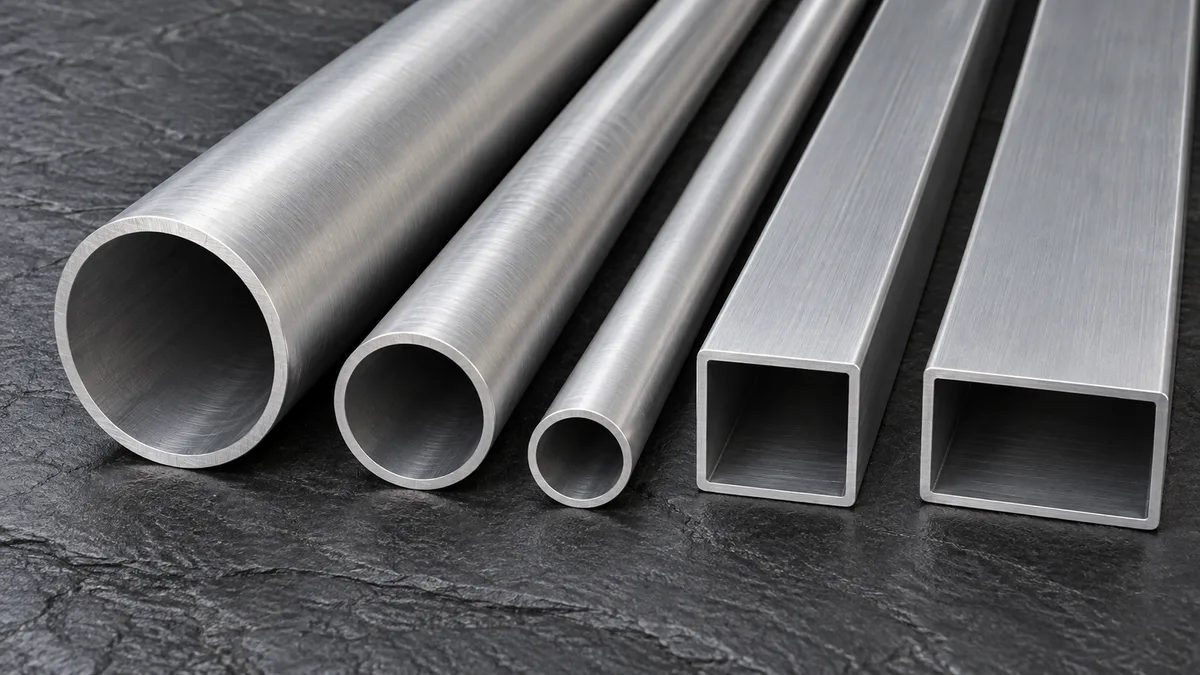
Aluminium is not the strongest pressure-vessel material, but it solves problems that steel cannot: it does not become brittle at cryogenic temperatures, it resists many corrosive media without lining, it does not spark or contaminate product, and a given vessel weighs roughly a third of its steel equivalent.
Those properties explain where aluminium pressure pipe actually appears: liquefied gas and cryogenic plant (LNG, liquid oxygen, nitrogen and argon), air-separation units, compressed-air and nitrogen distribution networks, refrigeration circuits, process lines in food, beverage and pharmaceutical plants, gas-insulated electrical switchgear, and lightweight vessels on ships, trucks and aircraft.
The design codes that cover aluminium vessels are well established. In North America, ASME Boiler and Pressure Vessel Code Section VIII, Division 1, Part UNF governs non-ferrous vessels, and the permitted pipe and tube material is ASME SB-241 (seamless extruded) or SB-210 (drawn seamless). In Europe, EN 13445-8 adds the aluminium-specific requirements to the unfired pressure vessel standard, and pipe is supplied to EN 755 with chemistry to EN 573-3. Classification societies such as Lloyd's Register, DNV, ABS and Bureau Veritas apply their own material rules to vessels and piping built for ships and offshore units.
Most pressure work is done with four alloys. The choice is driven by whether the pipe will be welded, the temperature range and the medium it carries.
| Alloy | Usual tempers | Typical pressure use | Why it is chosen |
|---|---|---|---|
| 5083 | O, H111, H112 | Cryogenic and LNG piping, welded vessels, marine systems | Highest strength of the non-heat-treatable alloys; keeps near-full strength across welds; tough down to −196 °C and below |
| 5086 | O, H111, H112 | Welded vessels and marine piping | Slightly lower strength than 5083 but easier to form; excellent seawater resistance |
| 6061 | T4, T6, T6511 | Compressed-air and gas lines, bolted or mechanically joined systems, aerospace vessels | Higher strength in the unwelded condition; good machinability for threaded and flanged ends |
| 6063 | T5, T6 | Low and medium-pressure air, vacuum and process lines | Smooth extruded surface, good corrosion resistance, economical |
| 6351 | T4, T6 | Structural and medium-pressure tube where 6061 is not stocked | Strength similar to 6061; common in some markets |
| 3003 | O, H112, H14 | Refrigeration, heat exchangers, low-pressure fluid lines | Very formable and brazeable; modest strength |
| 1060 / 1100 | O, H112 | Chemical and food lines at low pressure | Highest corrosion resistance and purity; low strength |
Heat-treatable alloys such as 6061 and 6063 lose a large part of their strength in the weld heat-affected zone, while 5083 and 5086 in the O or H111 condition lose very little. That is why welded cryogenic vessels and ship systems are dominated by 5xxx alloys, and 6xxx pipe is preferred where joints are mechanical (flanged, threaded, grooved or compression fittings).
The values below are the specified minimums for seamless extruded pipe and tube in ASTM B241/B241M, which ASME SB-241 adopts. Design allowables in ASME Section II, Part D are derived from these figures and fall at elevated temperature; always design to the code tables for your edition, not to these room-temperature values.
| Alloy and temper | Wall thickness | Tensile strength (MPa) | Yield strength 0.2 % (MPa) |
|---|---|---|---|
| 1060-O | All | 60 – 95 | — |
| 3003-O | All | 95 – 130 | 35 min |
| 3003-H112 | All | 95 min | 35 min |
| 5083-O | All | 270 – 350 | 110 min |
| 5083-H111 | All | 275 min | 165 min |
| 5083-H112 | All | 270 min | 110 min |
| 5086-O | All | 240 – 315 | 95 min |
| 5086-H111 | All | 250 min | 145 min |
| 5086-H112 | All | 240 min | 95 min |
| 6061-T4 | All | 180 min | 110 min |
| 6061-T6, T6511 | All | 260 min | 240 min |
| 6063-T5 | Up to 12.5 mm | 150 min | 110 min |
| 6063-T6 | Up to 25 mm | 205 min | 170 min |
| 6351-T6 | Up to 25 mm | 290 min | 255 min |
Elongation limits vary with wall thickness and gauge length and are stated on the mill certificate. Values rounded from the ksi limits in ASTM B241. Some older references quote a 6061-T6 yield of 260 MPa for pipe; the correct specified minimum is 240 MPa (35 ksi).
For a welded vessel, the governing strength is not the pipe in its delivered temper but the weld and heat-affected zone. Codes therefore list separate, lower allowables for welded construction in heat-treatable alloys.
| Material | Effect of welding | Practical consequence |
|---|---|---|
| 5083-O / H111, 5086-O / H111 | Heat-affected zone returns to roughly the annealed (O) condition, which is close to the delivered strength | Welded design stress is similar to unwelded; the reason 5xxx alloys dominate welded vessels |
| 5083-H112 / H32 strain-hardened | Work-hardening is lost next to the weld | Design welded areas to O-temper values |
| 6061-T6 | Tensile strength in the weld zone falls to about 165 MPa (24 ksi), well below the 260 MPa parent minimum | Thicker walls or post-weld solution treatment and ageing |
| 6063-T5 / T6 | Weld-zone tensile strength falls to about 115 MPa (17 ksi) | Suited to low-pressure welded lines only |
| 3003 | Welds at close to O-temper strength | Low-pressure service |
ER5183 matches the strength of 5083 and is the usual choice for cryogenic vessels; ER5356 is common for 5086 and general marine work. Avoid 4xxx fillers on high-magnesium alloys because Mg2Si can embrittle the joint.
ER4043 resists hot cracking and is preferred where the part may be heat-treated after welding; ER5356 gives higher shear strength and a better colour match after anodising.
ASME Section IX or ISO 15614-2 procedure and welder qualifications are required. Clean the oxide layer immediately before welding and keep filler wire dry to avoid porosity.
Extruded from a hollow billet over a mandrel so there is no longitudinal weld line. The standard route for SB-241 pipe in nominal sizes from about 1/2 in to 12 in and larger, in Schedule 5, 10, 40, 80 and 160 wall thicknesses.
Extruded shells cold-drawn to closer diameter and wall tolerances and a smoother bore. Supplied to ASTM B210 / ASME SB-210 for small-bore instrument, hydraulic and refrigeration lines.
Very large or thick-walled cylinders for vessel shells are produced by extrusion on large presses, by piercing and forging, or by rolling and welding plate. Rolled-and-welded shells are designed as welded construction.
Lower cost, but it contains internal weld seams formed in the die. It is not accepted as seamless pipe for code pressure parts unless the specification allows it.
Elbows, tees, reducers, stub ends and weld-neck flanges in matching alloys, so the system can be welded with one procedure.
5083 plate and bar for heads, reinforcing pads, nozzle bodies and tube sheets.
See the aluminium pipe size chart for schedule dimensions and weights.
For a vessel, the pipe order should match the material specification named in the design calculation exactly, including the edition year where the code requires it. A purchase order that says only "6061 pipe" will normally be supplied to a commercial extrusion standard, which may not satisfy the inspector.
If your vessel or piping must carry a classification society certificate, state the society and the rule edition at enquiry. The pipe then has to be sourced from a manufacturer holding the relevant approval and tested accordingly; material bought on a standard 3.1 certificate cannot be upgraded to class certification afterwards.
Yes. ASME Section VIII Division 1 (Part UNF) and EN 13445-8 both cover aluminium vessels. Seamless pipe to ASME SB-241 or EN 755 in alloys such as 5083, 5086, 6061 and 6063 is used for shells, nozzles and connecting piping.
5083 in the O or H111 temper is the usual choice, especially for cryogenic service, because its strength across the weld is close to the parent metal. 5086 is a slightly softer alternative, and 5454 is preferred where the vessel runs warm for long periods.
Porthole tube contains longitudinal seams where metal re-joins inside the die. They are generally sound, but codes treat only mandrel-extruded or drawn seamless pipe as seamless material, so porthole tube is not accepted for code pressure parts without specific permission.
ASTM B241 specifies 240 MPa (35 ksi) minimum yield and 260 MPa (38 ksi) minimum tensile strength. After welding, the tensile strength in the heat-affected zone drops to about 165 MPa unless the part is heat-treated again.
Yes. Aluminium has no ductile-to-brittle transition, and alloys such as 5083 actually gain strength and keep their toughness at liquid-nitrogen temperature, which is why they are standard for LNG and air-separation equipment.
Tell us the society and rule edition when you enquire. Class-certified material has to come from an approved manufacturer and be tested as the rules require, so it is arranged per order rather than supplied from general stock.
Send the alloy, size, schedule, code and testing requirements. Our technical team will confirm a compliant supply route and certification.





