Pipe
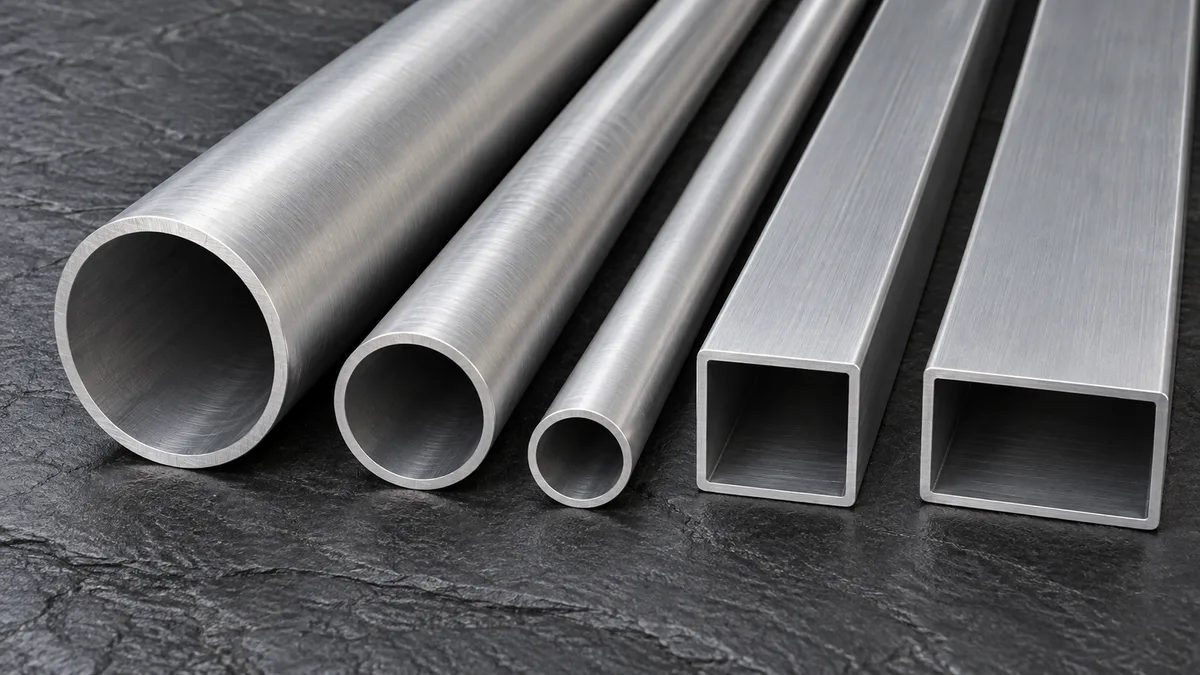
Extruded seamless or porthole-extruded aluminium tube, usually 6063-T6 or 6060-T6, in 3 m, 5.8 m or 6 m lengths, anodised or powder coated in a colour that identifies the medium.



Aluminium compressed air piping uses extruded, usually anodised or powder-coated 6063 or 6060 tube with push-fit or compression fittings to distribute air from the compressor to the point of use. Compared with galvanised steel it does not rust, keeps its smooth bore and low pressure drop for life, weighs about a third as much and installs without threading or welding. This guide covers pipe materials and sizes, pressure ratings, sizing, layout and installation.
Compressed air is one of the most expensive utilities in a factory: most of the electrical energy a compressor uses becomes heat, and only a small fraction reaches the tools as useful work. Anything that wastes air or pressure between the compressor and the point of use, such as leaks, rough corroded pipe or undersized lines, adds directly to the electricity bill.
Traditional black or galvanised steel pipe corrodes internally because compressed air always carries some moisture. Rust scale roughens the bore, raises pressure drop, flakes off into filters and tools, and threaded joints loosen over time and leak. Copper avoids rust but is expensive and must be brazed. Plastic pipes are cheap but have limited temperature and pressure capability and some types are prohibited for compressed air because of brittle failure.
Aluminium tube solves most of these problems. Its natural oxide film, thickened by anodising or protected by powder coating, prevents rust inside and out, so the bore stays smooth and air quality remains high. The tube is light enough for one person to lift a 6 m length, and modular fittings let a line be built, extended or re-routed in hours without hot work. For these reasons aluminium has become the default for new compressed air, vacuum and inert gas networks in automotive plants, food and pharmaceutical factories, workshops and laboratories.
Extruded seamless or porthole-extruded aluminium tube, usually 6063-T6 or 6060-T6, in 3 m, 5.8 m or 6 m lengths, anodised or powder coated in a colour that identifies the medium.
Push-fit or compression couplings, elbows, tees, reducers and end caps, typically in aluminium or technopolymer with nitrile or EPDM O-rings and a gripping ring.
Quick-connect drop brackets or saddle take-offs that tap into a live main to feed hoses, tools and machines.
Ball valves for isolating sections and branches, so a line can be extended without shutting down the whole network.
Clips, brackets and hanging systems sized to the pipe diameter, with sliding supports to accommodate thermal expansion.
Braided hoses connect the main to compressors and dryers, isolating vibration and accommodating movement.
Each component must be rated for the same pressure, temperature and medium. Mixing fittings from one system with pipe from another is a common cause of leaks, because tube OD tolerance, ovality and surface finish all affect how well an O-ring and gripping ring seal.
| Alloy / temper | Min. tensile strength (EN 755-2) | Min. 0.2 % proof | Why it is used |
|---|---|---|---|
| 6063-T6 | 215 MPa | 170 MPa | Standard air-pipe alloy; smooth extruded bore, excellent anodising |
| 6060-T6 | 190 MPa | 150 MPa | Common European equivalent; similar performance |
| 6082-T6 | 295 – 310 MPa | 250 – 260 MPa | Larger diameters or higher pressure where extra strength is needed |
Minimums shown for typical wall thicknesses; exact values depend on wall thickness band and are reported on the mill certificate. Seamless tube for pressure use is often ordered to ASTM B241 or EN 755.
Pipe is normally anodised (10 – 20 µm) or powder coated on the outside for colour coding and corrosion protection. The inside is left as extruded or anodised; a clean, smooth extruded bore has a very low roughness, which is why aluminium lines show lower friction loss than steel even when new, and much lower once steel has corroded.
| Colour | Common meaning | Notes |
|---|---|---|
| Blue | Compressed air | The most common default |
| Green | Nitrogen or inert gas | Check local colour codes |
| Grey | Vacuum or low pressure | Varies between systems |
| Black | Lubricated or untreated air | Also used for appearance |
| Silver (natural anodised) | Clean areas, laboratories, visible installations | Often specified for food and pharma |
Colour codes are not universal. Follow national standards and the plant's own identification scheme, and add labels with medium and flow direction.
Air quality is the other reason plants choose aluminium. ISO 8573-1 classifies compressed air by particles, water and oil content, and food, pharmaceutical, electronics and paint-shop users often need high purity classes at the point of use. A dryer and filters can deliver clean air to the main, but rusting steel pipe then adds particles back downstream. Corrosion-free aluminium preserves the quality created in the compressor room, so final filters at each drop last longer and need changing less often.
Pipe for compressed air is usually specified by outside diameter in millimetres. The table gives common sizes with representative wall thicknesses; walls vary between systems, so confirm the exact dimensions with the fittings you will use. Weights are calculated from geometry at 2.70 g/cm³.
| OD (mm) | Wall (mm) | Bore (mm) | Bore area (cm²) | Weight (kg/m) |
|---|---|---|---|---|
| 20 | 1.5 | 17 | 2.3 | 0.24 |
| 25 | 1.5 | 22 | 3.8 | 0.30 |
| 32 | 1.8 | 28 | 6.3 | 0.46 |
| 40 | 2.0 | 36 | 10.2 | 0.64 |
| 50 | 2.0 | 46 | 16.6 | 0.81 |
| 63 | 2.5 | 58 | 26.4 | 1.28 |
| 76 | 2.5 | 71 | 39.6 | 1.56 |
| 100 | 3.0 | 94 | 69.4 | 2.47 |
| 110 | 3.0 | 104 | 84.9 | 2.72 |
| 168 | 4.0 | 160 | 201.1 | 5.56 |
Nominal inch sizes are often quoted alongside: 20 mm is used for 1/2 in drops, 25 mm for 3/4 in, 40 mm for 1 1/4 in, 50 mm for 1 1/2 in, 63 mm for 2 in, 76 mm for 2 1/2 in, 100 – 110 mm for 4 in and 168 mm for 6 in mains. Larger diameters of 200 mm and above are available for high-flow distribution.
Complete aluminium air piping systems are commonly rated for maximum working pressures of 13 – 16 bar (about 190 – 230 psi) at ambient temperature in small and medium diameters, with lower ratings on the largest sizes. Ratings for vacuum service down to about −0.99 bar are also typical. Allowable pressure falls as temperature rises, mainly because the polymer seals and technopolymer fitting bodies lose strength, not because of the aluminium tube.
Always use the pressure-temperature table published for the specific pipe and fitting system you install.
Piping is pressure equipment in many jurisdictions. In Europe, systems fall under the Pressure Equipment Directive 2014/68/EU; elsewhere, codes such as ASME B31.3 may be applied to plant air lines. Pressure-test the completed installation before commissioning, typically with air or nitrogen at a test pressure set by the applicable code, and record the result.
A ring main (loop) feeds every drop from two directions and halves the effective flow path, which reduces pressure drop and evens out pressure across the plant. It is the preferred layout for larger shops, with isolation valves so sections can be maintained without shutting down production.
| Feature | Aluminium | Galvanised / black steel | Copper | Plastic (ABS, PE) |
|---|---|---|---|---|
| Internal corrosion | None in normal service | Rusts; scale forms | Very low | None |
| Pressure drop over time | Stays low | Increases | Stays low | Stays low |
| Weight | Light | Heavy | Medium | Very light |
| Installation | Push-fit, no hot work | Threading or welding | Brazing | Solvent welding or fusion |
| Modifications | Easy | Difficult | Moderate | Moderate |
| Temperature and pressure range | Good | Very good | Very good | Limited |
| Material cost | Medium | Low | High | Low |
| Installed lifetime cost | Low | Medium to high | Medium | Medium |
Steel remains appropriate for very high pressures, very large diameters and hot compressor discharge lines. For the main distribution network and drops in most factories, aluminium gives the lowest total cost once installation time, leakage and energy are counted.
Yes. It does not rust, keeps a smooth bore with low pressure drop for life, is light, and installs with push-fit fittings without threading or welding. That is why it is now the most common choice for new plant air networks.
Complete systems are typically rated up to about 13 – 16 bar at room temperature in small and medium sizes, with lower ratings on large diameters and at higher temperatures. Always use the rating table of the specific pipe and fitting system.
6063-T6 is the standard, with 6060-T6 as a common European equivalent. 6082-T6 is used where extra strength is needed for larger or higher-pressure pipe.
Add up the air demand, allow for growth, and choose a diameter that keeps velocity in the main around 6 – 10 m/s and total pressure drop to about 0.1 – 0.2 bar. A ring main reduces pressure drop further.
No. Compressor discharge air is too hot. Install an aftercooler, a dryer as needed, and a flexible hose between the compressor and the aluminium main.
Yes. Aluminium expands about twice as much as steel with temperature. Use sliding supports, one fixed point per run, and expansion loops or flexible sections on long straight runs.
Send pipe sizes, alloy, finish, colour, lengths and quantities. We will reply with availability, certification and a delivered price.





