


A356-T6 Aluminium Wheel Castings
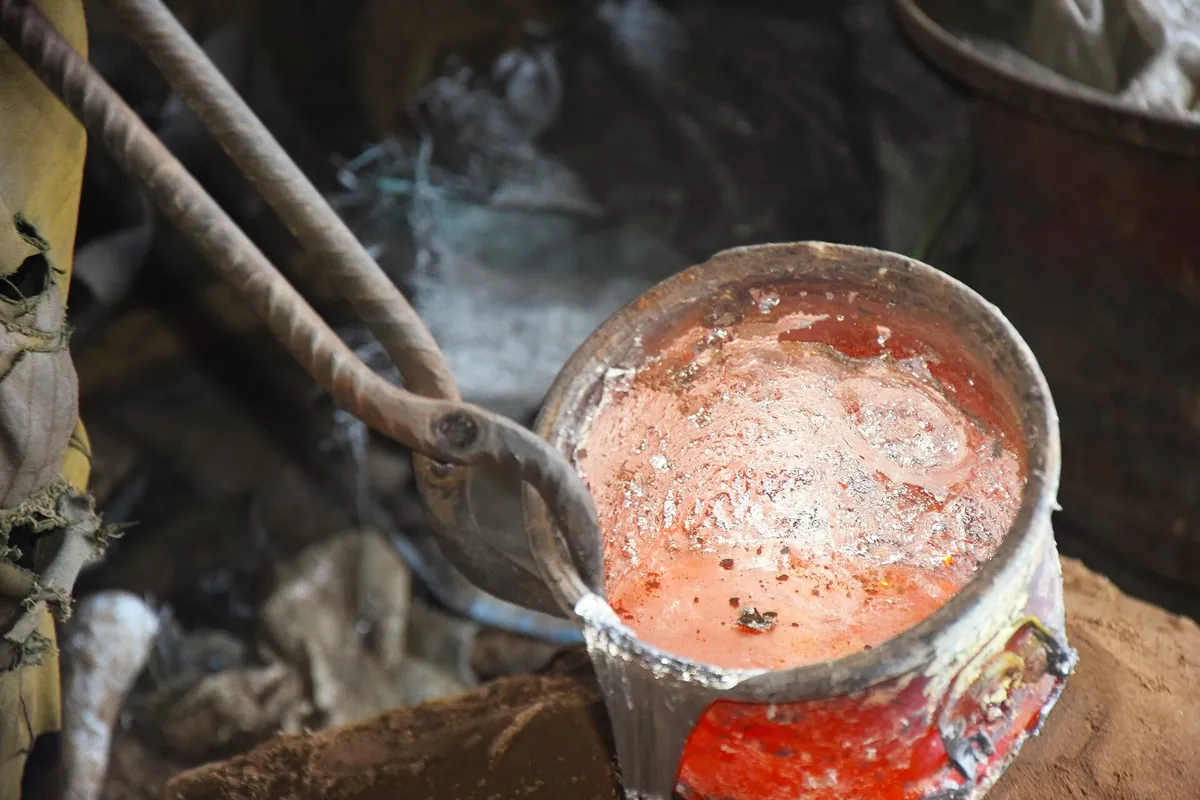
Almost every cast aluminium car wheel is made from A356 (AlSi7Mg0.3), cast by low-pressure die casting and heat-treated to T6. The alloy combines excellent fluidity for thin spokes with good ductility after heat treatment, which wheels need to pass impact and fatigue tests. Metline supplies A356.2 ingot, cast wheel blanks and finished wheels to drawing for vehicle and aftermarket programmes worldwide.
- Alloy
- A356 / A356.2 (AlSi7Mg0.3)
- Temper
- T6
- Process
- Low-pressure die casting
- Tests
- ISO 3006 · ISO 7141 · SAE J2530
Why A356 is the wheel alloy
A356 is a hypoeutectic aluminium-silicon-magnesium casting alloy. About 7 % silicon gives the melt the fluidity to fill rims and spokes; about 0.3 % magnesium forms Mg2Si, which precipitates during ageing and doubles the yield strength. Tight limits on iron and copper keep the casting ductile and corrosion resistant.
In the trade, "wheel hub" is often used for the whole road wheel, and that is what this page covers: the cast rim-and-disc wheel that carries the tyre. Low-pressure die casting (LPDC) is the dominant process for original-equipment wheels because molten metal rises into the die from below, without turbulence, and solidifies directionally toward the feeding hub. Gravity casting is used for some aftermarket designs, and flow-formed wheels combine a cast centre with a rim that is spun and stretched to refine its grain and thin the wall.
A356 composition and equivalents (wt %)
| Element | A356.0 (casting) | A356.2 (ingot) | 356.0 (casting) |
|---|---|---|---|
| Silicon (Si) | 6.5 – 7.5 | 6.5 – 7.5 | 6.5 – 7.5 |
| Magnesium (Mg) | 0.25 – 0.45 | 0.30 – 0.45 | 0.20 – 0.45 |
| Iron (Fe), max | 0.20 | 0.12 | 0.6 |
| Copper (Cu), max | 0.20 | 0.10 | 0.25 |
| Manganese (Mn), max | 0.10 | 0.05 | 0.35 |
| Zinc (Zn), max | 0.10 | 0.05 | 0.35 |
| Titanium (Ti), max | 0.20 | 0.20 | 0.25 |
| Others each / total, max | 0.05 / 0.15 | 0.05 / 0.15 | 0.05 / 0.15 |
| Aluminium | Remainder | Remainder | Remainder |
A356.2 ingot is the usual charge for wheel foundries because its lower iron leaves room for the small pick-up during melting. Raising magnesium toward the top of the range increases strength and hardness but reduces elongation; copper and zinc lower ductility and corrosion resistance and are kept to a minimum. Melts are normally grain-refined with titanium-boron and modified with strontium so that the eutectic silicon becomes fine and fibrous instead of coarse plates.
| System | Equivalent designation |
|---|---|
| Aluminum Association / ASTM | A356.0 (castings), A356.2 (ingot); UNS A13560 |
| Europe (EN 1706) | EN AC-42100 (AlSi7Mg0.3) |
| Japan (JIS H 5202) | AC4CH |
| China (GB/T 1173) | ZL101A (ZAlSi7MgA) |
Mechanical properties of A356-T6 wheels
| Condition | Tensile strength | Yield strength | Elongation | Hardness |
|---|---|---|---|---|
| A356-T6, permanent-mould minimum (ASTM B108) | 228 MPa / 33 ksi | 152 MPa / 22 ksi | 5 % | — |
| A356-T61, permanent-mould minimum (ASTM B108) | 255 MPa / 37 ksi | 179 MPa / 26 ksi | 5 % | — |
| LPDC wheel, typical, sample from spoke or rim | 260 – 290 MPa | 190 – 220 MPa | 7 – 12 % | 75 – 95 HB |
| 356-T6, typical permanent mould | about 260 MPa | about 185 MPa | about 5 % | — |
Wheel producers usually specify properties on test bars cut from the wheel, with separate limits for rim and spoke. Use the values on your drawing or OEM standard for design.
Elongation is as important as strength. A wheel must deform rather than crack when it strikes a kerb, which is what the 13° impact test simulates. High iron, coarse silicon, oxide films and shrinkage porosity all cut elongation, so melt treatment and degassing matter as much as alloy chemistry.
T6 heat treatment of cast wheels
- Solution treatmentTypically about 535 – 545 °C for 4 – 8 hours, enough to dissolve Mg2Si and spheroidise the eutectic silicon.
- QuenchInto water at about 60 – 80 °C within seconds of leaving the furnace; warm water limits distortion and residual stress in the rim.
- Artificial ageingAbout 150 – 165 °C for 3 – 6 hours to precipitate the strengthening phase. Exact cycles are tuned to wheel mass and target properties.
After heat treatment the wheel is X-rayed, machined on the hub face, bolt holes and bead seats, leak-tested for tubeless sealing, balanced, and painted or diamond-cut and clear-coated.
Inspection and wheel test standards
- Radiography: every wheel or a defined sample is X-rayed; gas porosity, shrinkage and inclusions are graded against reference radiographs such as ASTM E155, with stricter limits in the spoke-to-rim junction and bead seats.
- Surface: no cold shuts, cracks, laps or unfilled areas; machined faces free of exposed porosity.
- Leak test: helium or air-under-water test of the rim for tubeless tyres.
- Dimensional: radial and lateral run-out, bolt-circle position and centre-bore diameter.
- Mechanical: test bars from the wheel for tensile and elongation, plus hardness on each heat-treatment batch.
| Standard | What it covers |
|---|---|
| ISO 3006 | Passenger car road wheels: test methods (cornering fatigue, radial fatigue) |
| ISO 3894 | Road wheels for commercial vehicles: test methods |
| ISO 7141 | Light-alloy road wheels: impact test (13° impact) |
| SAE J2530 | Aftermarket wheels for passenger cars and light trucks: performance requirements |
| SAE J328 / SAE J175 | Passenger car wheel performance requirements; wheel impact test procedure |
| UN ECE R124 | Approval of replacement wheels for passenger cars in UNECE markets |
| JWL / JWL-T | Japanese technical standards for light-alloy wheels for passenger cars and trucks |
Cast A356 wheels compared with forged 6061 wheels
| Factor | Cast A356-T6 (LPDC) | Forged 6061-T6 |
|---|---|---|
| Typical yield strength | 190 – 220 MPa | 240 – 280 MPa |
| Typical elongation | 7 – 12 % | 10 – 14 % |
| Weight for the same load rating | Reference | Typically 20 – 30 % lighter |
| Design freedom | Very high; complex spoke shapes | High, but limited by forging and machining |
| Tooling and unit cost | Lowest at volume | Higher |
| Typical market | Most OEM passenger car wheels | Premium cars, motorsport, trucks and buses |
Flow-formed wheels sit between the two: a cast centre with a work-hardened rim, saving several percent of weight over a fully cast wheel at a moderate cost increase.
References and standards
- ASTM B108 – Standard Specification for Aluminum-Alloy Permanent Mold Castings
- ASTM B179 – Standard Specification for Aluminum Alloys in Ingot and Molten Forms for Castings
- EN 1706 – Aluminium and aluminium alloys: castings, chemical composition and mechanical properties
- ISO 7141 – Road vehicles: light alloy wheels, impact test
- SAE J2530 – Aftermarket Wheels: Passenger Cars and Light Truck, Performance Requirements
- ASTM E155 – Reference Radiographs for Inspection of Aluminum and Magnesium Castings
A356 aluminium (aluminum) wheel castings: FAQ
Why is A356 used for most alloy wheels?
It flows well into thin sections, has low shrinkage, and after T6 heat treatment offers a good balance of strength and elongation. Its tight iron and copper limits give the ductility a wheel needs to survive impacts and the corrosion resistance needed against road salt.
What is the difference between A356 and A356.2?
A356.2 is the ingot designation with lower iron, copper, manganese and zinc limits. Foundries melt A356.2 ingot so that the finished A356.0 casting stays within its limits after normal pick-up during melting.
What is the European equivalent of A356?
EN AC-42100 (AlSi7Mg0.3) in EN 1706. In Japan it is AC4CH and in China ZL101A.
Is a cast wheel weaker than a forged wheel?
A cast wheel is designed with thicker sections to reach the same load rating, so it is safe but heavier. Forged 6061-T6 has higher strength and elongation, which allows a lighter wheel for the same rating.
Which tests must a cast wheel pass?
Typically radial fatigue, cornering fatigue and 13° impact tests to ISO 3006, ISO 7141, SAE J2530 or JWL, plus radiography, leak testing and run-out checks on production wheels.
Sourcing cast aluminium wheels?
Send the wheel specification, test standard and volume, or your A356.2 ingot requirement. We reply with a supply plan and delivered quotation.






