Machining
Machines well in T851, with low distortion thanks to stretching. Balance roughing from both sides on deep pockets.



2124 is a high-purity version of 2024 made specifically for thick aerospace plate. Lower iron and silicon give better fracture toughness and short-transverse ductility in heavy sections, so 2124-T851 plate is used for machined bulkheads, wing attach fittings and other thick, damage-tolerant parts. Metline supplies 2124-T851 and T351 plate to AMS 4101 and ASTM B209, cut to size and fully certified, to customers worldwide.
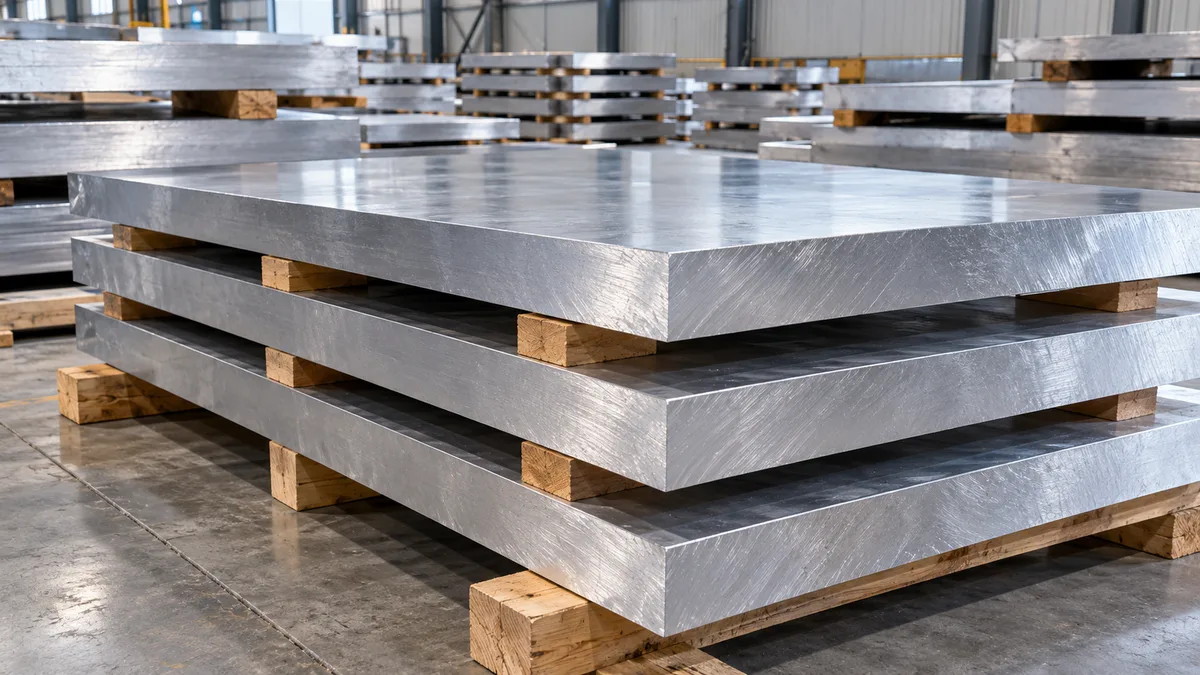
When 2024 is rolled into plate thicker than about 25 mm, coarse iron- and silicon-rich particles become starting points for cracks, especially in the short-transverse (through-thickness) direction. 2124 was developed to solve this.
The alloy keeps the copper, magnesium and manganese of 2024 but caps silicon at 0.20 % and iron at 0.30 %. Fewer constituent particles mean higher fracture toughness and better through-thickness ductility, while tensile strength is essentially unchanged. In the T851 temper, which is stretched and artificially aged, the plate also has good resistance to stress-corrosion cracking and holds its strength better at moderately raised temperatures than naturally aged tempers.
The result is a plate grade for heavy machined parts: a 100 mm plate may be machined down to a thin-webbed bulkhead with 90 % of the material removed. Stretching keeps residual stress low, so the part does not distort during machining.
| Element | 2124 min. | 2124 max. | 2024 max. (for comparison) |
|---|---|---|---|
| Silicon (Si) | — | 0.20 | 0.50 |
| Iron (Fe) | — | 0.30 | 0.50 |
| Copper (Cu) | 3.8 | 4.9 | 3.8 – 4.9 |
| Manganese (Mn) | 0.30 | 0.9 | 0.30 – 0.9 |
| Magnesium (Mg) | 1.2 | 1.8 | 1.2 – 1.8 |
| Chromium (Cr) | — | 0.10 | 0.10 |
| Zinc (Zn) | — | 0.25 | 0.25 |
| Titanium (Ti) | — | 0.15 | 0.15 |
| Others, each / total | — | 0.05 / 0.15 | 0.05 / 0.15 |
| Aluminium (Al) | Remainder |
Typical 2124-T851 values are about 480 MPa tensile strength and 440 MPa yield strength with 6 – 9 % elongation in the longitudinal direction. AMS 4101 sets minimum values by thickness band and test direction, and also guarantees minimum plane-strain fracture toughness (KIc), which is the main reason to buy 2124 instead of 2024.
| Temper | Condition | Typical tensile | Typical yield | Main benefit |
|---|---|---|---|---|
| T851 | Solution treated, stretched, artificially aged | about 480 MPa | about 440 MPa | High yield, SCC resistance, thermal stability |
| T351 | Solution treated, stretched, naturally aged | about 470 MPa | about 325 MPa | Higher toughness and crack-growth resistance |
Typical values compiled from producer and ASM data. Minimums fall as thickness increases and are lowest in the short-transverse direction; use AMS 4101 or MMPDS for design.
| System | Designation / document |
|---|---|
| SAE AMS | AMS 4101 – 2124-T851 plate, about 25.4 – 152.4 mm |
| ASTM / ASME | ASTM B209 (sheet and plate) |
| Federal (former) | AMS-QQ-A-250/29 |
| UNS | A92124 |
| European | EN AW-2124 (AlCu4Mg1(A)); EN 485 plate |
For thick plate, the cut position matters. If your part has a highly stressed region, ask for blocks cut so that region lies away from the plate mid-thickness, where properties are lowest.
Machines well in T851, with low distortion thanks to stretching. Balance roughing from both sides on deep pockets.
2124 is not fusion welded for structure; it is crack-prone and loses strength. Assemblies are bolted or riveted.
Like 2024, it needs protection: anodise or conversion coat and prime. It is not a seawater-resistant alloy.
T851 retains strength better than 7xxx tempers at around 120 – 150 °C, useful near engines and air systems.
| Property | 2124-T851 | 2024-T851 | 7050-T7451 | 7075-T7351 |
|---|---|---|---|---|
| Typical yield | about 440 MPa | about 450 MPa | about 470 MPa | about 435 MPa |
| Thick-plate toughness | Good | Fair | Very good | Good |
| Elevated-temperature strength | Good | Good | Fair | Fair |
| SCC resistance | Good | Good | Very good | Very good |
2124 has lower iron (0.30 % max.) and silicon (0.20 % max.). Strength is similar, but thick 2124 plate has higher fracture toughness and better short-transverse ductility.
Plate from about 25.4 mm (1 in) to 152.4 mm (6 in) in the T851 temper.
Not for structural joints. Like 2024 it is prone to hot cracking and loses strength in the weld zone; parts are bolted or riveted.
No. It is a copper-bearing alloy that needs anodising, conversion coating and paint. For marine exposure, 5xxx alloys are far better.
Yes, to AMS-STD-2154 or ASTM B594 at the class specified on the order, with the report included in the documentation.
Send thickness, size, temper and specification. We will reply with availability, inspection and certification.





