Aerospace
Bulkhead, frame and wing-attachment fittings, landing-gear and engine-mount brackets machined from 7050-T7452 or 7075-T7352 blocks.



A forged aluminium block is a rectangular hand forging: a cast ingot that has been upset and drawn on an open-die press in all three directions, then heat treated and stress relieved. It gives thick parts sounder centres and better through-thickness properties than very thick rolled plate. Metline supplies forged blocks in 6061, 6082, 2014, 7075 and 7050, rough or finish machined, UT tested and certified, to customers worldwide.
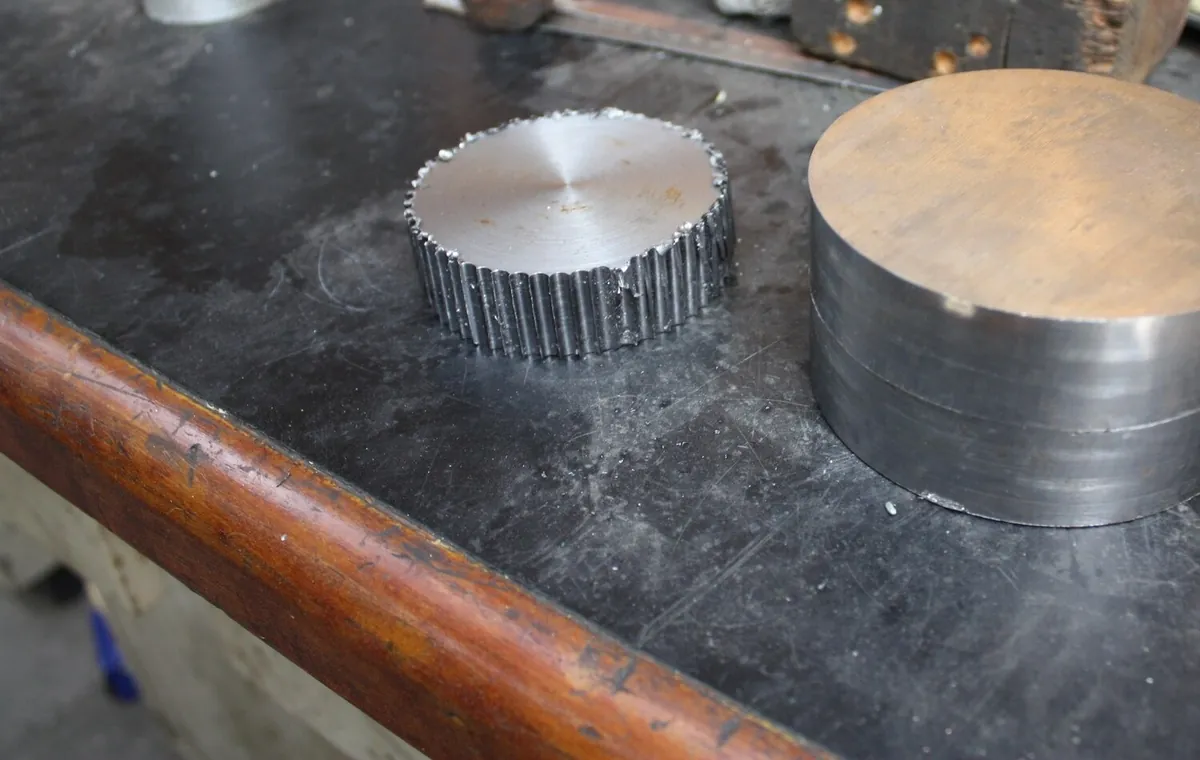
ASTM B247 calls it a hand forging: a forging shaped between flat or simple dies without a part-shaped cavity. A forged block is upset (compressed along its length), turned, and drawn out again several times, so that the cast structure of the ingot is broken down and the metal is worked in every direction. The result is a rectangular block, often called a forged billet or forged slab, from which a large or thick part is machined.
Why not simply use thick plate? Rolling squeezes metal mainly from the two broad faces. In very thick plate the centre receives the least work, so shrinkage porosity from the ingot can be stretched rather than closed, and properties in the short-transverse (through-thickness) direction are the weakest in the plate. Open-die forging compresses the block from several sides, closing centre porosity and spreading the work more evenly. Forged blocks are therefore specified for thick, highly stressed parts such as aircraft bulkhead fittings, landing-gear and wing-attachment fittings, and heavy machine and mould components loaded through their thickness.
Forged blocks also allow sizes that no plate mill can roll: very thick sections, square cross-sections, and blocks whose length, width and height are similar. For moderate thickness and ordinary loads, however, rolled plate or cast tooling plate is cheaper and has a better surface and thickness tolerance, so a forging should be chosen for a reason, not by default.
| Alloy | Forging tempers | Character | Typical uses |
|---|---|---|---|
| 6061 | T6, T652 | Medium strength, excellent corrosion resistance, machines and anodises well | Machine bases, vacuum chambers, mould frames, housings |
| 6082 | T6, T652 | Similar to 6061, stronger in thick sections; the European standard choice | Structural nodes, lifting gear, rail and offshore parts |
| 2014 | T6, T652 | High strength and hardness; needs corrosion protection | Heavily loaded fittings, aircraft and truck parts |
| 2219 | T6, T852 | Good strength at elevated and cryogenic temperatures; weldable | Space and cryogenic structures |
| 7075 | T6, T652, T73, T7352 | Very high strength; T73 tempers resist stress corrosion | Aerospace fittings, defence parts, high-load tooling |
| 7050 | T74, T7452 | High strength through thick sections with good toughness and stress-corrosion resistance | Thick aerospace bulkheads and frames |
| 5083 | O, H111, H112 | Non-heat-treatable; excellent in seawater and at cryogenic temperatures | Marine and LNG components |
Note the temper designations: the "51" suffix used for plate (T651, T7451) means stress relief by stretching, which is not possible on a forged block. Forgings are stress relieved by a controlled cold compression of 1 – 5 %, shown by the suffix "52" (T652, T7352, T7452). If a drawing calls for 7075-T651 or 2024-T351 and you want a forging, ask your engineer to approve the equivalent forging temper.
Values below are typical room-temperature properties of the alloy and temper. Specified minimums for hand forgings in ASTM B247 and EN 586-2 depend on the cross-sectional thickness and the test direction: longitudinal values are highest, long-transverse slightly lower and short-transverse lowest. Thicker blocks have lower minimums because the centre cools more slowly when quenched.
| Alloy / temper | Typical tensile | Typical yield (0.2 %) | Elongation | Brinell hardness |
|---|---|---|---|---|
| 6061-T6 / T652 | 310 MPa / 45 ksi | 275 MPa / 40 ksi | 12 % | 95 HB |
| 6082-T6 / T652 | 310 MPa / 45 ksi | 260 MPa / 38 ksi | 10 % | ≈ 95 HB |
| 2014-T6 / T652 | 485 MPa / 70 ksi | 415 MPa / 60 ksi | 13 % | 135 HB |
| 7075-T6 / T652 | 570 MPa / 83 ksi | 505 MPa / 73 ksi | 11 % | 150 HB |
| 7075-T73 / T7352 | 505 MPa / 73 ksi | 435 MPa / 63 ksi | 13 % | ≈ 135 HB |
| 5083-H112 | ≈ 290 MPa / 42 ksi | ≈ 145 MPa / 21 ksi | ≈ 20 % | ≈ 75 HB |
Typical values from Aluminum Association and ASM data; ≈ marks approximate values. They are not design minimums. The EN 10204 3.1 certificate reports tested results for each heat-treatment lot and direction.
Final sizes are confirmed against the drawing, the alloy and the inspection class.
Weight of a block is its volume multiplied by density: about 2.70 g/cm³ for 6061 and 6082, 2.80 g/cm³ for 2014 and 7075, and 2.83 g/cm³ for 7050. A 500 × 300 × 200 mm block of 6061 weighs about 81 kg; the same block in 7075 about 84 kg. Remember to add the forging allowance when estimating the as-delivered weight.
| Criterion | Forged block (hand forging) | Thick rolled plate (T651) | Cast tooling plate |
|---|---|---|---|
| Internal soundness | Highest; centre porosity closed | Good; centre of very thick plate is weakest | Fine porosity possible; adequate for tooling |
| Short-transverse properties | Good | Lowest of the three directions | Low strength in all directions |
| Available thickness | Very thick and near-cubic shapes | Limited by mill (very thick plate is scarce) | Up to large thicknesses |
| Flatness and stability | Good after T652 stress relief | Very good (stretched) | Excellent; very stable when machined |
| Surface and tolerance | Rough; machining allowance needed | Good; tight thickness tolerance | Precision-milled faces available |
| Cost and lead time | Highest | Moderate | Moderate |
| Best for | Highly stressed, thick, fatigue-critical parts | General structural and machined parts | Fixtures, jigs, tooling plates, vacuum chucks |
For fixtures, machine bases and plates where flatness rather than strength is the priority, consider our aluminium block range or a cast tooling plate. For aerospace parts machined from thick sections, compare a forged block with 7050 plate and forged plate.
Bulkhead, frame and wing-attachment fittings, landing-gear and engine-mount brackets machined from 7050-T7452 or 7075-T7352 blocks.
Launcher and turret components, armour-system brackets and equipment bases where shock and fatigue loads are high.
Large blow-moulding and rubber moulds, and press tooling, where a sound block avoids porosity breaking out on cavity surfaces.
Hydraulic manifolds, robot-arm nodes, gantry joints and spindle housings loaded in several directions.
Thick 6061 chamber bodies, where internal soundness reduces the risk of leak paths through the wall.
5083 and 6061 blocks for deck-equipment bases, cryogenic valve bodies and LNG-system components.
For thick, highly stressed parts, usually yes: open-die forging closes centre porosity and gives better short-transverse properties. For moderate thickness and ordinary loads, rolled plate is cheaper and has a better surface and thickness tolerance.
T652 is solution heat treated, stress relieved by cold compression of about 1 – 5 %, then artificially aged. It is the forging equivalent of T651 plate, which is stress relieved by stretching. T7352 and T7452 are the over-aged 7xxx equivalents.
T651 is a plate and bar temper. For a forging, the equivalent is 7075-T652 for maximum strength or 7075-T7352 for stress-corrosion resistance. Ask your design authority to approve the forging temper.
Class A or AA to AMS-STD-2154 is usual for aerospace and other fatigue-critical parts; class B suits general engineering. Tighter classes cost more and require a rough-machined sonic shape.
Multiply volume by density: about 2.70 g/cm³ for 6061 and 2.80 g/cm³ for 7075. A 500 × 300 × 200 mm 6061 block weighs about 81 kg before machining allowance.
Yes. Blocks can be supplied as forged, rough machined for inspection, or CNC machined to your drawing, with dimensional reports and certificates.
Send the alloy, finished size, quantity and inspection class. Our team will confirm the forged size and quote a delivered price.






