2024-T351
Solution heat-treated, stress-relieved by stretching, naturally aged. The standard temper for cold-finished flat bar; stays stable during heavy machining.



2024 flat bar is a rectangular bar in the aluminium-copper-magnesium alloy, chosen when a part needs high strength and very good fatigue resistance at low weight. It is supplied mainly as cold-finished T351 or extruded T3511 bar for aircraft fittings, machined structural parts and high-load components. Metline supplies 2024 flat bar in T351, T3511, T4 and T851 to ASTM, AMS and EN standards, cut to length and shipped worldwide.
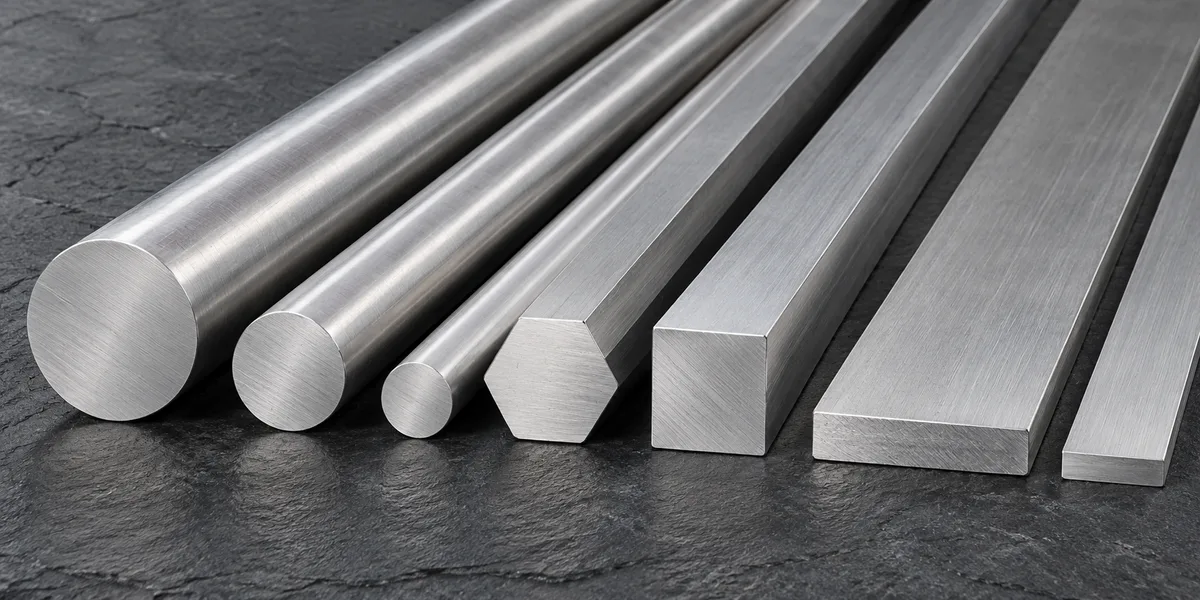
2024 was developed as an aircraft alloy and it still behaves like one: high static strength, excellent fatigue performance and good fracture toughness, but limited corrosion resistance and no practical fusion weldability.
The alloy contains about 4.4 % copper and 1.5 % magnesium. After solution heat treatment, these form fine precipitates that make 2024-T351 roughly 50 % stronger than 6061-T6 in tension, and noticeably better under repeated loading. That is why it is specified for parts that see cyclic stress: wing and fuselage fittings, brackets, hinges, actuator links, gears and bolted structural plates.
In flat bar form, two production routes dominate. Cold-finished bar (T351) is rolled or drawn, solution-treated and then stretched 1 – 3 % to relieve quenching stresses, giving close tolerances and good stability during machining. Extruded bar (T3511) is pushed through a die, solution-treated and stretched, then lightly straightened; it is available in wider and thicker rectangles and is usually the more economical choice for heavy sections.
| Element | Minimum | Maximum |
|---|---|---|
| Silicon (Si) | — | 0.50 |
| Iron (Fe) | — | 0.50 |
| Copper (Cu) | 3.8 | 4.9 |
| Manganese (Mn) | 0.30 | 0.9 |
| Magnesium (Mg) | 1.2 | 1.8 |
| Chromium (Cr) | — | 0.10 |
| Zinc (Zn) | — | 0.25 |
| Titanium (Ti) | — | 0.15 |
| Others, each / total | — | 0.05 / 0.15 |
| Aluminium (Al) | Remainder |
Aluminum Association registered limits, as used in ASTM B211, ASTM B221 and EN 573-3 (EN AW-2024 / EN AW-AlCu4Mg1).
| Temper | Tensile (typical) | Yield (typical) | Elongation (typical) | Hardness (typical) |
|---|---|---|---|---|
| O | 185 MPa | 75 MPa | 20 % | 47 HB |
| T4 / T351 | 470 MPa | 325 MPa | 19 – 20 % | 120 HB |
| T3511 (extruded) | About 460 – 480 MPa | About 320 – 340 MPa | 10 – 12 % | 120 HB |
| T851 | 485 MPa | 450 MPa | 6 % | 128 HB |
Typical values from Aluminum Association and ASM data for reference only. Specified minimums in ASTM B211, ASTM B221 and the AMS documents depend on temper and thickness band (extruded bar minimums rise with section thickness), and the 3.1 certificate shows the values for your lot.
Solution heat-treated, stress-relieved by stretching, naturally aged. The standard temper for cold-finished flat bar; stays stable during heavy machining.
The extruded equivalent: solution-treated, stretched and then minor straightening allowed. Common for wider and thicker rectangles.
Solution-treated and naturally aged without stretching. Higher residual stress, so less suited to deep machining but fine for small parts.
Stretched and artificially aged. Slightly higher yield and better resistance to stress corrosion and to intergranular attack, at the cost of elongation and toughness.
For most machined flat-bar parts, T351 or T3511 is the right default. Choose T851 when the part will be exposed to elevated temperatures (above about 120 °C) for long periods, where naturally aged tempers continue to change, or when stress corrosion resistance matters more than toughness.
| System | Designation | Product standard |
|---|---|---|
| Aluminum Association / ASTM | 2024 | ASTM B211 (cold-finished bar), ASTM B221 (extruded bar) |
| UNS | A92024 | — |
| Aerospace (SAE AMS) | 2024-T351 / T3511 | AMS 4120, AMS-QQ-A-225/6 (cold-finished); AMS-QQ-A-200/3 (extruded) |
| European (EN) | EN AW-2024 / EN AW-AlCu4Mg1 | EN 754 (drawn bar), EN 755 (extruded bar), EN 573-3 |
| German Werkstoff | 3.1355 | DIN EN 754 / 755 |
| ISO | AlCu4Mg1 | ISO 6362 |
| Japan (JIS) | A2024 | JIS H4040 |
| China (GB) | 2024 (2A12 is a close national grade) | GB/T 3191 |
Aerospace buyers usually order to an AMS number rather than an ASTM one, because AMS documents add requirements for testing, traceability and grain structure. If your drawing calls out a specification, give us the exact number and revision.
Weight per metre = thickness (mm) × width (mm) × 0.00278. Typical sizes:
| Thickness × width (mm) | kg per metre | kg per 3 m bar | kg per 3.66 m (12 ft) bar |
|---|---|---|---|
| 6 × 25 | 0.42 | 1.25 | 1.5 |
| 10 × 50 | 1.39 | 4.17 | 5.1 |
| 12 × 75 | 2.50 | 7.51 | 9.2 |
| 20 × 100 | 5.56 | 16.68 | 20.3 |
| 25 × 150 | 10.43 | 31.28 | 38.2 |
| 40 × 200 | 22.24 | 66.72 | 81.4 |
| 50 × 250 | 34.75 | 104.25 | 127.2 |
Dimensional tolerances follow ANSI H35.2 when bar is ordered to ASTM B211 or B221, and EN 754-5 or EN 755-5 for rectangular bar in Europe. Cold-finished T351 bar holds tighter thickness and width tolerances than extruded T3511 bar, which matters if you plan to machine only some faces.
| Check | Method | Reported on |
|---|---|---|
| Chemistry | Spectrometer analysis of the cast | EN 10204 3.1 certificate |
| Tensile, yield, elongation | Per lot to ASTM B557 or EN ISO 6892-1 | EN 10204 3.1 certificate |
| Ultrasonic inspection | To AMS-STD-2154 or ASTM B594 where specified | UT report |
| Dimensions and straightness | Callipers, micrometers and straight-edge | Inspection report |
| Conductivity / hardness | Eddy-current or hardness test to confirm temper | On request |
Excellent in T351 and T851: short chips and a good surface with carbide or high-speed steel tools. Avoid O temper for machining; it is gummy.
2024 is not recommended for arc welding because it hot-cracks and loses strength. Use mechanical fastening, adhesive bonding or friction stir welding.
Form in O or freshly quenched (W) condition. T351 bar takes only gentle bends.
The copper content reduces corrosion resistance. Anodise (sulphuric or chromic), apply conversion coating and primer, or use alclad sheet where exposure is severe.
| Property | 6061-T6 | 2024-T351 | 2014-T6 | 7075-T651 |
|---|---|---|---|---|
| Typical tensile strength | 310 MPa | 470 MPa | 485 MPa | 570 MPa |
| Typical yield strength | 275 MPa | 325 MPa | 415 MPa | 505 MPa |
| Fatigue performance | Moderate | Very good | Good | Good |
| Corrosion resistance | Good | Fair | Fair | Fair |
| Arc weldability | Good | Poor | Poor | Poor |
Choose 7075 when static strength is the main requirement, 2024 when fatigue and damage tolerance govern the design, and 6061 when the part must be welded or exposed to weather without coating.
T351 is cold-finished (rolled or drawn) bar; T3511 is extruded bar. Both are solution-treated, stretched and naturally aged, but T3511 allows minor straightening after stretching and generally has wider dimensional tolerances.
Not with conventional MIG or TIG; the welds crack and lose most of their strength. Bolt, rivet or bond 2024 parts, or use friction stir welding.
Yes. Typical 2024-T351 tensile strength is about 470 MPa against 310 MPa for 6061-T6, and its fatigue strength is considerably higher.
7075 is stronger in static load. 2024 is preferred where fatigue and crack growth control the design, such as tension-loaded lower wing structure.
Usually, yes. Its copper content makes it vulnerable in moist or salty air, so parts are normally anodised or primed and painted.
Multiply thickness by width in millimetres and by 0.00278 to get kg per metre. A 20 × 100 mm bar weighs about 5.56 kg/m.
Send size, temper, length, quantity and specification. We will confirm availability and quote a delivered price.





