T6511
Solution treated, stretched 1 – 3 % and aged, with minor straightening allowed after stretching. The most common aerospace temper for 2014 extruded bar and shapes.



2014 extrusions combine high strength (about 480 MPa tensile in T6511) with very good machinability, making them a standard choice for machined aircraft fittings, stiffeners and links cut from extruded bar and profile. Metline supplies 2014 and 2014A extruded bars, standard shapes and custom profiles in T4, T6, T6510 and T6511 to AMS, ASTM and EN specifications, shipped worldwide with full certification.
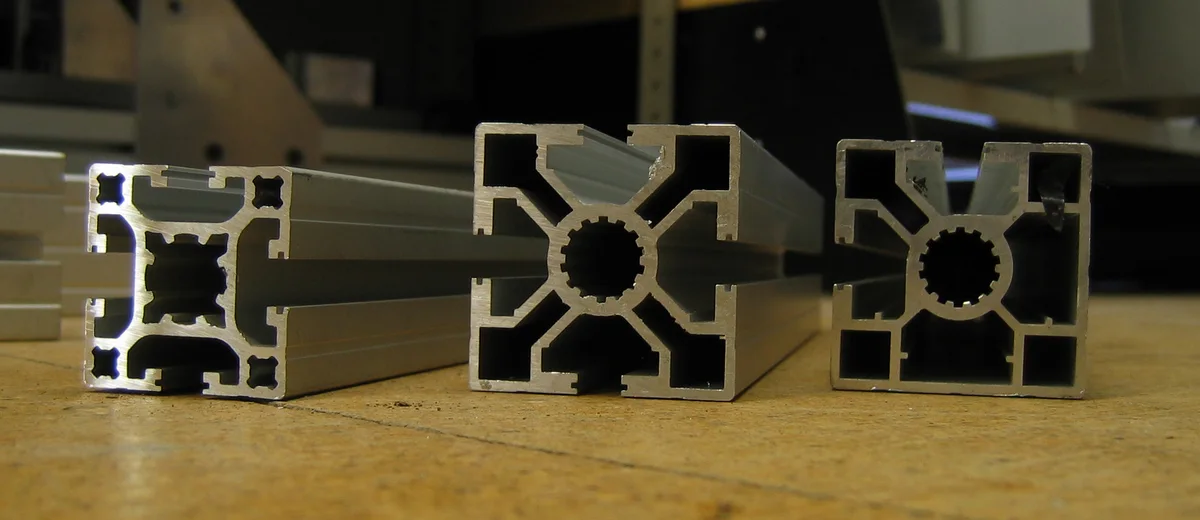
An extrusion is made by pushing a heated billet through a steel die, producing a long product with a constant cross-section. For 2014, extrusion is followed by solution heat treatment, quenching, stretching and ageing, which gives the T6510 or T6511 temper most aerospace drawings call for.
2014 is a hard alloy to extrude compared with 6061 or 6063, so press speeds are lower and very thin, complex hollow shapes are difficult. Solid shapes such as bars, angles, tees, zees, channels and I-sections are common, as are thick-walled tubes. Many aerospace parts are simply machined from extruded rectangular or round bar, because the extrusion gives a fine, directional grain structure and good longitudinal properties at a lower cost than forgings.
The alloy offers higher yield strength than 2024-T3511 extrusions and machines faster, but it has lower fatigue and corrosion performance. It is therefore used for fittings, brackets, links and stiffeners that are protected by surface treatment, while 2024 and 7075 extrusions are used for stringers, spar caps and highly loaded members.
| Element | 2014 (AA / ASTM) | 2014A (EN AW-2014A) | Role |
|---|---|---|---|
| Copper (Cu) | 3.9 – 5.0 | 3.9 – 5.0 | Main strengthening element (Al2Cu precipitates) |
| Silicon (Si) | 0.50 – 1.2 | 0.50 – 0.9 | Speeds the ageing response; the "Si" in AlCu4SiMg |
| Manganese (Mn) | 0.40 – 1.2 | 0.40 – 1.2 | Grain control and toughness |
| Magnesium (Mg) | 0.20 – 0.8 | 0.20 – 0.8 | Adds to precipitation hardening |
| Iron (Fe) | 0.7 max | 0.50 max | Impurity; lower Fe improves toughness |
| Chromium (Cr) | 0.10 max | 0.10 max | Impurity |
| Nickel (Ni) | — | 0.10 max | Impurity |
| Zinc (Zn) | 0.25 max | 0.25 max | Impurity |
| Titanium (Ti) | 0.15 max | 0.15 max (Ti + Zr 0.20) | Grain refiner |
| Others, each / total | 0.05 / 0.15 | 0.05 / 0.15 | |
| Aluminium (Al) | Remainder | Remainder |
ASTM B221 sets minimum properties for 2014 extrusions that rise with section size, because thicker extrusions of this alloy develop a stronger, unrecrystallised core. Typical values are shown in the second table.
| Temper and wall / diameter (ASTM B221) | Min. tensile strength | Min. yield strength | Min. elongation |
|---|---|---|---|
| T4, T4510, T4511 – all sizes | 345 MPa / 50 ksi | 240 MPa / 35 ksi | 12 % |
| T6, T6510, T6511 – up to 12.5 mm | 415 MPa / 60 ksi | 365 MPa / 53 ksi | 7 % |
| T6, T6510, T6511 – 12.5 to 19 mm | 440 MPa / 64 ksi | 400 MPa / 58 ksi | 7 % |
| T6, T6510, T6511 – 19 mm and over (area to 160 cm²) | 470 MPa / 68 ksi | 415 MPa / 60 ksi | 7 % |
| Temper | Tensile strength | Yield strength (0.2 %) | Elongation | Brinell hardness |
|---|---|---|---|---|
| O (annealed) | 186 MPa / 27 ksi | 97 MPa / 14 ksi | 18 % | 45 HB |
| T4, T451 | 427 MPa / 62 ksi | 290 MPa / 42 ksi | 20 % | 105 HB |
| T6, T651, T6511 | 483 MPa / 70 ksi | 414 MPa / 60 ksi | 13 % | 135 HB |
Minimums summarised from ASTM B221; AMS 4153 and EN 755-2 have their own tables. Always confirm against the certificate for your section.
Solution treated, stretched 1 – 3 % and aged, with minor straightening allowed after stretching. The most common aerospace temper for 2014 extruded bar and shapes.
As T6511 but with no straightening after stretching, so the section is as-stretched. Specified where the drawing forbids post-stretch straightening.
Solution treated and aged without stretching. Used for small sections and tube where residual stress is less important.
Naturally aged, more ductile. Suitable for parts that are formed after extrusion and aged later.
Solution treated, cold worked and naturally aged; mainly for drawn products made from extruded stock.
Annealed or as-extruded stock for subsequent forging, forming or customer heat treatment.
| System | Designation | Note |
|---|---|---|
| Aluminum Association / UNS | 2014 / A92014 | Basis of ASTM and AMS specifications |
| European (EN) | EN AW-2014 (AlCu4SiMg); EN AW-2014A (AlCu4SiMg(A)) | 2014A has tighter Si and Fe limits |
| German Werkstoff | 3.1255 | AlCuSiMn in older DIN usage |
| ISO | AlCu4SiMg | ISO 209 |
| Japan (JIS) | A2014 | JIS H4000 / H4040 / H4140 |
| France (old NF) | AU4SG | Still seen on older drawings |
| China (GB) | 2A14 (close equivalent) | Similar chemistry; check limits before substituting |
| Product | Typical size range | Notes |
|---|---|---|
| Round bar | about 6 – 250 mm diameter | Machining stock for pins, links, fittings |
| Rectangular and square bar | about 6 mm thick up to 150 mm; widths to about 300 mm | Machined fittings and blocks |
| Hexagon bar | about 6 – 75 mm across flats | Nuts, couplings, screw-machine parts |
| Angles, tees, zees, channels | Legs from about 20 to 150 mm, walls from about 2 mm | Stiffeners, frames, brackets |
| Extruded tube | Thick-walled, ODs to about 250 mm | See the 2014 tube page for drawn tube |
| Custom profiles | To customer drawing, subject to die and press review | Solid shapes preferred |
Standard lengths are 3 – 6 m, with cut lengths available. Dimensional tolerances follow ANSI H35.2 for ASTM and AMS orders and EN 755-9 for profiles on EN orders.
Excellent in T6511: fast feeds, bright finish, small broken chips. Stretched tempers stay straight as material is removed.
Mechanical fasteners or adhesive bonding. Fusion welding is not recommended; friction-stir welding is possible with qualification.
Sulphuric, boric-sulphuric or hard anodising, conversion coatings and aerospace primers. Protect every machined surface.
Limited in T6; form in O, T4 or freshly quenched condition, then age.
Extrusions have best properties along the length. Check transverse properties for fittings loaded across the section.
Keep long-term service below about 120 – 150 °C to avoid over-ageing.
| Property | 2014-T6511 | 2024-T3511 | 7075-T6511 |
|---|---|---|---|
| Typical tensile strength | ~483 MPa | ~483 MPa | ~572 MPa |
| Typical yield strength | ~414 MPa | ~345 – 360 MPa | ~503 MPa |
| Fatigue performance | Fair | Very good | Fair |
| Stress-corrosion resistance | Low | Low–moderate | Low (T6); high in T73511 |
| Machinability | Excellent | Good | Excellent |
Both are solution treated, stretched and aged. T6510 receives no straightening after stretching; T6511 may be lightly straightened to meet straightness tolerances. Mechanical properties are the same.
Thicker extrusions keep a fibrous, unrecrystallised core with higher strength along the extrusion direction. ASTM B221 therefore lists higher minimums for sections of 12.5 mm and above.
They are difficult. 2014 is a hard alloy to extrude, so solid shapes and thick-walled tube are preferred. For thin hollow profiles, consider 6061 or 6082 if the strength allows.
No, not by fusion welding for structural parts. Use mechanical fastening or bonding.
Tensile strength is similar, but 2014-T6511 has higher yield strength. 2024 is better in fatigue and is preferred for tension members.
Send the section, temper, specification and quantity. We will confirm availability, testing and delivery.





