O (annealed)
Softest condition for stretch forming, deep drawing and tight bends. The formed part is then solution treated and aged to T4 or T6.



2014 sheet and plate gives the highest strength of the common 2xxx rolled products: about 480 MPa tensile and 410 MPa yield in T6 and T651. It is used for machined fittings, frames and heavy-duty structure where strength and machinability matter more than corrosion resistance. Metline supplies bare and Alclad 2014 and 2014A sheet and plate, certified to AMS, ASTM and EN standards, to customers worldwide.
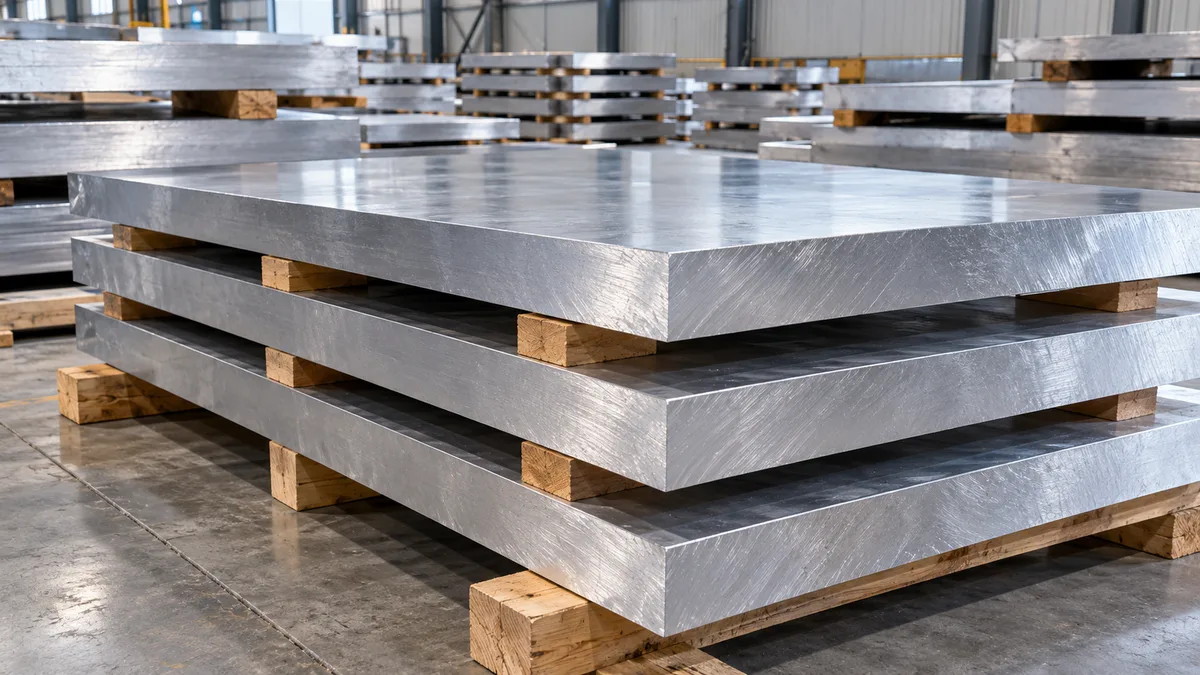
2014 is an aluminium-copper-silicon-magnesium alloy (AlCu4SiMg). In sheet and plate form it is chosen when a part needs higher yield strength than 2024 can give, and when the part will be machined or formed and then protected by cladding, anodising or paint.
Two families of product are supplied. Bare 2014 plate in T651 is the machining grade: it is stretched after quenching so it stays flat as material is removed, and it is cut into fittings, frames, ribs and test hardware. Alclad 2014 sheet carries a thin layer of 6003 aluminium alloy on each face; the cladding is anodic to the core and corrodes sacrificially, protecting the 2014 underneath. Alclad sheet is used for formed skins and panels where the surface stays exposed.
2014A is the European version of the alloy, with tighter silicon and iron limits. It is called up in European aerospace standards and British "L" specifications, while US programmes use 2014 to SAE AMS and ASTM documents. For most designs the two are interchangeable only with the approval of the design authority, so always order the designation shown on your drawing.
The table gives registered limits. Alclad 2014 has a 2014 core with 6003 cladding on both sides; the certificate reports the core chemistry.
| Element | 2014 (AA / ASTM) | 2014A (EN AW-2014A) | Role |
|---|---|---|---|
| Copper (Cu) | 3.9 – 5.0 | 3.9 – 5.0 | Main strengthening element (Al2Cu precipitates) |
| Silicon (Si) | 0.50 – 1.2 | 0.50 – 0.9 | Speeds the ageing response; the "Si" in AlCu4SiMg |
| Manganese (Mn) | 0.40 – 1.2 | 0.40 – 1.2 | Grain control and toughness |
| Magnesium (Mg) | 0.20 – 0.8 | 0.20 – 0.8 | Adds to precipitation hardening |
| Iron (Fe) | 0.7 max | 0.50 max | Impurity; lower Fe improves toughness |
| Chromium (Cr) | 0.10 max | 0.10 max | Impurity |
| Nickel (Ni) | — | 0.10 max | Impurity |
| Zinc (Zn) | 0.25 max | 0.25 max | Impurity |
| Titanium (Ti) | 0.15 max | 0.15 max (Ti + Zr 0.20) | Grain refiner |
| Others, each / total | 0.05 / 0.15 | 0.05 / 0.15 | |
| Aluminium (Al) | Remainder | Remainder |
Typical values describe what the material normally achieves. Specified minimums are what the standard guarantees; they fall slightly as plate thickness rises and are lower for Alclad sheet, because the soft cladding carries little load.
| Temper | Tensile strength | Yield strength (0.2 %) | Elongation | Brinell hardness |
|---|---|---|---|---|
| O (annealed) | 186 MPa / 27 ksi | 97 MPa / 14 ksi | 18 % | 45 HB |
| T4, T451 | 427 MPa / 62 ksi | 290 MPa / 42 ksi | 20 % | 105 HB |
| T6, T651, T6511 | 483 MPa / 70 ksi | 414 MPa / 60 ksi | 13 % | 135 HB |
| Product (ASTM B209, approximate minimums) | Tensile strength | Yield strength | Elongation |
|---|---|---|---|
| 2014-T4 bare sheet | ~400 MPa / 58 ksi | ~250 MPa / 36 ksi | 14 % |
| 2014-T6 bare sheet, 1 – 6 mm | ~455 MPa / 66 ksi | ~400 MPa / 58 ksi | 6 – 7 % |
| Alclad 2014-T6 sheet, 1 – 6 mm | ~440 MPa / 64 ksi | ~395 MPa / 57 ksi | 7 – 8 % |
| 2014-T651 plate, 6 – 50 mm | ~450 – 460 MPa | ~405 MPa | 4 – 7 % |
Minimums vary by thickness band; the governing values are those in the order specification and on the mill certificate.
Softest condition for stretch forming, deep drawing and tight bends. The formed part is then solution treated and aged to T4 or T6.
Solution treated and naturally aged. Good formability with useful strength; T451 plate is stretched to relieve stress. Often formed in T4 and aged to T6 (T62) afterwards.
Solution treated and artificially aged for full strength. The usual temper for sheet in finished structure.
Solution treated, stretched 1.5 – 3 % and aged. The standard plate temper for machined parts, because residual stresses are low.
Aged to T6 by the user after heat treatment from O or F. Specify T62 properties when you heat-treat parts yourself.
Alclad 2014 is supplied in O, T3, T4 and T6; the core is heat-treated in the same way as bare material.
| System | Designation | Note |
|---|---|---|
| Aluminum Association / UNS | 2014 / A92014 | Basis of ASTM and AMS specifications |
| European (EN) | EN AW-2014 (AlCu4SiMg); EN AW-2014A (AlCu4SiMg(A)) | 2014A has tighter Si and Fe limits |
| German Werkstoff | 3.1255 | AlCuSiMn in older DIN usage |
| ISO | AlCu4SiMg | ISO 209 |
| Japan (JIS) | A2014 | JIS H4000 / H4040 / H4140 |
| France (old NF) | AU4SG | Still seen on older drawings |
| China (GB) | 2A14 (close equivalent) | Similar chemistry; check limits before substituting |
2014 weighs 2.80 kg per square metre per millimetre of thickness, about 4 % more than 6061. The plate weight calculator handles any size.
| Thickness (mm) | kg per m² | 1220 × 2440 mm (kg) | 1500 × 3000 mm (kg) |
|---|---|---|---|
| 0.8 | 2.24 | 6.7 | 10.1 |
| 1 | 2.80 | 8.3 | 12.6 |
| 1.6 | 4.48 | 13.3 | 20.2 |
| 2 | 5.60 | 16.7 | 25.2 |
| 3 | 8.40 | 25.0 | 37.8 |
| 4 | 11.20 | 33.3 | 50.4 |
| 6 | 16.80 | 50.0 | 75.6 |
| 10 | 28.00 | 83.4 | 126.0 |
| 12 | 33.60 | 100.0 | 151.2 |
| 16 | 44.80 | 133.4 | 201.6 |
| 20 | 56.00 | 166.7 | 252.0 |
| 25 | 70.00 | 208.4 | 315.0 |
| 30 | 84.00 | 250.1 | 378.0 |
| 40 | 112.00 | 333.4 | 504.0 |
| 50 | 140.00 | 416.8 | 630.0 |
| 60 | 168.00 | 500.1 | 756.0 |
| 80 | 224.00 | 666.8 | 1008.0 |
| 100 | 280.00 | 833.5 | 1260.0 |
Dimensional tolerances follow ANSI H35.2 for ASTM and AMS orders and EN 485-3/-4 for EN orders. Aerospace plate is commonly ultrasonically inspected to AMS-STD-2154 or ASTM B594, with the class stated on the order. Each lot is tested for tensile properties in the directions the specification requires, and electrical conductivity and hardness are used to confirm correct heat treatment.
T651 machines cleanly with short chips. Remove material evenly from both faces of thick plate and keep coolant flowing to control heat.
Form in O or freshly quenched (W) condition, then age. T6 sheet tolerates only generous bend radii, typically 3 – 6 × thickness depending on gauge.
Riveting, bolting and adhesive bonding are standard. Fusion welding is avoided because of hot cracking and strength loss.
Anodise or conversion-coat and prime all bare surfaces after machining. Alclad sheet protects itself unless the cladding is machined away.
Do not hold 2014 above about 150 °C for long periods; over-ageing reduces strength.
Check formed parts for orange peel and cracking at bends, and confirm properties after re-heat treatment.
| Property | 2014-T651 | 2024-T351 | 7075-T651 |
|---|---|---|---|
| Typical tensile strength | ~483 MPa | ~469 MPa | ~572 MPa |
| Typical yield strength | ~414 MPa | ~324 MPa | ~503 MPa |
| Fatigue crack growth resistance | Fair | Very good | Fair |
| Fracture toughness | Moderate | Good | Moderate |
| Corrosion resistance (bare) | Low | Low | Low–moderate |
| Typical use | Fittings, frames | Tension skins, damage-tolerant parts | Highly stressed machined parts |
Choose 2024-T351 for tension-loaded, fatigue-critical structure and 7075-T651 or 7050-T7451 for the highest strength. 2014-T651 sits between them, giving high yield strength with excellent machinability.
Alclad 2014 is 2014 sheet or plate with a thin metallurgically bonded layer of 6003 alloy on each face. The cladding corrodes in preference to the core, protecting it. It slightly lowers strength, so Alclad minimums are a little below bare values.
Yes in yield strength: about 414 MPa against about 324 MPa typical. 2024-T351 has better fatigue crack-growth resistance and toughness, so it is preferred for tension skins and damage-tolerant parts.
Only with generous bend radii. For tight forming, use O or T4 temper, or form immediately after quenching, and then age the part to T6 (reported as T62).
2014A has tighter limits on silicon and iron and is the designation used in European standards. Mechanical properties are similar, but substitution needs approval from the design authority.
Yes. Bare 2014 has low corrosion resistance. Anodise or conversion-coat and paint after machining, or use Alclad sheet for exposed formed parts.
An EN 10204 3.1 mill test certificate with chemistry and mechanical results for the lot, plus ultrasonic and dimensional reports when the order specifies them.
Tell us the temper, thickness, size, specification and quantity. We will reply with availability, certification and a delivered price.





