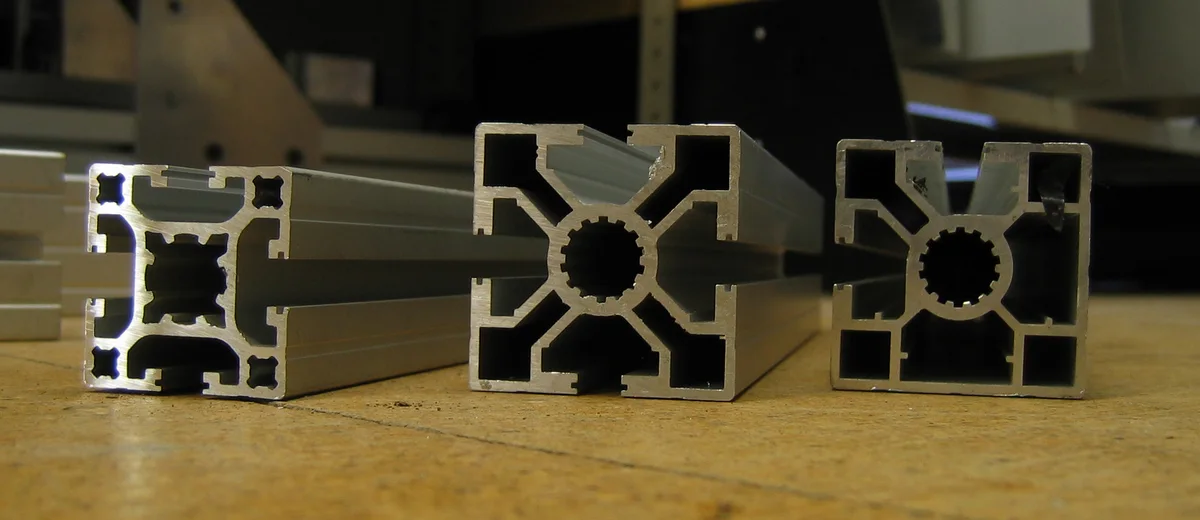
Extruded round, square & hex bar
Stretched T3511 or T8511 bar for machined fittings, bosses and brackets. Diameters from about 10 mm to 250 mm depending on press size.



2219 is the aluminium-copper alloy aerospace engineers choose when an extruded part must be welded, must hold its strength at up to about 300 °C, or must stay tough at cryogenic temperatures. Metline supplies 2219 bars, rods, tubes and profiles in T3511 (AMS 4163) and T8511 (AMS 4162) with mill certification, shipped worldwide from Mumbai.
2219 carries about 6.3 % copper, far more than 2024 or 2014, together with small additions of manganese, zirconium, vanadium and titanium. The copper produces a dense population of strengthening precipitates that stay stable when the metal is warm, while zirconium and vanadium hold a fine grain structure through extrusion and heat treatment.
Three properties set it apart from other high-strength aluminium. First, it is one of the few 2xxx alloys that can be fusion welded with sound, crack-free joints, using the matching 2319 filler. Second, it keeps a useful share of its room-temperature strength after long exposure at 150 – 300 °C, where 7xxx alloys over-age quickly. Third, its strength and toughness actually rise as temperature falls, which is why it has been used for decades in welded tanks for liquid oxygen and liquid hydrogen.
The price of these advantages is modest room-temperature strength compared with 7075 or 7050, a slightly higher density (2.84 g/cm³) and poor resistance to corrosion if left unprotected. In an airframe or launch vehicle, 2219 extrusions are therefore used where welding, heat or cold matter more than ultimate strength: stiffeners and rings for welded tanks, engine-bay structure, frames near hot zones, and supersonic airframe members.
Limits are the registered Aluminum Association values that AMS 4162, AMS 4163 and ASTM B221 apply. The old practice of listing "zinc" twice on some data sheets is an error: the 0.10 – 0.25 % element is zirconium.
| Element | Limit | Function |
|---|---|---|
| Copper (Cu) | 5.8 – 6.8 | Main strengthening element; source of elevated-temperature strength |
| Manganese (Mn) | 0.20 – 0.40 | Forms dispersoids that raise strength and control grain |
| Zirconium (Zr) | 0.10 – 0.25 | Inhibits recrystallisation; refines weld-zone grain |
| Vanadium (V) | 0.05 – 0.15 | Improves strength retention at temperature |
| Titanium (Ti) | 0.02 – 0.10 | Grain refiner |
| Silicon (Si) | 0.20 max | Impurity |
| Iron (Fe) | 0.30 max | Impurity; limited for toughness |
| Magnesium (Mg) | 0.02 max | Kept very low to avoid weld cracking |
| Zinc (Zn) | 0.10 max | Impurity |
| Others each / total | 0.05 / 0.15 | |
| Aluminium | Remainder |
The two aerospace tempers behave very differently. T3511 is solution heat-treated, stretched and naturally aged; it is the softer, more ductile condition, often bought by fabricators who will form the section and then age it themselves. T8511 is stretched and then artificially aged, which roughly adds a third to the yield strength and gives the stable structure needed for elevated-temperature service.
| Temper | Tensile strength | Yield strength (0.2 %) | Elongation | Basis |
|---|---|---|---|---|
| T3511 | ≈ 290 MPa / 42 ksi | ≈ 180 MPa / 26 ksi | ≈ 12 – 14 % | Specified minimum, typical section |
| T8511 | ≈ 400 MPa / 58 ksi | ≈ 290 MPa / 42 ksi | ≈ 6 % | Specified minimum, typical section |
| T81 / T851 (wrought, typical) | 455 MPa / 66 ksi | 350 MPa / 51 ksi | 10 % | Typical value |
| O (annealed) | ≤ 220 MPa | — | ≈ 12 – 18 % | For forming before heat treatment |
Minimums vary with section thickness and area; the governing values are those in AMS 4162 (T8511), AMS 4163 (T3511) or ASTM B221 for your size, and they are reported on the mill certificate. Older data sheets that show identical figures for T3511 and T8511 are wrong.
| System | Designation / document | Covers |
|---|---|---|
| SAE AMS | AMS 4162 | 2219-T8511 extrusions: solution treated, stretched, straightened and precipitation heat-treated |
| SAE AMS | AMS 4163 | 2219-T3511 extrusions: solution treated, stretched and straightened |
| ASTM | ASTM B221 | Commercial and general aerospace extruded bar, rod, wire, profile and tube |
| Inspection | AMS-STD-2154 / ASTM B594 | Ultrasonic inspection of wrought products when ordered |
| UNS | A92219 | — |
| European | EN AW-2219 (AlCu6Mn) | EN 573-3 composition |
| China (GB) | 2219; 2A16 is the close Chinese counterpart | GB/T 3190 |
AMS 4163 covers extruded bars, rods, wire, profiles and tubing up to about 76 mm (2.999 in) thick and 161 cm² (25 in²) in cross-section; larger sections are normally ordered against ASTM B221 with supplementary requirements. Always confirm the current revision letter required by your customer or quality plan, because AMS documents are revised every few years.
Stretched T3511 or T8511 bar for machined fittings, bosses and brackets. Diameters from about 10 mm to 250 mm depending on press size.
Stock for stiffeners, rings and machined frame members. Supplied straightened to ASTM B221 / AMS tolerances.
Standard aerospace stiffener sections for welded tank and fuselage stringers.
Sections to your drawing, extruded through qualified mill partners after die design review.
Round seamless or porthole tube for ducts and structural members; see our 2219 tube page for drawn sizes.
Mill lengths of about 3.7 – 7.3 m (12 – 24 ft), or saw-cut blanks to your list.
Achievable sizes depend on the section shape, the press and the temper; we confirm feasibility against your drawing.
GTAW (TIG), GMAW (MIG), plasma, electron-beam and friction-stir welding are all used. Fusion welds use 2319 filler, which matches the base chemistry and adds titanium to refine weld grain. Welding in T8511 and leaving the assembly as welded is common; the heat-affected zone softens, so allowable stresses are reduced locally.
2219 was one of the first alloys welded by FSW in launch-vehicle tank production, because the solid-state process avoids porosity and keeps more joint strength than fusion welding.
Good in T8511: chips break cleanly and surface finish is fine with sharp carbide tooling. T3511 is gummier. Stretched tempers stay straight when material is removed asymmetrically.
Form in O or freshly quenched condition, then age to T62 or T81. Bending fully aged T8511 sections needs generous radii.
Like other high-copper alloys, 2219 needs protection: chromic or sulphuric acid anodising, chemical conversion coating and primer, or paint systems to your process specification.
Solution treatment is around 530 – 540 °C followed by a fast quench; artificial ageing around 175 – 190 °C produces the T8 tempers. Follow AMS 2770 or your approved heat-treat specification.
A typical welded tank build uses T8511 extruded stiffeners friction-stir welded to 2219 plate, with 2319 filler used for any fusion repairs, then a conversion coating and primer before final assembly.
| Property | 2219-T8511 | 2024-T3511 | 2014-T6511 | 7075-T73511 |
|---|---|---|---|---|
| Room-temperature strength | Medium–high | High | High | Very high |
| Fusion weldability | Good (2319 filler) | Poor | Limited | Poor |
| Strength at 150 – 250 °C | Best of the group | Fair | Fair | Poor |
| Cryogenic toughness | Excellent | Good | Good | Good |
| Corrosion resistance (bare) | Low | Low | Low | Medium (T73) |
| Density (g/cm³) | 2.84 | 2.78 | 2.80 | 2.81 |
If the part is not welded and runs cool, 2024 or 7075 extrusions give more strength for less weight. Choose 2219 when the design is driven by welding, temperature or cryogenic toughness. For engine parts above 200 °C that are not welded, 2618 is the main alternative.
Both are solution heat-treated, stretched to relieve quench stress and straightened. T3511 is then naturally aged and stays softer and more ductile; T8511 is artificially aged for higher yield strength and a stable structure at elevated temperature. AMS 4163 covers T3511 and AMS 4162 covers T8511.
Yes. 2219 is one of the most weldable 2xxx alloys. Use 2319 filler for TIG or MIG welding; friction-stir welding is also widely used. The heat-affected zone loses some strength, so designs use reduced allowables at welds or re-heat-treat the assembly.
It keeps useful strength for long exposures up to roughly 250 – 300 °C, better than 2024 and much better than 7xxx alloys. It also performs very well at cryogenic temperatures.
Yes. The high copper content makes bare 2219 susceptible to corrosion, so aerospace parts are anodised or conversion coated and painted to the programme process specification.
About 2.84 g/cm³, slightly heavier than 2024 (2.78) and 7075 (2.81), which is worth accounting for in weight-critical designs.
Yes. Metline ships 2219 extrusions worldwide with EN 10204 3.1 certificates, export packing and sea or air freight on EXW, FOB, CIF or DAP terms.
Send the section, temper, specification and quantity. We will confirm availability, inspection and a delivered price.





