T6511 / T6510
Extruded tube, solution treated, stretched and aged. Best for machined structural parts.



2014 tube is a high-strength aluminium-copper tube used where a hollow section must carry high loads: struts, actuator bodies, torque tubes and machined sleeves. In T6 and T6511 it reaches about 480 MPa tensile strength, well above 6061 tube. Metline supplies 2014 and 2014A seamless drawn and extruded tube, certified to ASTM, AMS and EN specifications, to aerospace and engineering buyers worldwide.
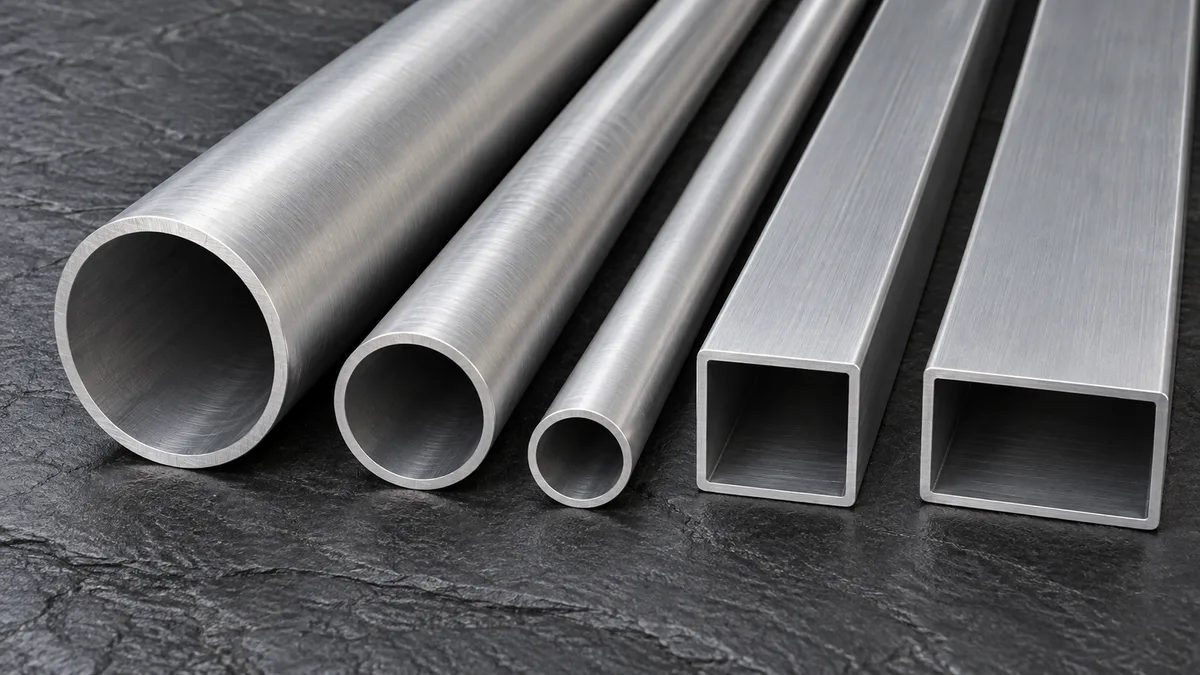
Aluminium alloy 2014 contains about 4.4 % copper with silicon, manganese and magnesium. In tube form it gives one of the highest strength-to-weight ratios available in a seamless aluminium hollow, which is why it is chosen for structural tubes and thick-walled sleeves rather than for fluid lines.
Two production routes are used. Extruded seamless tube is pierced or extruded over a mandrel from a hollow billet, then heat-treated, stretched and aged to T6510 or T6511; it covers larger diameters and heavy walls. Drawn seamless tube starts from extruded tube and is cold drawn through dies over a plug to closer tolerances and a finer surface, then heat-treated to T4 or T6.
Because 2014 has limited corrosion resistance and poor fusion weldability, it is rarely used for hydraulic or fuel lines, where 6061-T6, 2024-T3 (to AMS 4086/4088) or stainless steel are standard. Its strength makes it a good fit for machined structural tube: landing-gear and actuator parts, struts and links, where the tube is protected by anodising or paint.
| Element | 2014 (AA / ASTM) | 2014A (EN AW-2014A) | Role |
|---|---|---|---|
| Copper (Cu) | 3.9 – 5.0 | 3.9 – 5.0 | Main strengthening element (Al2Cu precipitates) |
| Silicon (Si) | 0.50 – 1.2 | 0.50 – 0.9 | Speeds the ageing response; the "Si" in AlCu4SiMg |
| Manganese (Mn) | 0.40 – 1.2 | 0.40 – 1.2 | Grain control and toughness |
| Magnesium (Mg) | 0.20 – 0.8 | 0.20 – 0.8 | Adds to precipitation hardening |
| Iron (Fe) | 0.7 max | 0.50 max | Impurity; lower Fe improves toughness |
| Chromium (Cr) | 0.10 max | 0.10 max | Impurity |
| Nickel (Ni) | — | 0.10 max | Impurity |
| Zinc (Zn) | 0.25 max | 0.25 max | Impurity |
| Titanium (Ti) | 0.15 max | 0.15 max (Ti + Zr 0.20) | Grain refiner |
| Others, each / total | 0.05 / 0.15 | 0.05 / 0.15 | |
| Aluminium (Al) | Remainder | Remainder |
| Temper | Tensile strength | Yield strength (0.2 %) | Elongation | Brinell hardness |
|---|---|---|---|---|
| O (annealed) | 186 MPa / 27 ksi | 97 MPa / 14 ksi | 18 % | 45 HB |
| T4, T451 | 427 MPa / 62 ksi | 290 MPa / 42 ksi | 20 % | 105 HB |
| T6, T651, T6511 | 483 MPa / 70 ksi | 414 MPa / 60 ksi | 13 % | 135 HB |
| Temper and wall / diameter (ASTM B221) | Min. tensile strength | Min. yield strength | Min. elongation |
|---|---|---|---|
| T4, T4510, T4511 – all sizes | 345 MPa / 50 ksi | 240 MPa / 35 ksi | 12 % |
| T6, T6510, T6511 – up to 12.5 mm | 415 MPa / 60 ksi | 365 MPa / 53 ksi | 7 % |
| T6, T6510, T6511 – 12.5 to 19 mm | 440 MPa / 64 ksi | 400 MPa / 58 ksi | 7 % |
| T6, T6510, T6511 – 19 mm and over (area to 160 cm²) | 470 MPa / 68 ksi | 415 MPa / 60 ksi | 7 % |
Extruded-tube minimums from ASTM B221 / B241; drawn tube to ASTM B210 has its own table by wall thickness. Confirm with the certificate.
Extruded tube, solution treated, stretched and aged. Best for machined structural parts.
Drawn or extruded tube aged to full strength without stretching. Common for drawn tube.
Naturally aged; better for bending, flaring and swaging, and can be aged to T6 afterwards.
Annealed tube for heavy forming before heat treatment.
| System | Designation | Note |
|---|---|---|
| Aluminum Association / UNS | 2014 / A92014 | Basis of ASTM and AMS specifications |
| European (EN) | EN AW-2014 (AlCu4SiMg); EN AW-2014A (AlCu4SiMg(A)) | 2014A has tighter Si and Fe limits |
| German Werkstoff | 3.1255 | AlCuSiMn in older DIN usage |
| ISO | AlCu4SiMg | ISO 209 |
| Japan (JIS) | A2014 | JIS H4000 / H4040 / H4140 |
| France (old NF) | AU4SG | Still seen on older drawings |
| China (GB) | 2A14 (close equivalent) | Similar chemistry; check limits before substituting |
Weight per metre of round tube is π × (OD − t) × t × 2.80 / 1000 kg, with OD and wall t in mm. The examples include common imperial aircraft-tube sizes converted to millimetres.
| OD × wall (mm) | ID (mm) | kg per metre |
|---|---|---|
| 6.35 × 0.89 | 4.57 | 0.043 |
| 9.53 × 1.24 | 7.05 | 0.090 |
| 12.7 × 1.65 | 9.4 | 0.160 |
| 19.05 × 2.11 | 14.83 | 0.314 |
| 25.4 × 3.18 | 19.04 | 0.622 |
| 38.1 × 3.18 | 31.74 | 0.977 |
| 50.8 × 6.35 | 38.1 | 2.483 |
| 76.2 × 6.35 | 63.5 | 3.902 |
| 101.6 × 12.7 | 76.2 | 9.931 |
| 152.4 × 19.05 | 114.3 | 22.346 |
Excellent. Bore and turn with sharp carbide tools and steady support for thin walls.
Use T4 or O temper and age afterwards; T6 tube cracks at tight radii.
Threaded ends, swaged fittings, pins and adhesive bonding. Avoid fusion welding.
Anodise inside and out where possible, or conversion-coat and prime. Seal ends.
For hydraulic, fuel and pneumatic lines, specify a dedicated line-tube material such as 2024-T3 to AMS 4086 or 6061-T6 to AMS 4083 rather than 2014.
| Property | 2014-T6 | 2024-T3 |
|---|---|---|
| Main alloying | Cu with high Si, Mn, Mg | Cu with higher Mg (1.2 – 1.8 %) |
| Typical tensile / yield | ~483 / 414 MPa | ~483 / 345 MPa |
| Fatigue and toughness | Fair | Better |
| Typical tube use | Machined structural tube | Drawn hydraulic and structural tube |
| Weldability | Poor | Poor |
Both alloys need corrosion protection and neither is fusion-welded in structure. Choose 2014 for higher yield strength in machined parts, and 2024 for fatigue-loaded tube and hydraulic lines.
Rarely. Hydraulic lines use materials with dedicated line-tube specifications, such as 2024-T3 to AMS 4086 or 6061-T6. 2014 tube is used for structural and machined parts.
Drawn tube is cold drawn from extruded tube to tighter tolerances and a smoother surface, usually in smaller sizes. Extruded tube covers larger sizes and heavy walls, typically in T6511.
Yes in O or T4, with generous radii, followed by ageing to T6. T6 tube has limited ductility and may crack in tight bends.
Yes. Typical yield strength is about 414 MPa against 276 MPa for 6061-T6, but 6061 has much better corrosion resistance and weldability.
Yes. Tube can be supplied in inch OD and wall sizes, such as 1/2 in × 0.065 in, as well as metric sizes.
Send the size, temper, specification and quantity for a delivered quotation.





