Machining
Excellent machinability in T6511 and T73511, with short chips and a fine finish. Stretched tempers stay straight when flanges are milled.



7075 extrusions provide very high strength in long sections such as stringers, spar caps, frame members, seat tracks and extruded bar. They are supplied stretched in T6510 or T6511 for maximum strength, or overaged in T73511 and T76511 where corrosion resistance matters. Metline supplies 7075 angles, tees, channels, Z and hat sections, tube and extruded bar to AMS 4154 and ASTM B221, with full certification, to customers worldwide.
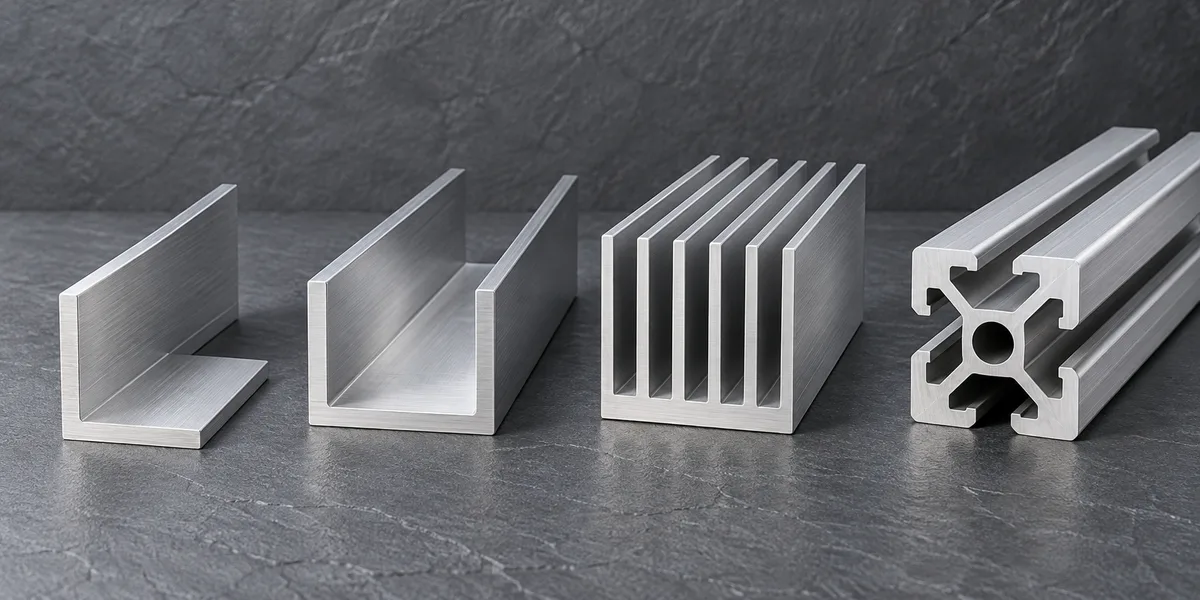
Extrusion produces long members with a constant cross-section in a single operation, which suits stringers, longerons, frame chords and floor members. In 7075, those sections reach strength levels that 6xxx extrusion alloys cannot approach: roughly 570 MPa tensile strength in T6511 compared with about 310 MPa for 6061-T6.
7075 is harder to extrude than 6xxx alloys. It needs lower speeds, tight temperature control and separate solution heat treatment, and very thin or complex hollow sections are difficult. Aerospace 7075 extrusions are therefore mostly solid open shapes and bar, produced to aircraft-manufacturer drawings and stretched after quenching to remove residual stress and straighten them.
Where stress corrosion or exfoliation is a risk, for example in floor beams, seat tracks and lower fuselage members, the overaged T73511 and T76511 tempers are used. Many newer designs use 7050 or 7150 extrusions instead, but 7075 remains common on existing aircraft, in general aviation, helicopters, defence and high-performance industrial products.
Registered Aluminum Association limits, used by AMS 4154, ASTM B221 and EN 573-3. The "others" total is 0.15 % maximum.
| Element | Minimum | Maximum | Role in the alloy |
|---|---|---|---|
| Silicon (Si) | — | 0.40 | Impurity |
| Iron (Fe) | — | 0.50 | Impurity |
| Copper (Cu) | 1.2 | 2.0 | Adds strength; improves stress-corrosion resistance in T73 |
| Manganese (Mn) | — | 0.30 | Residual |
| Magnesium (Mg) | 2.1 | 2.9 | Forms MgZn2 with zinc |
| Chromium (Cr) | 0.18 | 0.28 | Grain control; resists recrystallisation and stress corrosion |
| Zinc (Zn) | 5.1 | 6.1 | Main strengthening element |
| Titanium (Ti) | — | 0.20 | Grain refiner |
| Others, each / total | — | 0.05 / 0.15 | |
| Aluminium (Al) | Remainder | About 87.1 – 91.4 % |
Approximate typical values for extrusions of moderate thickness are shown. Specification minimums are lower and depend on thickness; use the mill certificate and the specification for design.
| Temper | Tensile strength (typical) | Yield strength (typical) | Elongation | Hardness |
|---|---|---|---|---|
| T6 / T6510 / T6511 | About 570 MPa / 83 ksi | About 500 MPa / 73 ksi | About 10 % | About 150 HB |
| T76 / T76510 / T76511 | About 545 MPa | About 475 MPa | About 10 % | About 145 HB |
| T73 / T73510 / T73511 | About 500 MPa / 73 ksi | About 430 MPa / 62 ksi | About 11 % | About 135 HB |
| O (annealed) | About 230 MPa | About 105 MPa | About 16 % | About 60 HB |
The suffix 510 means stretched about 1 – 3 % after quenching without further straightening; 511 means stretched and then lightly straightened. Both have low residual stress and stay straight when machined.
| Temper | Specification | When to use it |
|---|---|---|
| T6, T6510, T6511 | AMS 4154 (replaced AMS 4168, AMS 4169 and AMS-QQ-A-200/11), ASTM B221 | Maximum strength where stress-corrosion risk is low |
| T76510, T76511 | ASTM B221 and customer specifications | Good exfoliation resistance with modest strength loss |
| T73, T73510, T73511 | AMS T73 extrusion specification on the drawing, ASTM B221 | Best stress-corrosion resistance for fittings and wet areas |
| O, F | AMS 4186 (bar, rod and wire), ASTM B221 | Material for later forming and heat treatment |
Several older 7075 extrusion specifications have been cancelled and consolidated. Quote the specification and revision on your drawing and we will confirm the current equivalent before ordering.
| Shape | Typical size range | Notes |
|---|---|---|
| Angles | About 25 × 25 mm to 200 × 200 mm, walls 3 – 12 mm | Equal and unequal legs |
| Tees, channels and I sections | Flange widths about 25 – 150 mm | Standard and drawing-specific |
| Z, J, F and hat sections | To drawing | Stringers and frame chords |
| Round and square tube | About 25 – 250 mm OD, walls 3 – 19 mm | Seamless extruded tube |
| Round, square, flat and hex bar | Rounds about 5 – 200 mm | Machining stock |
Lengths are usually supplied in mill lengths of about 3 – 6 m or cut to size. Long stringer lengths are available by enquiry. For custom aerospace sections, send the die drawing or the manufacturer part number.
Excellent machinability in T6511 and T73511, with short chips and a fine finish. Stretched tempers stay straight when flanges are milled.
Not weldable by MIG or TIG. Use rivets, bolts or bonding, and seal fasteners in wet areas.
Limited in T6. Contoured stringers are formed in O or freshly quenched condition and then aged, or stretch formed under controlled processes.
Anodising (sulphuric, chromic, boric-sulphuric or hard), conversion coating, primer and paint.
| Property | 7075-T6511 | 2024-T3511 | 6061-T6511 | 7050-T76511 |
|---|---|---|---|---|
| Typical tensile strength | About 570 MPa | About 485 MPa | About 310 MPa | About 550 MPa |
| Ease of extrusion | Difficult | Difficult | Easy; complex shapes | Difficult |
| Corrosion resistance | Fair (better in T73) | Fair | Very good | Good |
| Weldability | Poor | Poor | Good | Poor |
| Typical role | Compression and general high-strength members | Tension members, damage tolerance | Secondary structure, complex shapes | Thick, corrosion-critical members |
6061 is the easiest to extrude into complex and hollow shapes and is weldable, but has half the strength. 2024 offers better fatigue-crack growth resistance for tension members. 7075 gives the highest strength of the three, and 7050 is the upgrade where thick sections and corrosion resistance matter.
Both are stretched after quenching to relieve stress. T6511 is also lightly straightened after stretching, giving better straightness. Strength is the same.
AMS 4154 now covers T6, T6510 and T6511 extrusions; it replaced AMS 4168, AMS 4169 and AMS-QQ-A-200/11. ASTM B221 is the general extrusion standard.
When the part is exposed to moisture or sustained stress across the grain, such as floor beams and seat tracks. T73511 has excellent stress-corrosion resistance at about 12 % lower strength than T6511.
Seamless tube and simple hollows are possible, but complex multi-void hollows are very difficult in 7075. Use 6061 or 6082 where the design needs complex hollow shapes.
Not by conventional arc welding. They are riveted, bolted or bonded.
Send the section, temper, specification and quantity. We will reply with feasibility, certification and a delivered price.





