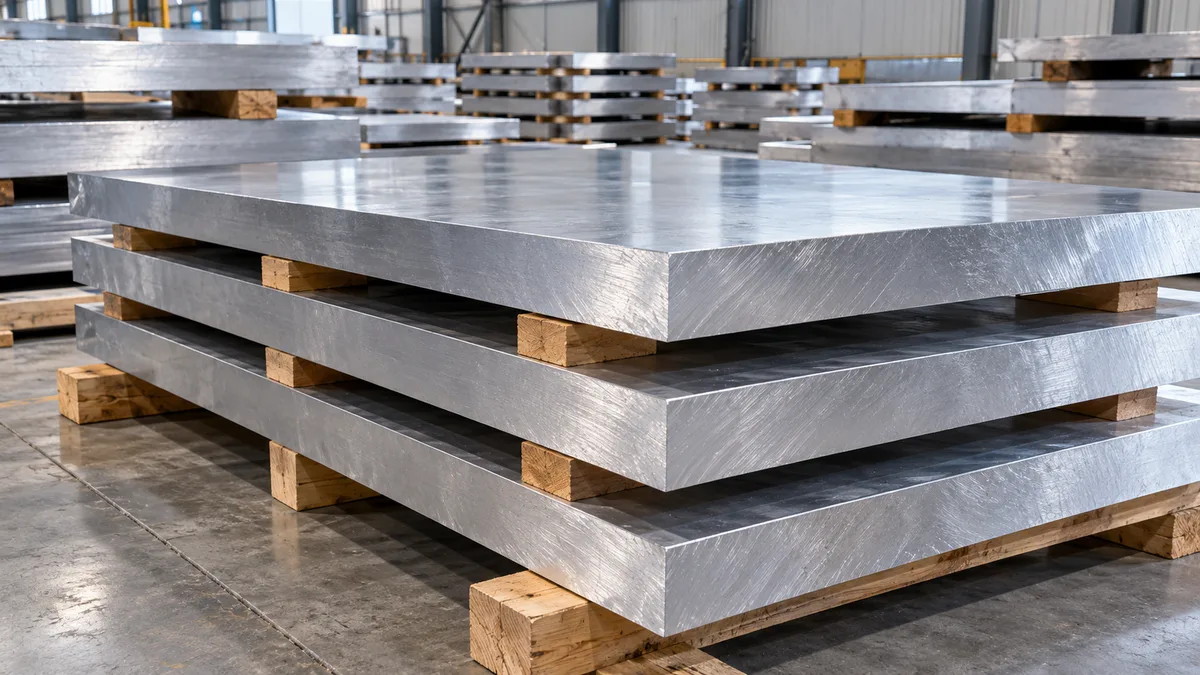
T651 plate
Solution heat-treated, stretched 1.5 – 3 % and artificially aged. The standard temper for machined plate parts; stretching removes quench stresses and keeps parts flat.



2014 is a heat-treatable aluminium-copper alloy that reaches about 480 MPa tensile strength in the T6 and T651 tempers, making it one of the strongest 2xxx grades in plate form. Metline supplies 2014 and the European 2014A as bare or clad sheet and stretched plate, certified to ASTM, AMS and EN standards, to customers worldwide.
2014 contains about 4.4 % copper plus silicon, manganese and magnesium. The higher silicon content distinguishes it from 2024: it allows 2014 to respond strongly to artificial ageing, so the T6 temper reaches higher yield strength than 2024-T3, though with lower fatigue resistance and toughness.
The alloy was developed for aircraft structures and heavy-duty forgings and remains common where high static strength and good machinability are needed in thick sections. Typical plate parts include aircraft fittings and frames, truck and trailer components under high load, hydraulic and pneumatic blocks, military equipment and tooling.
Two things limit where 2014 is used. First, copper lowers corrosion resistance, so unprotected 2014 should be anodised, painted or ordered as Alclad (clad with a thin layer of pure aluminium alloy) for exposed service. Second, fusion welding is difficult; 2014 parts are normally machined from solid and joined mechanically.
2014 is the Aluminum Association grade; 2014A is the European variant with tighter silicon and iron limits and a nickel limit. Both are supplied with an EN 10204 3.1 certificate showing the cast analysis.
| Element | 2014 (AA / ASTM) | 2014A (EN 573-3) |
|---|---|---|
| Silicon (Si) | 0.50 – 1.2 | 0.50 – 0.9 |
| Iron (Fe) | ≤ 0.7 | ≤ 0.50 |
| Copper (Cu) | 3.9 – 5.0 | 3.9 – 5.0 |
| Manganese (Mn) | 0.40 – 1.2 | 0.40 – 1.2 |
| Magnesium (Mg) | 0.20 – 0.8 | 0.20 – 0.8 |
| Chromium (Cr) | ≤ 0.10 | ≤ 0.10 |
| Nickel (Ni) | — | ≤ 0.10 |
| Zinc (Zn) | ≤ 0.25 | ≤ 0.25 |
| Titanium (Ti) | ≤ 0.15 | ≤ 0.15 (Ti + Zr ≤ 0.20) |
| Others, each / total | 0.05 / 0.15 | 0.05 / 0.15 |
| Aluminium (Al) | Remainder | Remainder |
Typical values are from published Aluminum Association / ASM data. Guaranteed minimums fall with increasing plate thickness and are listed in ASTM B209, AMS 4029 or EN 485-2; your certificate shows the tested values.
| Temper | Tensile strength | Yield strength | Elongation | Brinell hardness |
|---|---|---|---|---|
| 2014-O | 186 MPa / 27 ksi | 97 MPa / 14 ksi | 18 % | 45 HB |
| 2014-T4 / T451 | 427 MPa / 62 ksi | 290 MPa / 42 ksi | 20 % | 105 HB |
| 2014-T6 / T651 | 483 MPa / 70 ksi | 414 MPa / 60 ksi | 13 % | 135 HB |
| Alclad 2014-T6 sheet | 469 MPa / 68 ksi | 414 MPa / 60 ksi | 10 % | — |
Solution heat-treated, stretched 1.5 – 3 % and artificially aged. The standard temper for machined plate parts; stretching removes quench stresses and keeps parts flat.
Same heat treatment without stretching, used for thinner sheet. Highest strength, lowest formability.
Naturally aged. Lower yield, higher elongation and better toughness; can be formed and then aged to T6.
Softest condition for forming; must be fully heat-treated afterwards to regain strength.
Sheet clad on both sides with a thin aluminium layer that protects the core electrochemically. Choose it for exposed skins and panels.
2014 is also a major forging alloy; for complex shapes see our forging range rather than machining from plate.
| System | Designation | Sheet and plate standard |
|---|---|---|
| Aluminum Association / ASTM | 2014, Alclad 2014 | ASTM B209 |
| Aerospace (SAE) | 2014-T6 sheet, -T651 plate | AMS 4029; AMS-QQ-A-250/3 (historic federal basis) |
| UNS | A92014 | — |
| European (EN) | EN AW-2014 / 2014A (AlCu4SiMg) | EN 485-2, EN 573-3; EN 2000-series aerospace standards |
| German Werkstoff | 3.1255 | DIN EN 485 |
| ISO | AlCu4SiMg | ISO 6361 |
| Japan (JIS) | A2014P | JIS H4000 |
| China (GB) | 2014 / 2A14 (close) | GB/T 3880, GB/T 3190 |
AMS 4029 covers 2014-T6 sheet and T651 plate from 0.51 to 101.6 mm thick. Close national equivalents differ in detail; confirm which specification governs before ordering.
2014 is a little denser than most aluminium alloys at 2.80 g/cm³, so it weighs 2.80 kg per m² per millimetre:
| Thickness (mm) | kg per m² | 1220 × 2440 mm (kg) | 1500 × 3000 mm (kg) |
|---|---|---|---|
| 1 | 2.80 | 8.3 | 12.6 |
| 2 | 5.60 | 16.7 | 25.2 |
| 3 | 8.40 | 25.0 | 37.8 |
| 4 | 11.2 | 33.3 | 50.4 |
| 5 | 14.0 | 41.7 | 63.0 |
| 6 | 16.8 | 50.0 | 75.6 |
| 8 | 22.4 | 66.7 | 100.8 |
| 10 | 28.0 | 83.4 | 126.0 |
| 12 | 33.6 | 100.0 | 151.2 |
| 16 | 44.8 | 133.4 | 201.6 |
| 20 | 56.0 | 166.7 | 252.0 |
| 25 | 70.0 | 208.4 | 315.0 |
| 30 | 84.0 | 250.1 | 378.0 |
| 40 | 112.0 | 333.4 | 504.0 |
| 50 | 140.0 | 416.8 | 630.0 |
| 60 | 168.0 | 500.1 | 756.0 |
| 80 | 224.0 | 666.8 | 1008.0 |
| 100 | 280.0 | 833.5 | 1260.0 |
Very good in T6/T651: short chips and a bright finish with carbide tooling. T4 is gummier. Leave stock on both faces when removing large volumes from one side.
Not recommended for fusion welding in structural parts because of hot cracking and loss of strength. Resistance spot welding and friction-stir welding are possible; mechanical fastening is the normal route.
Form in O or freshly quenched (W) condition, then age. Bending T6 needs large radii and risks cracking.
Lower resistance than 5xxx or 6xxx alloys and susceptible to intergranular and stress-corrosion attack in some tempers. Protect by anodising, chromate-free conversion coatings, primers or by specifying Alclad sheet.
Compared with 2024, choose 2014-T651 when static strength and machinability matter most; choose 2024-T351 when fatigue and damage tolerance govern. Compared with 7075-T651, 2014 is weaker but holds strength better at moderately elevated temperatures.
In the T6/T651 temper 2014 has higher yield strength (about 414 MPa typical) than 2024-T3 or T351 (about 324 – 345 MPa). 2024 has better fatigue resistance and fracture toughness, which is why it dominates fatigue-critical airframe skins.
2014A is the European grade with tighter limits on silicon and iron and a nickel limit; the mechanical properties are effectively the same. Many buyers accept either, but check your drawing.
Fusion welding is not recommended for structural parts because of hot cracking and strength loss. Friction-stir and resistance welding are possible; most 2014 parts are machined and bolted or riveted.
Yes, for most exposed service. Use anodising, conversion coating and paint, or specify Alclad 2014 sheet.
2014-T6 sheet and 2014-T651 plate, solution and precipitation heat-treated, in thicknesses from 0.020 to 4.00 in (0.51 – 101.6 mm).
Yes. We saw-cut and profile 2014 plate to your dimensions and supply it with an EN 10204 3.1 certificate.
Send the temper, size, quantity and specification. We will confirm availability, certification and a delivered price.





