7075-T6 (sheet)
Solution heat-treated and artificially aged to peak strength. Normal for sheet up to about 6 mm, used flat or formed lightly, where residual stress is low.



7075 aerospace plate is the long-established high-strength aircraft material: in T6 and T651 it gives about 570 MPa tensile and 505 MPa yield strength, and in T7351 it adds strong resistance to stress-corrosion cracking. It is machined into fittings, frames, ribs and spars, and Alclad 7075 sheet is used for skins. Metline supplies bare and Alclad 7075 sheet and plate to AMS 4045, AMS 4078, AMS-QQ-A-250/12 and ASTM B209, cut to size and certified, to customers worldwide.
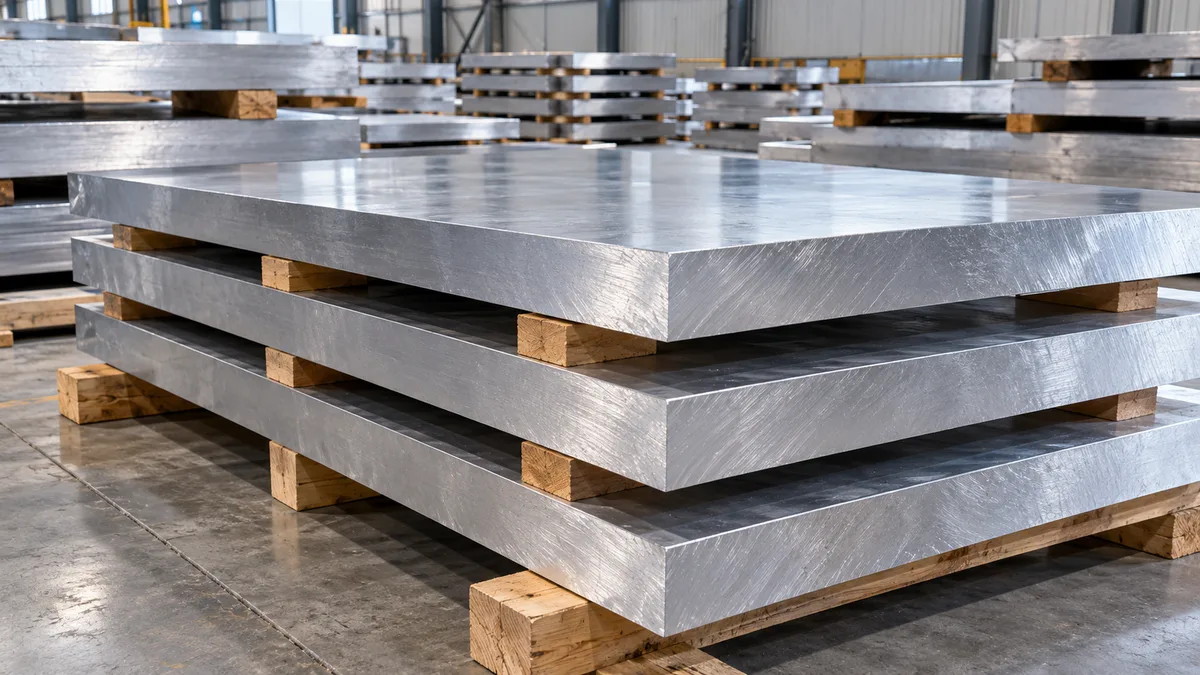
7075 was first produced in the early 1940s and quickly became the standard high-strength alloy for aircraft structure. It contains about 5.6 % zinc, 2.5 % magnesium, 1.6 % copper and 0.23 % chromium. During ageing, zinc and magnesium form extremely fine MgZn2 precipitates that block dislocation movement, which is what gives the alloy its strength.
In sheet and plate form, 7075 offers a combination that is still hard to beat for many parts: very high strength for its weight, excellent machinability, good fatigue strength and a long record in service. It is used for fuselage frames, wing ribs and spars on many aircraft types, for machined fittings, and as Alclad sheet for skins on older and general-aviation designs.
Two limitations shape how it is used. In the peak-aged T6 and T651 tempers, thick 7075 plate is susceptible to stress-corrosion cracking when stressed in the short-transverse direction (through the thickness). And because 7075 is quench sensitive, very thick plate loses strength at the centre. The overaged T7351 temper solves the first problem, and 7050-T7451 is now often chosen for the second.
Registered Aluminum Association limits, followed by AMS 4045, AMS 4078, ASTM B209 and EN 573-3 (EN AW-7075, AlZn5.5MgCu). Each lot ships with a certificate reporting the actual cast analysis.
| Element | Minimum | Maximum | Role in the alloy |
|---|---|---|---|
| Silicon (Si) | — | 0.40 | Impurity |
| Iron (Fe) | — | 0.50 | Impurity |
| Copper (Cu) | 1.2 | 2.0 | Adds strength; improves stress-corrosion resistance in T73 |
| Manganese (Mn) | — | 0.30 | Residual |
| Magnesium (Mg) | 2.1 | 2.9 | Forms MgZn2 with zinc |
| Chromium (Cr) | 0.18 | 0.28 | Grain control; resists recrystallisation and stress corrosion |
| Zinc (Zn) | 5.1 | 6.1 | Main strengthening element |
| Titanium (Ti) | — | 0.20 | Grain refiner |
| Others, each / total | — | 0.05 / 0.15 | |
| Aluminium (Al) | Remainder | About 87.1 – 91.4 % |
Alclad 7075 sheet carries a thin cladding of 7072 (an Al-1 % Zn alloy) on each face. The cladding is anodic to the core, so it corrodes sacrificially and protects the 7075 underneath.
Typical values describe what the material usually achieves; specified minimums in ASTM B209, AMS 4045 and AMS 4078 are what the design must use. For T651 and T7351 plate those minimums fall as thickness increases, because the centre of thick plate cools more slowly during quenching.
| Temper | Tensile strength | Yield strength (0.2 %) | Elongation | Hardness |
|---|---|---|---|---|
| O (annealed), typical | 228 MPa / 33 ksi | 103 MPa / 15 ksi | About 17 % | 60 HB |
| T6 / T651, typical | 572 MPa / 83 ksi | 503 MPa / 73 ksi | About 11 % | 150 HB |
| T7651, typical | About 550 MPa / 80 ksi | About 470 MPa / 68 ksi | About 10 % | About 145 HB |
| T7351, typical | 505 MPa / 73 ksi | 435 MPa / 63 ksi | About 13 % | 135 HB |
Short-transverse properties are the key difference between tempers in thick plate. In T651 the short-transverse stress-corrosion threshold is low, so parts with through-thickness loads (lugs, fittings, frames with integral attachments) are usually made from T7351 or from 7050-T7451. Plane-strain fracture toughness of 7075 plate is moderate and depends on orientation; where a design needs guaranteed toughness, specify KIc testing or select 7475 or 7050.
Solution heat-treated and artificially aged to peak strength. Normal for sheet up to about 6 mm, used flat or formed lightly, where residual stress is low.
Same strength as T6, stretched 1.5 – 3 % after quenching to relieve stress. The standard high-strength machining plate. Watch the short-transverse direction in thick sections.
Stretched and overaged. Strength is about 12 % lower than T651, but stress-corrosion resistance is far better. Specified for structural fittings and parts in wet or corrosive zones.
Moderately overaged for good exfoliation resistance with less strength loss than T7351. Used for wing skins and parts loaded in the plane of the plate.
Annealed for forming. Parts are formed and then heat-treated to T6 or T73 by the fabricator.
Clad with 7072 on both faces for corrosion protection; supplied in O, T6 and T76 tempers. Strength is slightly below bare material because the cladding is softer.
Aerospace orders are usually written to an AMS specification or to AMS-QQ-A-250/12 (bare) and AMS-QQ-A-250/13 (Alclad), which replaced the cancelled federal QQ-A-250 series. ASTM B209 covers general sheet and plate and is common for non-flight hardware and tooling.
| System | Designation / standard | Scope |
|---|---|---|
| SAE AMS | AMS 4045 | 7075-T6 sheet and T651 plate |
| SAE AMS | AMS 4078 | 7075-T7351 plate |
| SAE AMS | AMS 4049 | Alclad 7075 sheet and plate, T6 and T651 |
| SAE AMS | AMS-QQ-A-250/12 and /13 | Bare and Alclad 7075 sheet and plate, several tempers |
| ASTM / ASME | ASTM B209 (ASME SB-209) | Sheet and plate, general |
| Inspection | AMS-STD-2154 / ASTM B594 | Ultrasonic inspection of plate |
| UNS | A97075 | — |
| European | EN AW-7075 (AlZn5.5MgCu) | EN 485-1/-2, EN 573-3 |
| German Werkstoff | 3.4365 | — |
| Japan | A7075P | JIS H4000 |
| China | 7075; 7A09 is a close relative | GB/T 3880, GB/T 3190 |
Cutting to the part envelope saves on high-value material and freight. Tell us the blank sizes and we will nest them on standard plate.
Weight is 2.81 kg per square metre for every millimetre of thickness. The table converts common imperial thicknesses; use the plate weight calculator for other sizes.
| Thickness (in) | Thickness (mm) | kg per m² | 48 × 144 in sheet (kg) |
|---|---|---|---|
| 0.040 | 1.02 | 2.85 | 12.7 |
| 0.063 | 1.60 | 4.50 | 20.1 |
| 0.080 | 2.03 | 5.71 | 25.5 |
| 0.125 | 3.17 | 8.92 | 39.8 |
| 0.190 | 4.83 | 13.56 | 60.5 |
| 0.250 | 6.35 | 17.84 | 79.6 |
| 0.375 | 9.52 | 26.77 | 119.4 |
| 0.500 | 12.70 | 35.69 | 159.1 |
| 0.750 | 19.05 | 53.53 | 238.7 |
| 1.000 | 25.40 | 71.37 | 318.3 |
| 1.500 | 38.10 | 107.06 | 477.4 |
| 2.000 | 50.80 | 142.75 | 636.6 |
| 2.500 | 63.50 | 178.44 | 795.7 |
| 3.000 | 76.20 | 214.12 | 954.8 |
| 4.000 | 101.60 | 285.50 | 1273.1 |
| 5.000 | 127.00 | 356.87 | 1591.4 |
| 6.000 | 152.40 | 428.24 | 1909.7 |
One of the best aluminium alloys to machine. Use sharp carbide with high positive rake, high spindle speeds and flood coolant. Balance roughing between faces on thin-walled parts and leave a finishing allowance.
Limited in T6. For tight bends, form in O or in the freshly quenched (W) condition and then age. Use inside bend radii of several times thickness in T6 sheet.
Not recommended for arc welding: 7075 is prone to hot cracking and the heat-affected zone loses much of its strength. Join with rivets, bolts or adhesive bonding; friction stir welding is possible with qualification.
Takes sulphuric, chromic, boric-sulphuric and hard anodic coatings well. Hard anodising suits wear surfaces on fittings and tooling.
Bare 7075 needs protection: anodise or conversion coat and prime. Use Alclad sheet for skins, seal faying surfaces and isolate from carbon fibre and stainless fasteners.
Prolonged exposure above about 120 °C reduces strength. The alloy performs well at low and cryogenic temperatures.
A typical example is a fuselage frame segment cut from 7075-T7351 plate: the plate is ultrasonically inspected, saw-cut to a blank, high-speed machined to a thin-webbed profile, anodised and primed, then fastened to the skin and stringers. Where the same part sees mainly in-plane loads and no corrosion risk, a designer may choose T651 for its higher strength.
| Property | 7075-T651 | 7075-T7351 | 7050-T7451 | 2024-T351 | 7475-T7351 | 6061-T651 |
|---|---|---|---|---|---|---|
| Typical tensile strength | 572 MPa | 505 MPa | 524 MPa | 470 MPa | About 505 MPa | 310 MPa |
| Typical yield strength | 503 MPa | 435 MPa | 469 MPa | 325 MPa | About 435 MPa | 276 MPa |
| Stress-corrosion resistance | Poor (ST) | Very good | Good–very good | Fair | Very good | Very good |
| Fracture toughness | Moderate | Moderate | Good | Good | Very good | Good |
| Thick-plate strength | Falls with size | Falls with size | Very good | Fair | Fair | Fair |
| Relative cost | Medium | Medium–high | High | Medium | High | Low |
Choose 7075-T651 for high strength where through-thickness stress and corrosion risk are low. Choose T7351 for fittings and wet areas. Move to 7050-T7451 for very thick plate, to 7475 where fracture toughness is critical, and to 2024 for damage-tolerant, tension-loaded skins. See 7050 versus 7075 for more.
T651 is peak-aged for maximum strength. T7351 is overaged, giving about 12 % lower strength but much better resistance to stress-corrosion cracking. Both are stretched to relieve stress.
AMS 4045 covers T6 sheet and T651 plate, AMS 4078 covers T7351 plate, and AMS-QQ-A-250/12 covers bare 7075 sheet and plate in several tempers.
7075 sheet or plate with a thin layer of 7072 alloy bonded to each face. The cladding corrodes sacrificially and protects the core, which suits aircraft skins.
Not by conventional arc welding. It cracks and loses strength in the heat-affected zone, so it is riveted, bolted or bonded.
About 2.81 kg per m² per millimetre. A 48 × 144 in sheet that is 0.250 in thick weighs about 80 kg.
For plate thicker than about 75 mm, or where both high strength and stress-corrosion resistance are needed in thick sections. 7050-T7451 keeps its strength through the thickness and is tougher.
Yes. Plate is saw-cut into blanks to your sizes, inspected and certified, and shipped worldwide in export packing.
Send temper, thickness, size, specification and quantity. Our team will reply with availability, certification and a delivered price.





