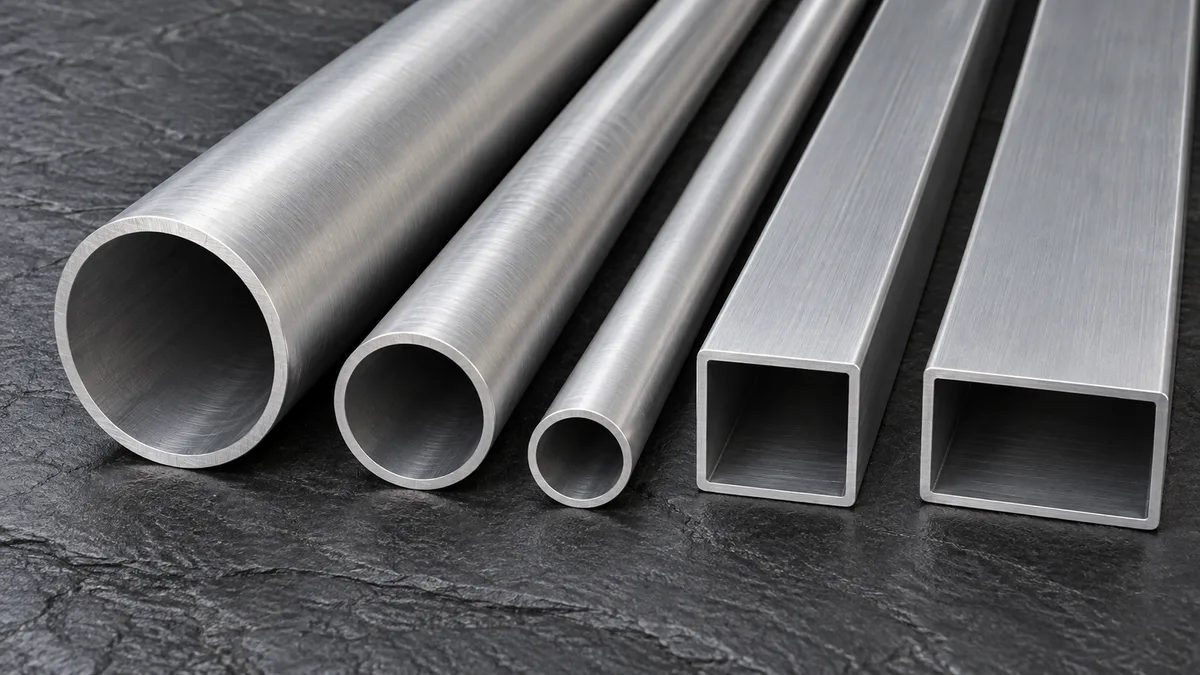
Aluminium Streamline Tube: Shapes, Sizes, Alloys and Strut Design
Streamline tube is round tube reshaped into a teardrop or airfoil section, so that air flows around it with a small fraction of the drag of a round tube. In aluminium it is used for aircraft lift and jury struts, ultralight and gyroplane frames, sailing spreaders, roof bars, drone arms and fairings. This guide covers how streamline tube is made, how its size relates to the round tube it comes from, which aluminium alloys to use, and how to check a strut.
A round tube moving through air leaves a wide, turbulent wake behind it, and that wake is where most of its drag comes from. Streamline tube has a rounded leading edge and a tapering trailing edge, so the flow stays attached around the section and closes behind it with a narrow wake. The shape is usually described by its major axis (chord, front to back) and minor axis (thickness, side to side).
Streamline tube is also called streamlined tube, airfoil tube, aerofoil tube, teardrop tube or flow-line tube. True aircraft streamline tube is a symmetric section with a fineness ratio (major ÷ minor axis) of about 2.3 – 2.4 : 1. Oval and egg-shaped tubes are related but less efficient: an ellipse is symmetric front to back, so its rear half does not let the flow close as cleanly.
Its first home was aviation. Biplanes and high-wing monoplanes from the 1920s onwards used streamline steel and aluminium for wing struts, wires and landing-gear legs, and many light aircraft, homebuilts, ultralights and gyroplanes still do. Outside aviation the same benefit is used on sailing-boat spreaders, vehicle roof bars, bicycle and wheelchair racing frames, wind-tunnel stings, antenna and sensor booms, and on structures where low wind load or low noise matters.
Aerodynamics
How much drag does streamline tube save?
A round cylinder in the speed range of light aircraft and road vehicles has a drag coefficient of roughly 1.0 – 1.2 based on its frontal area. A well-shaped symmetric streamline section of around 2.5 : 1 fineness has a drag coefficient in the region of 0.05 – 0.1 on the same basis, according to classic wind-tunnel data compiled in references such as Hoerner's Fluid-Dynamic Drag.
Because a streamline tube made from a given round tube is also narrower than that tube (its minor axis is a little over half the original diameter), the drag per metre of strut falls further still. In practice, replacing a round strut with streamline tube of similar strength cuts the drag of that member by about an order of magnitude, which is why the claim "ten times less drag" is commonly made.
Factor
Round tube
Streamline tube
Drag coefficient (frontal area, typical)
About 1.0 – 1.2
About 0.05 – 0.1
Frontal width for the same perimeter
1.0 × D
About 0.57 × D
Wake and vibration
Wide wake, vortex shedding, possible strut flutter and whistle
Narrow wake, much less vortex shedding
Sensitivity to flow direction
None
Best aligned with the flow; drag rises with yaw angle
Bending stiffness
Same in all directions
High about the minor axis plane, lower in the thin direction
Drag figures are indicative ranges for comparison. Actual values depend on Reynolds number, surface finish, section shape and alignment.
Alignment matters. A streamline strut is efficient only when it points into the airflow; a strut turned 10 – 15° off the flow loses much of its advantage. Fittings at the ends should fix the strut at the correct angle, and drawings should specify the orientation of the major axis.
Size conversion
Streamline sizes and the round tube they come from
Streamline tube is normally made by drawing or rolling a round tube into shape, so the perimeter of the streamline section is the same as the circumference of the original round tube, and wall thickness stays about the same. Sizes are therefore quoted as an "equivalent round" diameter plus the major and minor axes. For the classic aircraft profile, the major axis is about 1.35 times and the minor axis about 0.57 times the round diameter.
Equivalent round (OD)
Streamline, major × minor (in)
Streamline, major × minor (mm)
Perimeter
1/2 in (12.7 mm)
0.67 × 0.29 in
17.1 × 7.3 mm
1.57 in (39.9 mm)
5/8 in (15.9 mm)
0.84 × 0.36 in
21.4 × 9.1 mm
1.96 in (49.9 mm)
3/4 in (19.0 mm)
1.01 × 0.43 in
25.7 × 10.9 mm
2.36 in (59.8 mm)
7/8 in (22.2 mm)
1.18 × 0.50 in
30.0 × 12.7 mm
2.75 in (69.8 mm)
1 in (25.4 mm)
1.35 × 0.57 in
34.3 × 14.5 mm
3.14 in (79.8 mm)
1 1/8 in (28.6 mm)
1.52 × 0.64 in
38.5 × 16.3 mm
3.53 in (89.8 mm)
1 1/4 in (31.8 mm)
1.69 × 0.71 in
42.8 × 18.1 mm
3.93 in (99.7 mm)
1 1/2 in (38.1 mm)
2.02 × 0.86 in
51.4 × 21.8 mm
4.71 in (119.7 mm)
1 3/4 in (44.4 mm)
2.36 × 1.00 in
60.0 × 25.4 mm
5.50 in (139.6 mm)
2 in (50.8 mm)
2.70 × 1.14 in
68.5 × 29.0 mm
6.28 in (159.6 mm)
2 1/2 in (63.5 mm)
3.37 × 1.43 in
85.7 × 36.3 mm
7.85 in (199.5 mm)
Calculated from the 2.36 : 1 profile used for many standard streamline shapes. Actual axes vary slightly by drawing die and maker; confirm the exact section and its tolerance before ordering fittings.
Common wall thicknesses follow aircraft round tube: 0.035 in (0.89 mm), 0.049 in (1.24 mm), 0.058 in (1.47 mm) and 0.065 in (1.65 mm), with heavier walls for larger lift struts. Flatter "blade" shapes with ratios of 3 : 1 or more, and fuller egg shapes nearer 2 : 1, are made by changing the die. Extruded aluminium airfoil profiles, often with internal webs or a sail track, are an alternative where a non-standard shape or larger chord is needed; see our custom aluminium tube guide.
Material selection
Aluminium alloys for streamline tube
Most aluminium streamline tube is 6061-T6. The alloy draws well, is heat-treatable to good strength, resists corrosion and welds. Higher-strength and lower-strength alloys are used for special cases. Minimum values below are from ASTM B210 (drawn seamless tube) where stated; for other alloys the comparison is qualitative and the certificate gives the actual figures.
A useful rule: if the strut carries flight or structural loads, start from 6061-T6 or 2024-T3 drawn tube made to an aerospace or ASTM tube specification. If the part is a fairing or decorative profile, 6063 extrusions or 5052 formed sheet are often simpler and cheaper. For comparison, steel streamline tube to 4130 specifications is stronger but almost three times as dense; aluminium wins where stiffness per weight and corrosion resistance matter more than outright strength.
Production
How aluminium streamline tube is made
Cold drawing from round
A seamless round tube is pulled through a shaped die, sometimes over a shaped mandrel, in one or more passes. This gives accurate sections, a smooth surface and good wall control. Drawing is often done in a softer condition and the tube is then solution heat-treated and aged to T6.
Roll forming from round
Rolls progressively flatten and shape a round tube. Suited to longer production runs of simple shapes and to tubes too large for drawing benches.
Direct extrusion of a profile
An airfoil-section hollow is extruded through a dedicated die, often in 6061, 6063 or 6082. Allows internal webs, thicker leading edges, tracks and non-standard chords, at the cost of a die.
Formed and welded sheet
Sheet is formed around a shape and seam-welded or riveted. Used for large fairings and covers rather than load-bearing struts.
For load-bearing aviation struts, seamless drawn tube is the usual route, because it gives uniform wall and properties around the section with no seam. Straightness and twist matter as much as cross-section: a strut with twist along its length is misaligned with the flow at one end. Ask for straightness and twist limits on the drawing and inspect each length. The general principles of drawn tube are covered in drawing tube and wire.
Structural checks
Checking a streamline strut
Lift struts work in tension in normal flight and in compression under negative loads or on the ground, so both cases must be checked. Tension is simple: allowable load is cross-sectional area times the allowable stress. For example, a section with 0.554 in² of metal in 6061-T6 drawn tube at the 42 ksi minimum tensile strength has an ultimate tensile capacity of about 23,300 lbf before any fittings are considered. Compression is different, because a long, thin strut buckles long before the metal reaches its strength.
Find the section propertiesGet area and second moments of area about both axes from the maker's data or by CAD. The minor-axis value (bending in the thin direction) is the lowest and usually governs buckling.
Check bucklingUse Euler or Johnson column formulas with the unsupported length and realistic end fixity. Jury struts are often added at mid-span simply to halve the buckling length.
Check fittingsEnd fittings, bolts and the tube wall in bearing at the bolt holes often limit the strut rather than the tube body.
Check fatigue and vibrationExposed struts see vibration and gust loads. Smooth fittings, avoid sharp notches and check natural frequency against engine and flow excitation.
Protect against corrosionAnodise or prime and paint, seal inside the tube where moisture can collect, and isolate steel fittings from aluminium.
Aircraft struts are primary structure. Their design, materials and repairs must follow the aircraft's approved data or be approved by the relevant aviation authority. This guide is general engineering background, not approval data.
Processing
Cutting, fittings and surface finishing
Cutting: cut square with a fine-tooth saw and deburr; mark the major-axis orientation on each piece.
End fittings: streamline-to-round inserts, machined plugs or forked fittings are riveted, bolted or bonded in; drill holes on the neutral axis where possible.
Bending: 6061-T6 streamline is hard to bend without distortion; if bends are needed, form in a softer temper and re-heat-treat, or use a profile die.
Welding: 6061 can be TIG welded, but the heat-affected zone loses strength unless the part is re-heat-treated; 2024 and 7075 are not normally welded.
Anodising: clear or coloured anodising gives corrosion and wear resistance and a durable finish; hard anodising suits sliding or clamped areas.
Painting: chromate-free primer plus topcoat is standard for aircraft struts; powder coating suits non-aviation roof bars and frames.
Define the sectionMajor and minor axis or equivalent round diameter, wall thickness and the section drawing if it is not a standard shape.
Choose alloy and specificationFor example 6061-T6 to ASTM B210 or an aerospace tube specification, or 6063-T6 extrusion for non-structural parts.
Set length and tolerancesCut length, straightness, twist and axis tolerances, and how orientation should be marked.
Add processingCutting, drilling, end fittings to drawing, anodising or primer.
Documents and deliveryMill test certificate to EN 10204 3.1, any required certificate of conformance, export packing in rigid crates to protect long, thin sections, and EXW, FOB, CIF or DAP delivery terms.
Metline supplies aluminium streamline and airfoil tube in 6061, 2024, 7075 and 6063 to customers worldwide, together with the round drawn tube it is made from. We supply aluminium only; for steel streamline tube, see the relevant steel specifications.
Mainly for members exposed to airflow where drag or wind load matters: aircraft lift and jury struts, ultralight frames, sailing spreaders, roof bars, drone booms, aero bicycle parts and architectural fins.
How is streamline tube sized?
By the major and minor axis and wall thickness, often together with the equivalent round diameter it was drawn from. For the standard profile the major axis is about 1.35 × and the minor axis about 0.57 × the round diameter; a 1 in round becomes about 1.35 × 0.57 in.
Which aluminium alloy is best for streamline struts?
6061-T6 drawn seamless tube is the usual choice for its balance of strength, corrosion resistance and weldability. 2024-T3 is used where higher strength is needed; 6063 and 5052 suit fairings and decorative profiles.
How much less drag does streamline tube have than round tube?
Typically about a tenth or less for the same strength, because the drag coefficient falls from around 1.0 – 1.2 to roughly 0.05 – 0.1 and the frontal width is also smaller. The advantage depends on keeping the strut aligned with the flow.
Can aluminium streamline tube be bent or welded?
6061-T6 can be TIG welded, though the weld zone loses strength unless re-heat-treated. Bending a streamline section without distortion is difficult; form it in a softer temper and heat-treat afterwards, or design straight members with end fittings.
Does Metline supply steel or titanium streamline tube?
No. Metline supplies aluminium streamline and airfoil tube and the aluminium round tube it is drawn from. Steel and titanium are mentioned on this page only for comparison.
Need aluminium streamline tube?
Send the section, wall, alloy, length and quantity, or the round tube you want converted. Metline will reply with supply options, certification and delivery worldwide.