Standard elliptical tube
Smooth ellipse, usually extruded 6063 or 6061. The general type for handrails, furniture and frames.



Oval aluminium tubing is extruded or drawn tube with an elliptical or flat-sided oval section. It is stiffer than a round tube of the same weight in one direction, fits slim spaces and looks lighter, which is why it is used for handrails, furniture, sunshades, boat rails, bicycle frames and heat exchangers. This guide covers alloys, tempers, sizes, section properties, tolerances, finishes and how to order.
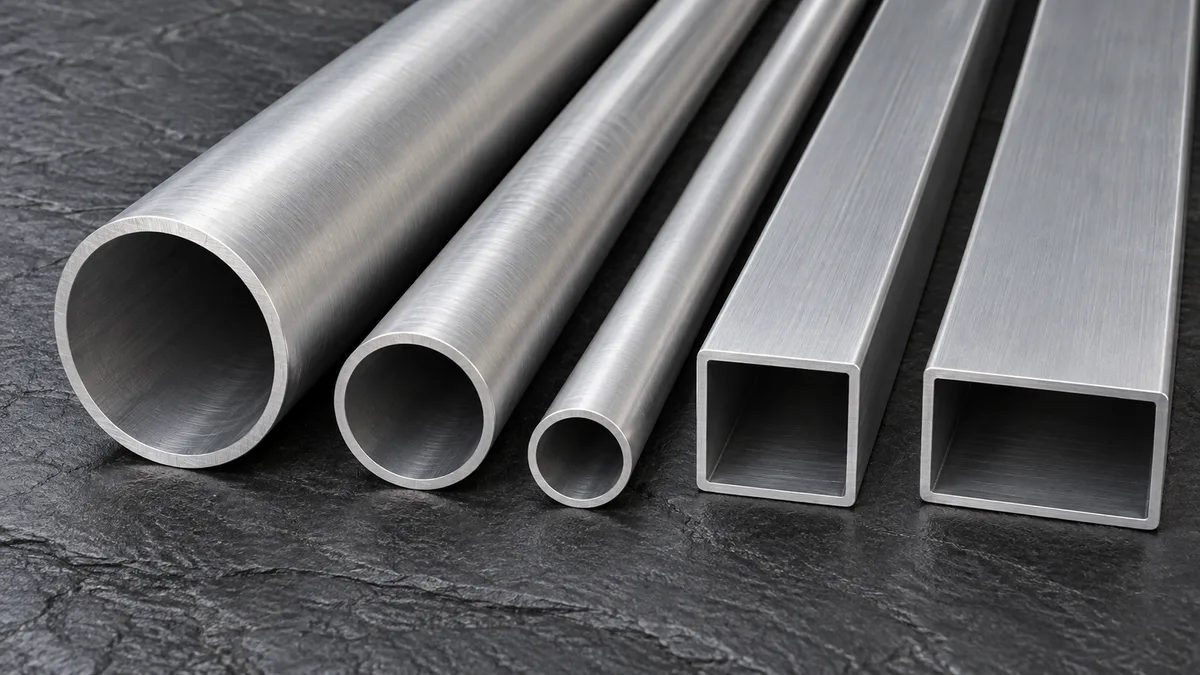
An oval tube has two different outside dimensions: a major axis (the long dimension) and a minor axis (the short one). In a true elliptical tube the outline is a smooth ellipse; in a flat-sided or flat-oval tube, two straight parallel faces are joined by semicircular ends. Both are made from the same alloys as round tube.
The shape changes how the tube behaves. Material is placed further from the centre along the major axis, so the tube resists bending much better in that plane and less well across it. It also presents a narrow face to wind or water flow, packs closely in rows (as in a radiator core) and gives handrails and furniture a slimmer, more comfortable profile.
Oval tube is made in two main ways. Extrusion pushes a heated billet through a die, either around a mandrel (seamless) or through a porthole die that welds the metal back together around a bridge (structural or porthole tube). Drawing then pulls extruded or round tube through an oval die to reach closer tolerances, thinner walls and a better surface. Round tube can also be formed into an oval by rolling, which suits short runs.
Feasible combinations of axis ratio, wall and alloy depend on the die and process; very thin walls on large ovals and high-strength alloys in complex shapes need review.
| Alloy / temper | Strength level | Corrosion resistance | Finish quality | Typical uses |
|---|---|---|---|---|
| 6063-T5 / T6 | Medium | Very good | Excellent for anodising | Handrails, furniture, shower rails, sunshades, decorative frames |
| 6061-T6 | Medium-high | Good | Good | Marine towers, structural frames, sports equipment |
| 6082-T6 | Medium-high (slightly above 6061 in thick sections) | Good | Good | Structural and transport frames, mainly in Europe |
| 5052-H32 / O | Medium | Excellent, including seawater | Fair | Marine rails, chemical equipment, formed parts |
| 3003-H14 / O | Low | Very good | Fair | Heat exchangers, bent and formed tube, trim |
| 7075-T6 | Very high | Fair (protect it) | Good | High-performance sports, aerospace and tooling parts |
For most architectural and furniture uses, 6063-T5 offers the best combination of extrudability, surface and cost. Choose 6061-T6 or 6082-T6 when the tube carries real structural load or will be welded into frames, 5052 when seawater or chemicals are involved, 3003 when the tube will be bent tightly or brazed into heat exchangers, and 7075 only when strength-to-weight is critical and the part can be protected from corrosion.
The table gives calculated values for true elliptical tubes with the stated outside major axis × minor axis × wall (mm), using density 2.70 g/cm³. Ix is the second moment of area for bending across the minor axis (weak direction); Iy is for bending in the plane of the major axis (strong direction). Flat-sided ovals of the same envelope have slightly higher area and stiffness.
| Size (mm) | Area (mm²) | Weight (kg/m) | Ix weak (cm⁴) | Iy strong (cm⁴) |
|---|---|---|---|---|
| 20 × 10 × 1 | 44 | 0.119 | 0.05 | 0.16 |
| 30 × 15 × 1.2 | 80 | 0.217 | 0.23 | 0.69 |
| 40 × 20 × 1.5 | 134 | 0.363 | 0.68 | 2.06 |
| 50 × 25 × 1.5 | 170 | 0.458 | 1.38 | 4.13 |
| 60 × 30 × 2 | 270 | 0.729 | 3.12 | 9.40 |
| 80 × 40 × 2 | 364 | 0.984 | 7.73 | 22.96 |
| 100 × 50 × 3 | 679 | 1.832 | 22.05 | 66.04 |
| 120 × 60 × 3 | 820 | 2.214 | 39.12 | 116.22 |
| 150 × 75 × 4 | 1363 | 3.681 | 100.99 | 300.83 |
Worked comparison: a 40 × 20 × 1.5 mm oval and a Ø30 × 1.5 mm round tube have the same area and therefore the same weight, about 0.36 kg/m. The round tube has I = 1.37 cm⁴ in every direction. The oval reaches 2.06 cm⁴ in its strong direction, about 50 % stiffer, but only 0.68 cm⁴ in its weak direction. Orient ovals so that the main load acts in the plane of the major axis.
Calculated from nominal geometry; check strength with the alloy minimum properties and your design code. Use the section properties calculator for other shapes.
Smooth ellipse, usually extruded 6063 or 6061. The general type for handrails, furniture and frames.
Two parallel flats joined by round ends. Higher moment resistance and easier to fix to flat surfaces; the standard shape for radiator and condenser tubes. See our flat-oval radiator tube guide.
Drawn from seamless stock for close tolerances, thin walls and pressure duties; used for hydraulic and aerospace lines and precision parts.
Ovals with screw ports, slots, grooves, threaded channels or internal webs, such as handrail ovals with a glass or infill slot and furniture ovals with fixing channels.
Structural ovals for columns, towers and sunshade blades, often 6061-T6 or 6082-T6.
Ovals bent to radius, nested telescopic sizes for poles and ladders, and oval-to-round transitions formed at the ends.
| Sector | Typical alloys | Finish | Examples |
|---|---|---|---|
| Building and interiors | 6063, 6061 | Anodised, powder-coated, PVDF | Handrails, balustrades, fences, curtain-wall sunshades, louvres, decorative frames |
| Furniture and bathrooms | 6063-T5 | Anodised, wood-grain, powder | Chair and table frames, wardrobe rails, shower curtain rods, towel rails |
| Marine | 5052, 6061-T6 | Anodised or polished | Bow and stern rails, tuna towers, T-tops, boarding ladders |
| Automotive and HVAC | 3003, 6063 | Mill or brazed | Radiator and condenser tubes, roof racks, trim |
| Sports and outdoor | 6061, 7005, 7075 | Anodised, powder | Bicycle frames, trekking poles, tent poles, telescopic ladders |
| Aerospace and precision | 6061, 7075 (drawn seamless) | Anodised | Interior structures, fluid lines, instrument parts |
| Electronics | 6063, 5052 | Anodised, sandblasted | Housings, heat-sink assemblies, light fittings |
Oval tubes are toleranced on major axis, minor axis, wall thickness, straightness, twist and length. Extruded ovals follow ANSI H35.2 tables for ASTM orders and EN 755-9 or EN 755-8 style tolerances for EN orders; drawn ovals can achieve tighter limits. The table summarises how the two routes differ; confirm the actual limits on the drawing for each size.
| Item | Extruded oval (typical) | Drawn oval (typical) |
|---|---|---|
| Axis dimensions | Per ANSI H35.2 / EN 755 tables; widens with size | Tighter, per drawn-tube tables (ANSI H35.2 / EN 754) |
| Wall thickness | Per standard tables as a band around nominal | Closer band; thin walls held more consistently |
| Straightness | Per standard; tighter by stretching | Better, after straightening |
| Surface | Die lines possible; architectural grade on request | Smooth, bright |
Each delivery includes a mill test certificate to EN 10204 3.1. Dimensional checks are carried out against the drawing; eddy-current or pressure testing can be added for seamless tube in fluid service.
Clear or coloured films of about 10 – 25 µm improve wear and corrosion resistance; 6063 gives the most uniform result.
Powder at about 60 – 120 µm for furniture and railings; PVDF (fluorocarbon) for long-life exterior architecture.
Linear brushed or bright-polished finishes for consumer and marine products.
Ovals can be bent about either axis, but bending about the minor axis (the easy way) is far simpler. Use mandrels and form in softer tempers (O, T4) where radii are tight, then age if needed.
Saw, laser or CNC cutting to length and profile; CNC drilling and punching of fixing holes.
TIG and MIG with 4043 or 5356 filler for 6xxx ovals. Expect strength loss in the heat-affected zone of T6 tubes.
In one direction. At equal weight, an oval tube is stiffer and stronger when bent in the plane of its major axis and weaker across it. A 40 × 20 × 1.5 mm oval is about 50 % stiffer than a round tube of the same weight in its strong direction.
Elliptical tube has a continuously curved outline. Flat-oval tube has two straight parallel sides joined by round ends, which gives more moment resistance, easier fixing to flat surfaces and close packing in heat-exchanger cores.
6063-T5 or T6 for indoor and general outdoor handrails, because it anodises and powder-coats well. Use 6061-T6 for higher loads and 5052 or anodised 6061 near seawater.
Yes. Bending about the minor axis is easiest. Tight bends need mandrel support and a soft temper (O or T4), followed by ageing if full strength is required.
Weight per metre equals cross-sectional area (mm²) × 0.0027. For an elliptical tube, area is π × (a·b − (a−t)(b−t)) with a and b the outside half-axes and t the wall. A 40 × 20 × 1.5 mm oval weighs about 0.36 kg/m.
Yes. Ovals with slots, screw ports, grooves or internal webs can be extruded from a new die made to your drawing. Send a CAD drawing, alloy, finish and annual quantity.
Send the size, alloy, temper, finish and quantity, or a custom section drawing. We will reply with options and a delivered price.





