Solid colours
Matt, satin or gloss solids matched to RAL, Pantone or a sample.



An aluminium composite panel (ACP or ACM) is two thin aluminium skins bonded to a polymer or mineral core, and the skin coil decides how flat, durable and colour-stable the finished panel is. Facade panels normally use 0.5 mm skins of 5005, 3105 or 3003 with a PVDF finish; signage and interior panels use thinner 0.18 – 0.30 mm skins with polyester coatings. This guide covers alloys, gauges, coatings, fire-rated cores, quality checks and how panel makers should specify skin coil.
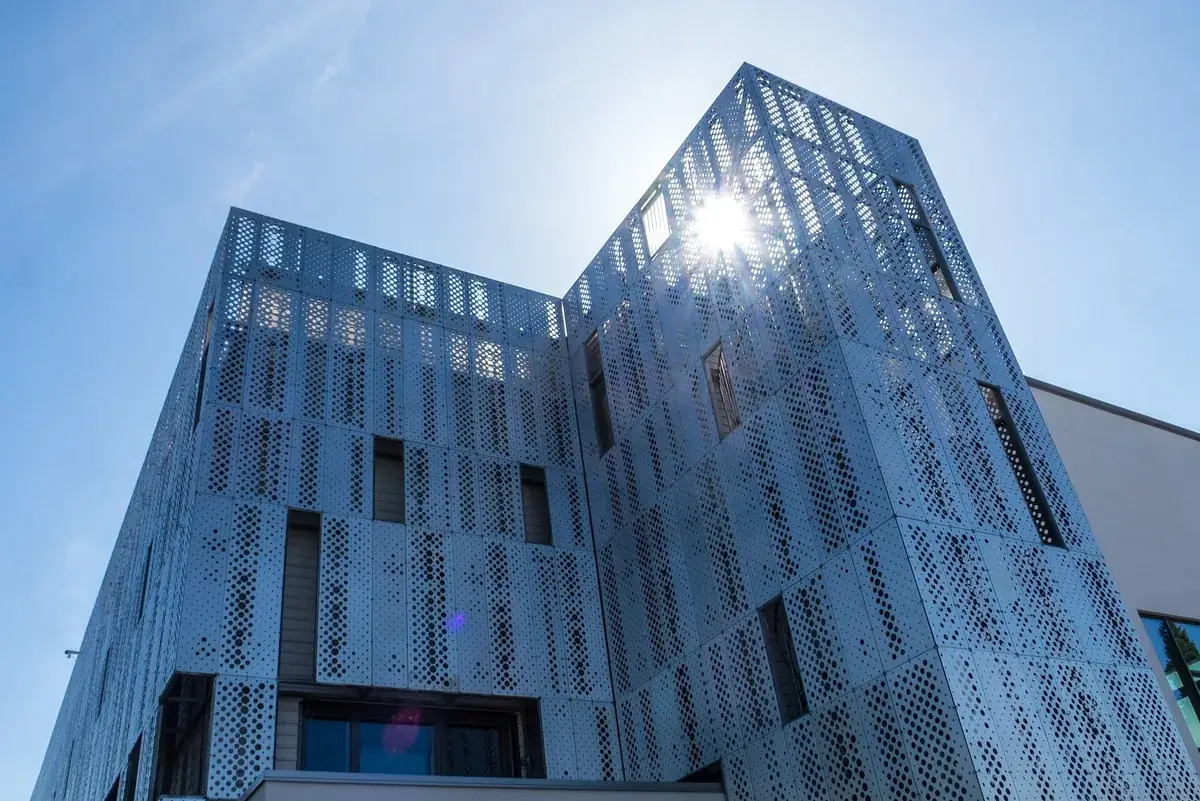
A typical facade ACP is 4 mm thick: a 3 mm core between two 0.5 mm aluminium skins. The skins carry nearly all the bending load, so the panel behaves like a light, stiff I-beam. They also provide the visible finish, the weather barrier and, in fire-rated panels, part of the protection for the core.
Panel makers buy skin as pre-painted coil. The coil is unwound on a continuous laminating line, the core is extruded or fed between the two skins, an adhesive film bonds the layers under heat and pressure, and the panel is cut to length. Any defect in the coil, such as poor flatness, gauge variation, edge wave or weak primer adhesion, shows up as waviness, delamination or colour mismatch on the facade.
The exposed face is usually painted with a high-durability finish; the reverse, which faces the core, carries a primer or wash coat chosen to bond with the adhesive film. On the panel's inside face, the second skin often carries a simple service coat because it is never seen.
| Alloy | Character | Typical ACP use |
|---|---|---|
| 5005 (H14, H22, H24, H44) | Al-Mg 0.5 – 1.1 %; good strength, excellent weathering, uniform appearance | Premium facade and curtain-wall cladding, exposed outer skins |
| 3105 (H14, H16, H24) | Al-Mn-Mg; stronger than 3003, good paint response | Facade skins, A2 and FR panels, signage exposed to wind |
| 3003 (H14, H16, H24) | Al-Mn; moderate strength, very good formability and corrosion resistance | Standard facade and interior ACP, transport and signage panels |
| 3004 | Al-Mn-Mg; stronger than 3003 | Larger panels where extra skin stiffness helps |
| 1100 / 1060 | Commercially pure; soft, very formable, lower strength | Interior decorative panels, signage, inner skins |
For exterior work, many national ACP standards and system manufacturers list 3003, 3105 and 5005 as permitted skin alloys, with 5005 often used for the outer face. Tempers are selected so the skin stays flat during lamination yet allows routing and folding of panel cassettes without cracking the paint. Exact mechanical limits for each alloy and temper are in ASTM B209 and EN 485-2 and are reported on the mill certificate.
| Parameter | Typical range |
|---|---|
| Thickness | 0.18 – 0.50 mm; 0.50 mm for most facade panels, 0.40 mm in some standards, 0.18 – 0.30 mm for signage and interior |
| Width | 1000, 1220, 1250, 1500 mm and up to about 1600 mm |
| Supply form | Coil (usual for laminating lines) or cut-to-length sheet |
| Top coat | PE, HDPE (high-durability polyester), PVDF or FEVE; typical top coat about 20 – 28 µm on facade grades |
| Back coat | Primer or wash coat about 5 – 8 µm, compatible with the core adhesive |
| Gloss | About 20 – 80 GU, matt to high gloss; mirror and brushed effects on special lines |
| Inner diameter | 405, 505 or 508 mm, to suit the line |
| Material standards | ASTM B209, EN 485 (sheet); EN 1396 (coil-coated sheet); AAMA 2605 / 2604 for architectural coatings |
| Coating | Weathering | Typical use | Notes |
|---|---|---|---|
| Polyester (PE) | Moderate; chalks and fades sooner in strong UV | Interior panels, signage, short-term exterior use | Wide colour range, lowest cost |
| High-durability polyester (HDPE) | Better than standard PE | Exterior panels in moderate climates | A step between PE and PVDF |
| PVDF, 70 % resin | Excellent colour and gloss retention | Facades, curtain walls, high-rise cladding | Specified to AAMA 2605 for top architectural performance |
| FEVE fluoropolymer | Excellent; strong colour retention, can give high gloss | Premium exteriors needing bright or glossy colours | Gloss options wider than PVDF |
| Nano / self-cleaning top coats | Depends on the base system | Hospitals, polluted city centres | Check test data for the actual coating |
AAMA 2605 is the usual specification for exterior PVDF. It is based on 70 % PVDF resin systems and requires ten years of South Florida exposure with colour change no more than 5 ΔE units and limited chalking, plus salt-spray, humidity and abrasion tests. AAMA 2604 is the intermediate tier, with five years of exposure. Ask for the coating maker's test certificate for the specific system and colour.
Matt, satin or gloss solids matched to RAL, Pantone or a sample.
Mica and metallic flake finishes, usually in 3-coat PVDF, which need tighter batch control.
Printed or transfer finishes for storefronts, hotels and residential facades.
Polished or brushed metal looks for interiors, lifts and retail.
The core, not the skin, decides most of an ACP's fire behaviour. Since several serious facade fires involving polyethylene-cored panels, many countries restrict or ban combustible cladding on taller buildings, so skin suppliers must know which core the panel will use.
| Core type | Make-up | Typical classification | Where it is used |
|---|---|---|---|
| PE (LDPE) | Polyethylene | Combustible; not permitted on many building facades | Signage, interiors, low-rise uses where regulations allow |
| FR | Mineral-filled polymer | Often B-s1,d0 to EN 13501-1 | Facades where codes accept Class B |
| A2 | Mostly inorganic mineral filler with little binder | A2-s1,d0 to EN 13501-1 | High-rise and public buildings requiring limited combustibility |
Classifications apply to the tested panel system, not to the skin coil alone. In the US, panel systems are tested to ASTM E84 and the full wall assembly to NFPA 285. Skin coil itself is non-combustible, but its primer and adhesive compatibility affect how the panel performs in fire tests, so changes to coil or coating should be checked with the panel maker's certification body.
Metline supplies the aluminium skin coil and sheet that panel makers laminate; the finished panel, its fire classification and its installation remain the responsibility of the panel manufacturer and facade contractor.
| Check | Why it matters | Typical approach |
|---|---|---|
| Gauge and width | Uneven gauge causes waviness and uneven bonding | Online gauge monitoring; tolerance per EN 485-4 / ASTM B209 |
| Flatness and edge wave | Prevents oil-canning on the facade | Tension levelling; flatness checks across width |
| Coating thickness | Durability and colour | Dry film measurement on top and back coats |
| Colour and gloss | Panels from different batches must match on the building | Spectrophotometer ΔE (often ≤ 1 – 2 for architectural work), gloss meter |
| Adhesion and flexibility | Paint must survive routing, folding and weathering | Cross-hatch, T-bend and impact tests (EN 13523 series) |
| Back-coat bond | Prevents delamination of the panel | Peel tests on laminated samples, such as climbing drum peel |
For large projects, reserve enough coil from one coating batch for the whole facade, or agree in advance how batch-to-batch colour variation will be controlled.
| Application | Recommended skin | Key consideration |
|---|---|---|
| High-rise facade | 5005 or 3105, 0.5 mm, PVDF (AAMA 2605) | Fire-rated core required by most codes |
| Low-rise facade | 3003 or 3105, 0.4 – 0.5 mm, PVDF or HDPE | Check local fire rules for the core |
| Interior decorative | 1100 or 3003, 0.2 – 0.3 mm, PE | Appearance and cost |
| Signage | 1100 or 3003, 0.21 – 0.3 mm, PE or PVDF | Colour brightness and outdoor life |
| Honeycomb panels | 3003 or 5005, 0.5 – 1.0 mm, PVDF | Skin thickness for flatness over the cells |
| Sandwich panels | 3003, PE or HDPE | Primer compatibility with PU or mineral wool |
Facade panels normally use 0.5 mm skins on a 3 mm core for a 4 mm panel; some standards allow 0.4 mm. Signage and interior panels often use 0.18 – 0.30 mm skins.
5005 is widely used for the exposed face because of its weathering and appearance; 3105 and 3003 are also common. All three are accepted by most facade specifications.
Polyester is economical with a wide colour range but fades and chalks sooner outdoors. PVDF, specified to AAMA 2605, keeps its colour and gloss for many years in sun and pollution and is the normal choice for facades.
The core governs most of the fire behaviour, but the skin, primer and adhesive form part of the tested system. Any change to the skin coil should be checked against the panel's fire certification.
Yes. Colours can be matched to RAL, Pantone or a physical sample, with an agreed ΔE tolerance and gloss range, and supplied from a single batch for large projects where possible.
Coils are wrapped in protective film and moisture barrier, packed eye-to-sky or eye-to-wall on reinforced wooden pallets or in cases, with the mill test certificate and coating test report.
Send alloy, gauge, width, coating and colour. Our team will reply with a specification and delivered price.





