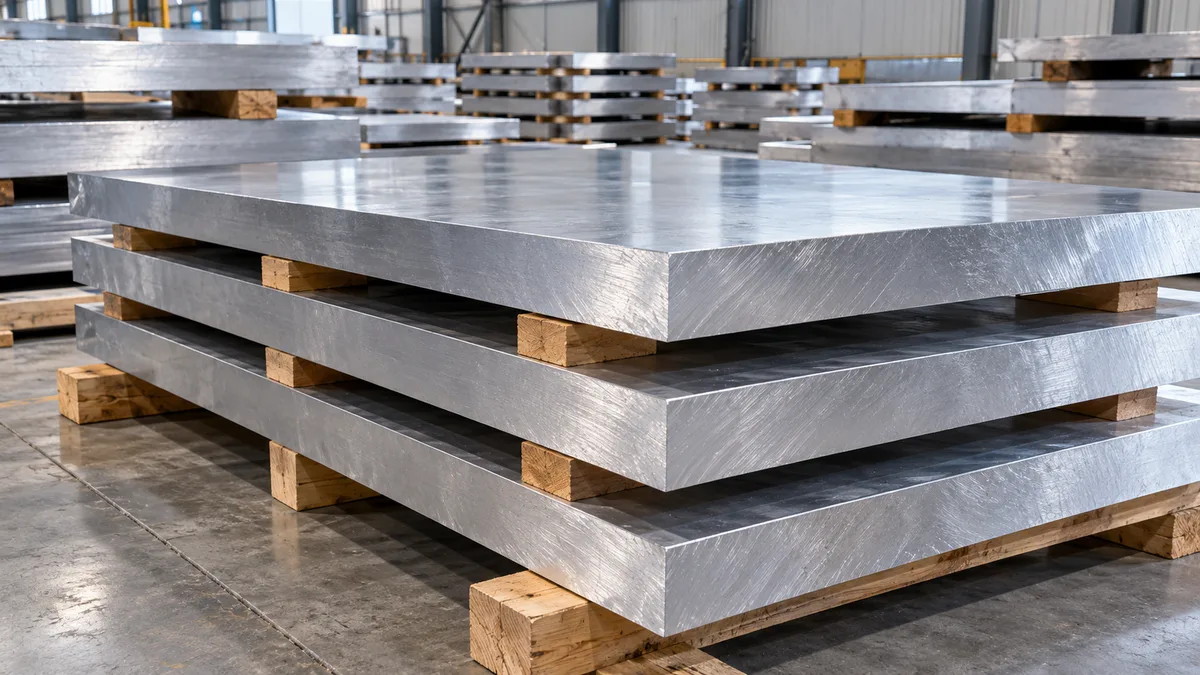
T61 forged plate and blocks
Solution treated, quenched in boiling water to limit residual stress, and artificially aged. The standard condition for forgings and forged plate for pistons and wheels.



2618 and 2618A are aluminium-copper-magnesium alloys with nickel and iron additions that keep their strength at temperatures where most aluminium alloys soften, roughly 150 – 250 °C. Metline supplies 2618A rolled plate in T651 and T851, forged plate and blocks in T61, and clad sheet, certified to the specification on your drawing, to customers worldwide.
2618 was developed in Britain as Hiduminium RR58 for aero-engine parts and later became the skin alloy of the Concorde supersonic airliner, whose surface heated to over 100 °C in cruise. Nickel and iron form thermally stable Al9FeNi particles that resist coarsening, so the alloy holds strength and creep resistance far better than 2024 or 7075 at elevated temperature.
Today 2618 is the classic material for forged pistons, turbocharger and compressor wheels, impellers and other rotating or hot-running components, as well as aircraft and engine structure that operates warm. Rolled and forged plate is used to machine prototype and low-volume parts that would otherwise be forged to shape, such as compressor wheels for motorsport and test engines.
Two versions exist. 2618 is the Aluminum Association grade used with AMS specifications (for example AMS 4132 for T61 die and hand forgings). 2618A is the European grade (EN AW-2618A, AlCu2Mg1.5Ni) with slightly wider limits, used for plate and clad sheet under EN and UK aerospace standards.
| Element | 2618 (AA) | 2618A (EN 573-3) |
|---|---|---|
| Silicon (Si) | 0.10 – 0.25 | 0.15 – 0.25 |
| Iron (Fe) | 0.9 – 1.3 | 0.9 – 1.4 |
| Copper (Cu) | 1.9 – 2.7 | 1.8 – 2.7 |
| Manganese (Mn) | — | ≤ 0.25 |
| Magnesium (Mg) | 1.3 – 1.8 | 1.2 – 1.8 |
| Nickel (Ni) | 0.9 – 1.2 | 0.8 – 1.4 |
| Zinc (Zn) | ≤ 0.10 | ≤ 0.15 |
| Titanium (Ti) | 0.04 – 0.10 | ≤ 0.20 (Ti + Zr ≤ 0.25) |
| Others, each / total | 0.05 / 0.15 | 0.05 / 0.15 |
| Aluminium (Al) | Remainder | Remainder |
Iron and nickel are deliberate alloying elements here, not impurities. The mill certificate reports the analysis for each lot.
Room-temperature typical values for the T61 temper are shown below. 2618 is not the strongest aluminium alloy at room temperature; its value lies in how much of that strength it keeps after long exposure at 150 – 250 °C, where 2024 and 7075 lose strength quickly. For hot design, use elevated-temperature and creep data from handbooks such as MMPDS or ASM.
| Condition | Tensile strength | Yield strength | Elongation | Hardness |
|---|---|---|---|---|
| 2618-T61 (typical) | about 420 – 440 MPa | about 350 – 370 MPa | 6 – 10 % | about 115 HB |
| 2618A-T651 / T851 plate (typical) | about 410 – 440 MPa | about 360 – 380 MPa | 5 – 8 % | — |
Solution treated, quenched in boiling water to limit residual stress, and artificially aged. The standard condition for forgings and forged plate for pistons and wheels.
Solution treated, stretched and aged. Flat, low-stress plate for machining.
Stretched before artificial ageing; used under EN aerospace standards for structural plate.
Thin sheet clad for corrosion protection, historically used for supersonic airframe skins (UK DTD 5070 family).
| System | Designation | Typical specifications |
|---|---|---|
| Aluminum Association / SAE | 2618-T61 | AMS 4132 (die and hand forgings, rolled rings) |
| UNS | A92618 | — |
| European (EN) | EN AW-2618A / AlCu2Mg1.5Ni | EN 573-3; EN aerospace plate standards |
| German Werkstoff | 3.1924 | DIN / LW aerospace sheets |
| United Kingdom | RR58 (Hiduminium), 2618A | DTD 5070 clad sheet, BS aerospace series |
| France (old) | AU2GN | — |
AMS 4132 is a forging specification. Rolled plate is certified to EN or customer specifications; tell us the exact specification and revision on your drawing.
2618 weighs about 2.76 kg per m² per millimetre of thickness:
| Thickness (mm) | kg per m² | 1220 × 2440 mm (kg) | 1500 × 3000 mm (kg) |
|---|---|---|---|
| 6 | 16.6 | 49.3 | 74.5 |
| 8 | 22.1 | 65.7 | 99.4 |
| 10 | 27.6 | 82.2 | 124.2 |
| 12 | 33.1 | 98.6 | 149.0 |
| 16 | 44.2 | 131.5 | 198.7 |
| 20 | 55.2 | 164.3 | 248.4 |
| 25 | 69.0 | 205.4 | 310.5 |
| 30 | 82.8 | 246.5 | 372.6 |
| 40 | 110.4 | 328.6 | 496.8 |
| 50 | 138.0 | 410.8 | 621.0 |
| 60 | 165.6 | 493.0 | 745.2 |
| 80 | 220.8 | 657.3 | 993.6 |
| 100 | 276.0 | 821.6 | 1242.0 |
| 150 | 414.0 | 1232.4 | 1863.0 |
| 200 | 552.0 | 1643.2 | 2484.0 |
Machines well in T61 with carbide tooling; iron-nickel particles are slightly abrasive, so expect somewhat shorter tool life than with 2024.
Not recommended for fusion welding; parts are machined from solid or forged to shape.
Moderate. Protect by anodising or coatings, or use clad sheet for skins.
The boiling-water quench in T61 reduces residual stress in heavy sections. If re-heat-treating, follow the specification cycle closely.
For room-temperature structural use, 2024 or 7075 is stronger and cheaper. Choose 2618 when the part runs hot for long periods, and compare with 2219 when welding is also required.
Parts that must stay strong at elevated temperature: forged pistons, turbocharger and compressor wheels, aero-engine parts and supersonic aircraft skins.
2618 is the Aluminum Association grade used in AMS forging specifications; 2618A is the European grade with slightly wider composition limits. Properties are essentially the same.
4032 has lower thermal expansion and better wear resistance due to its high silicon; 2618 is tougher and more fatigue resistant, so it is preferred for highly loaded racing and boosted engines.
Solution heat-treated, quenched in boiling water to limit residual stress, then artificially aged. It is the standard temper for 2618 forgings.
It is not normally fusion welded; parts are machined from solid or forged to shape.
Send form, temper, size, quantity and specification. We will reply with availability, certification and price.





