O (annealed)
Fully soft, with the widest elongation. The usual choice for shells that are rolled to tight diameters and heads that are pressed or spun, and the basis for welded design stresses.



The shells and heads of aluminium pressure vessels are rolled from a short list of code-approved alloys: 5083 for strong welded and cryogenic vessels, 5454 where the vessel runs warm, and 3003, 5052 and 6061 for lighter duty. This guide sets out the specified minimum properties under ASME SB-209 and EN 485-2, the temperature limits that catch many designers out, and the testing and class documentation a vessel fabricator should order with the plate.
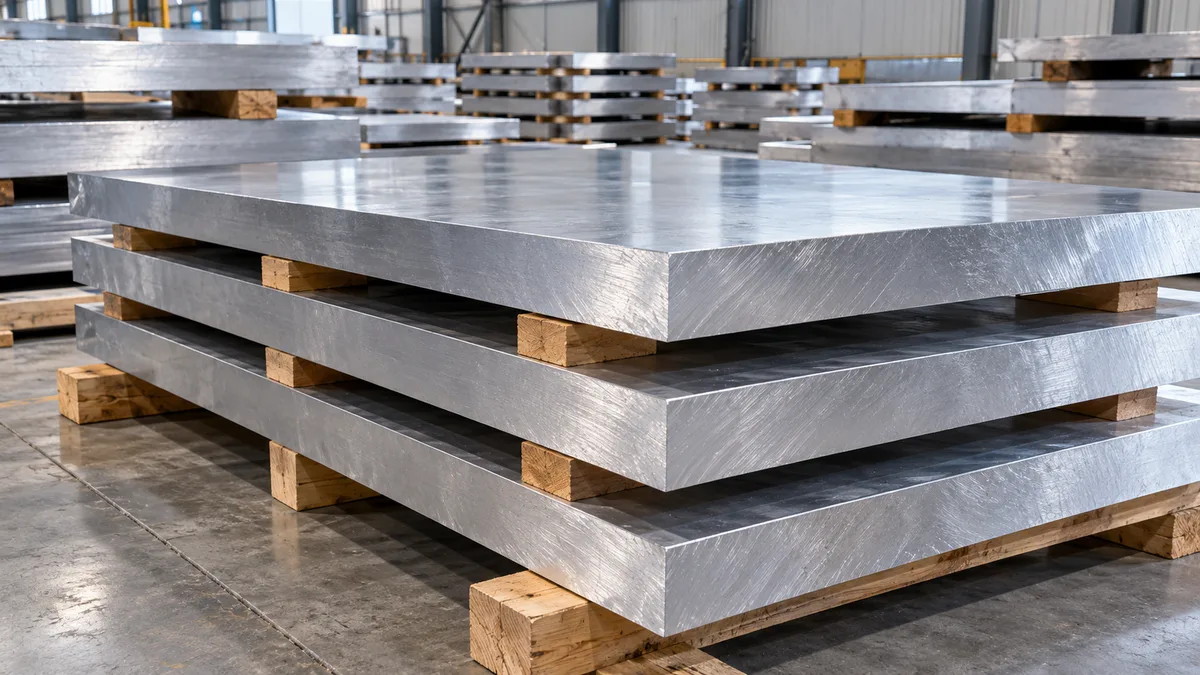
Aluminium plate is chosen for pressure equipment when weight, cryogenic toughness, corrosion resistance or product purity matter more than raw strength. The same vessel in aluminium can weigh about one third of a steel vessel, which is decisive on trucks, ships and aircraft.
Typical uses include cryogenic storage tanks and cold boxes for liquid nitrogen, oxygen and argon; LNG and LPG containment; air receivers and nitrogen buffers; brazed plate-fin heat exchangers in air-separation and gas-processing plants; road tankers and rail tank cars for chemicals and fuels; gas-insulated switchgear enclosures; and process vessels in food, brewing and pharmaceutical plants where iron contamination is unacceptable.
In North America the plate specification is ASME SB-209 (identical in content to ASTM B209), and the vessel is designed under ASME Section VIII, Division 1, Part UNF, using allowable stresses from Section II, Part D. European vessels follow EN 13445-8, with plate supplied to EN 485 and chemistry to EN 573-3. Marine and offshore vessels are additionally governed by classification society rules such as those of Lloyd's Register, DNV, ABS and BV.
| Alloy | Common tempers | Main pressure uses | Key point |
|---|---|---|---|
| 5083 | O, H111, H112, H321 | Cryogenic tanks, LNG, cold boxes, welded vessels | Highest strength of the weldable non-heat-treatable alloys; strength across the weld close to parent metal; ASME limits service to 65 °C (150 °F) |
| 5454 | O, H111, H32, H34 | Vessels and tankers that run warm, heated chemical tanks | Lower magnesium (about 2.7 %) avoids sensitisation; ASME permits service to 204 °C (400 °F) |
| 5052 / 5754 | O, H32, H111 | Smaller vessels, tanks and fuel containers | Good formability for heads; moderate strength |
| 3003 | O, H14, H112 | Low-pressure vessels, heat-exchanger shells, chemical tanks | Very formable; low strength |
| 6061 | T6, T651 | Unwelded or post-weld heat-treated parts, flanges and covers | High unwelded strength; weld zone drops to about 165 MPa tensile |
| 1100 / 1060 | O, H14, H112 | Chemical and food vessels with very low pressure | High purity, best general corrosion resistance |
| Brazing sheet (4004 / 3003 / 4004 and similar) | O, H14 | Brazed plate-fin heat exchangers | Clad layers melt during vacuum brazing to bond fins and parting sheets |
The single most important rule: alloys with more than about 3 % magnesium, such as 5083, 5086 and 5456, must not be held above about 65 °C for long periods. Prolonged warm exposure lets magnesium-rich β-phase precipitate along grain boundaries, which makes the plate susceptible to intergranular and stress-corrosion cracking. That is why ASME limits these alloys to 150 °F and why 5454 exists as the warm-service alternative.
Allowable design stresses are calculated from these specified minimums. Use the code's own allowable stress tables for the design temperature; the values below help with comparison and with checking certificates.
| Alloy and temper | Thickness (mm) | Tensile strength (MPa) | Yield strength 0.2 % (MPa) | ASME max. service temp. |
|---|---|---|---|---|
| 5083-O | 1.3 – 38 | 275 – 350 | 125 min | 65 °C |
| 5083-O | 38 – 76 | 270 – 345 | 115 min | 65 °C |
| 5083-O | 76 – 125 | 260 min | 110 min | 65 °C |
| 5083-H112 | 6.3 – 38 | 275 min | 125 min | 65 °C |
| 5454-O | 0.5 – 76 | 215 – 285 | 85 min | 204 °C |
| 5052-O | 0.15 – 76 | 170 – 215 | 65 min | 204 °C |
| 3003-O | 0.15 – 76 | 95 – 130 | 35 min | 204 °C |
| 3003-H14 | 0.2 – 25 | 140 – 180 | 115 min | 204 °C |
| 6061-T6 sheet | 0.15 – 6.3 | 290 min | 240 min | 204 °C |
| 1100-H14 | 0.2 – 25 | 110 – 145 | 95 min | 204 °C |
Values converted and rounded from the inch-pound limits in ASTM B209; thickness bands simplified. EN 485-2 values for EN AW-5083-O/H111 are similar (275 – 350 MPa tensile, 125 MPa minimum proof stress in thinner gauges). Elongation and bend requirements depend on thickness and appear on the mill certificate.
Fully soft, with the widest elongation. The usual choice for shells that are rolled to tight diameters and heads that are pressed or spun, and the basis for welded design stresses.
Annealed and then given a small amount of strain by levelling or stretching. Properties close to O with slightly higher yield; widely used in Europe for marine and pressure plate.
As-fabricated plate with only incidental strain-hardening. Common in thicker 5083 plate; minimum properties are guaranteed by test.
Strain-hardened and stabilised marine tempers with higher strength and tested resistance to exfoliation. Strength is lost next to welds, so welded vessel design usually reverts to O-temper allowables.
Half-hard sheet for low-pressure vessels and heat-exchanger parts that are not heavily formed.
Used for bolted covers, flanges and parts that are not welded, or are solution treated and aged after welding.
O and H111 plate rolls readily into cylinders. Keep the rolling rolls clean of steel debris, which embeds and causes pitting later.
Torispherical and ellipsoidal heads are pressed or spun from circles. 5083-O and 5454-O form well cold; heavy sections may be warm-formed under controlled temperature to avoid sensitisation in 5083.
MIG and TIG with ER5183 filler for 5083, ER5554 or ER5356 for 5454, ER5356 or ER4043 for 6061. Qualify procedures to ASME Section IX or ISO 15614-2 and remove the oxide film just before welding.
Radiography or ultrasonic testing of longitudinal and circumferential seams according to the joint efficiency used in design; dye-penetrant on nozzle welds.
Separate aluminium from carbon steel supports and copper piping with insulating pads or transition joints.
For oxygen and food service, specify degreasing and cleanliness requirements for the plate surface and finished vessel.
A Lloyd's Register (or DNV, ABS, BV) requirement means the plate must come from a mill approved by that society for the product and thickness, with tests witnessed or reviewed by its surveyor and the certificate endorsed accordingly. This cannot be added after delivery, so tell us at enquiry if your vessel needs class-certified material and which rule set applies.
A plate weighs 2.70 kg per square metre per millimetre of thickness for most alloys (5083 is slightly lighter at about 2.66). A 2000 × 6000 × 20 mm 5083 shell plate therefore weighs roughly 640 kg.
5083 in the O, H111 or H112 temper is the most common for welded and cryogenic vessels. 5454 is used where the vessel operates above about 65 °C, and 3003, 5052 and 6061 serve lower-pressure or unwelded applications.
Alloys with more than about 3 % magnesium can become sensitised when held warm for long periods: magnesium-rich particles form at grain boundaries and the plate becomes prone to intergranular and stress-corrosion cracking. ASME therefore restricts 5083, 5086 and 5456 to 150 °F (65 °C).
The technical content is the same. SB-209 is the ASME adoption of B209 for boiler and pressure-vessel work, and the code may require a specific edition year; the plate certificate should state compliance with SB-209.
Yes. 5083 keeps its toughness and actually gains strength at cryogenic temperatures, which is why it is a standard material for cryogenic storage, cold boxes and LNG equipment.
It can, but the welded allowable stress is much lower than the plate's T6 strength, because welding softens the heat-affected zone to about 165 MPa tensile. 6061 is more often used for bolted covers and flanges, or for vessels that are heat-treated after welding.
Class-certified plate is arranged per order from a mill approved by the society, with witnessed testing and a 3.2 certificate. State the society and rule set at enquiry.
Send your alloy, thickness, plate sizes, code and certification needs. We will confirm a compliant supply and the documents that come with it.





