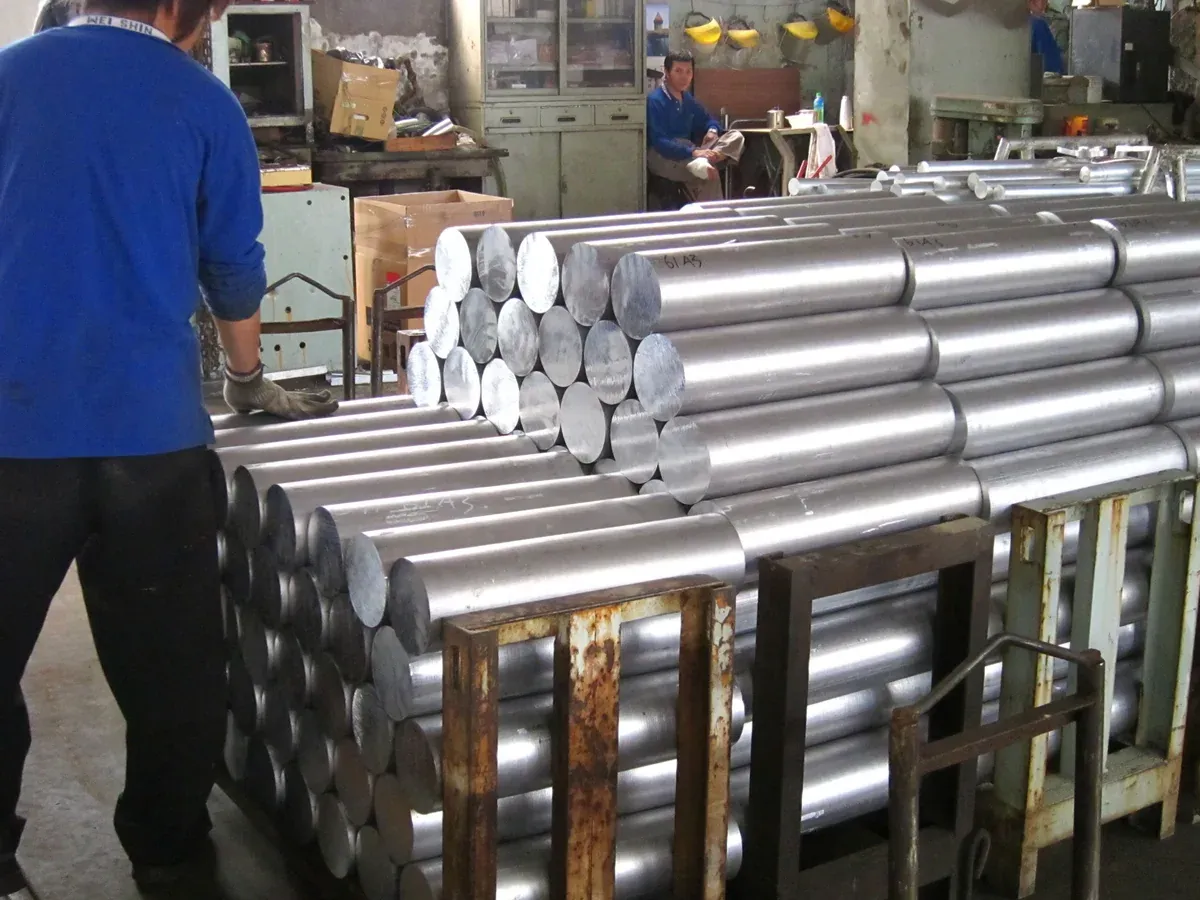
Seamless high-pressure aluminium cylinders, from scuba tanks and medical oxygen bottles to fire extinguishers and composite cylinder liners, are made almost entirely from 6061 in the T6 temper, formed from extruded slugs, billet or seamless tube. Low-pressure LPG and propane cylinders use formable 5xxx alloys in the annealed condition. This guide explains which alloys the cylinder standards allow, why, and what to specify when buying the raw material.
Steel was the original material for compressed-gas cylinders and is still common for industrial gases, but aluminium cylinders dominate wherever weight, corrosion or gas purity matter: diving, medical oxygen, beverage CO2, specialty and calibration gases, portable fire extinguishers, breathing apparatus liners and vehicle fuel systems.
Corrosion resistance
Aluminium forms a stable oxide film and does not rust, so cylinders exposed to seawater, humid air or wet gases keep their wall thickness and appearance. Internal corrosion is also low, which matters for high-purity and reactive specialty gases.
Weight
For small and medium cylinders the lower density gives a lighter bottle than steel, which is why portable oxygen, scuba and extinguisher cylinders are typically aluminium. Composite cylinders with thin aluminium liners save even more mass.
Low-temperature toughness
Aluminium has a face-centred cubic structure with no ductile-to-brittle transition, so it keeps toughness at cryogenic temperatures. This is also why aluminium liners are used for cold gases and why it suits cold climates.
Formability
6061 can be backward-extruded, ironed and hot-spun into a one-piece shell with an integral base and neck, with no welds in the pressure boundary.
Gas compatibility
Aluminium is compatible with oxygen, nitrogen, argon, helium, CO2, natural gas and many specialty gases. It is not suitable for every gas, so compatibility is checked against ISO 11114-1 for each service.
Heat transfer
Good thermal conductivity helps cylinders equalise temperature quickly during filling and use.
The trade-off is strength and fatigue. Aluminium alloys are weaker than cylinder steels, so walls are thicker, and their fatigue strength is lower, so cylinder standards demand cycle testing, careful neck design and alloys with proven resistance to cracking under sustained load.
The standard alloy. 49 CFR 178.46 (DOT-3AL) chemistry is 6061 with lead and bismuth each limited to 0.005 % max
6082
T6
Seamless cylinders to ISO 7866 in some markets
Listed in ISO 7866 as 6082A with controlled chemistry; older high-lead variants (HE30) have shown sustained-load cracking
6351
T6
Historic scuba and SCBA cylinders
No longer recommended: cylinders made from it suffered sustained-load cracking in the neck. Several regulators require special inspection or have withdrawn approval
7060
T6-type
Higher-pressure seamless cylinders
A 7xxx alloy registered for cylinders and listed in ISO 7866; offers higher strength, with SLC qualification required
5283
Work-hardened
Seamless cylinders to ISO 7866
An Al-Mg alloy listed in ISO 7866; non-heat-treatable
5052, 5154, 5083
O
Welded or deep-drawn LPG, propane and low-pressure cylinders
Supplied as annealed circles or coil for deep drawing and spinning; excellent weldability and corrosion resistance
For a DOT-3AL cylinder the regulation also sets minimum mechanical properties for the finished 6061-T6 shell: 38,000 psi (262 MPa) tensile strength, 35,000 psi (241 MPa) yield strength and 14 % elongation, with wall stress at test pressure limited to 80 % of minimum yield or 67 % of minimum tensile strength. Cylinder makers then design walls around the properties their own heat treatment achieves, which is why the raw material chemistry must be consistent from lot to lot.
Values above are quoted from 49 CFR 178.46. ISO 7866 sets its own chemistry ranges, property limits and qualification tests, and the cylinder manufacturer's approved design governs which alloy and supplier may be used.
Material risk
Sustained load cracking: why chemistry control matters
Sustained load cracking (SLC) is slow intergranular crack growth that can occur in some aluminium alloys held under constant stress for years, as a full cylinder is. It typically starts in the neck threads and shoulder of the cylinder, where stress is highest. A crack can grow slowly over many years and, in rare cases, lead to rupture.
Field experience in the 1980s and 1990s linked SLC mainly to alloy 6351 and to high lead content, with bismuth also suspected. Lead and bismuth have low melting points and can segregate to grain boundaries. As a result, modern cylinder specifications cap lead and bismuth at very low levels and ISO 7866 includes a specific SLC test for new alloys and designs. 6061 with controlled chemistry, 5283 and 7060 have shown good resistance in testing.
How cylinders are made
Manufacturing routes and the stock each one needs
Route
Starting stock
Process outline
Typical products
Backward extrusion + ironing
6061 slug cut from extruded bar or homogenised billet
Slug is cold or warm backward-extruded into a cup with an integral base, wall thinned by drawing or ironing, open end hot-spun to form shoulder and neck, then solution treated and aged to T6
Scuba, medical oxygen, CO2, specialty gas and extinguisher cylinders; composite liners
Tube spinning
6061 seamless extruded tube
Tube cut to length, both ends heated and spun closed to form base and neck, then heat treated
Liners and some industrial cylinders
Deep drawing + welding
5052, 5154 or 5083 O-temper circles or coil
Two halves deep-drawn from circles, girth-welded, fittings attached
LPG, propane and low-pressure refrigerant cylinders
Spinning from circle
Thick 5xxx or 6061-O circles
Circle is spun or flow-formed into a closed shell
Low-pressure vessels, extinguisher bodies
Backward extrusion is mandatory for DOT-3AL shells: the regulation requires the shell to be made by that method and specifies the base shape (torispherical, hemispherical or ellipsoidal, with a knuckle radius of at least 12 % of the inside diameter). After forming, every cylinder is solution heat-treated and aged, and samples from each batch go through tensile, flattening or bend tests, hydrostatic testing and, at design approval, burst and pressure-cycling tests.
For the raw-material supplier, the critical points are slug weight and dimensional consistency, which control wall thickness, and internal quality, which controls whether the metal survives the heavy deformation of extrusion and spinning. Surface defects on slugs or circles become surface defects on the cylinder.
Standards
Cylinder standards that govern the material
Standard
Scope
Material implications
ISO 7866 (EN ISO 7866)
Refillable seamless aluminium alloy gas cylinders: design, construction and testing
Lists permitted alloys with chemistry limits; requires SLC and other qualification tests; burst-to-test-pressure ratio of at least 1.6
49 CFR 178.46 (DOT-3AL) / CSA B339 (TC-3ALM)
Seamless aluminium cylinders for the US and Canadian markets
6061-T6 chemistry and property minimums, backward extrusion, 1.5 burst/test ratio, cycle test qualification
ISO 11119-1 and -2
Hoop-wrapped and fully wrapped composite cylinders with load-sharing metal liners
Aluminium liners, usually 6061-T6, must meet liner-specific tests
ISO 11439
High-pressure cylinders for on-board storage of natural gas as a vehicle fuel
Covers aluminium-lined (Type 3) composite designs
ISO 11114-1
Compatibility of cylinder and valve materials with gas contents
Confirms whether aluminium alloys are suitable for a given gas
Directive 2010/35/EU (TPED) and 2014/68/EU (PED)
European transportable and stationary pressure equipment
Cylinders and fire extinguishers must be conformity-assessed; material traceability is required
These standards apply to the finished cylinder and to the cylinder manufacturer. The material supplier's job is to deliver stock that meets the chemistry and property limits of the approved design, with full traceability. Metline supplies the aluminium stock with EN 10204 3.1 mill certificates; cylinder design approval and testing remain with the cylinder maker.
Supply range
Aluminium stock forms for cylinder makers
Typical supply range
6061 slugs and blanks
Sawn from extruded bar or billet, diameter and weight to drawing; ends faced if required
6061 extruded round bar and billet
Homogenised, low lead and bismuth, cut lengths for in-house slug cutting
6061 seamless tube
For tube-spun cylinders and liners; outside diameter and wall to drawing
5052, 5154, 5083 circles
O temper, typically 4–6 mm thick for LPG cylinder halves; bright, smooth surface free of rolling marks and oil stains
5xxx and 6061 coil and sheet
For blanking in-house
Certification
EN 10204 3.1 mill certificate with heat number, chemistry and mechanical results
Surface quality matters for deep-drawn and spun circles: defects can open into orange peel or splits after drawing, so specify the surface grade on the order.
Seamless scuba, oxygen and specialty-gas cylinders: 6061 slugs or billet
Fire extinguisher bodies: 6061 slugs, or 5xxx circles for low-pressure designs
LPG, propane and refrigerant bottles: 5052, 5154 or 5083 O-temper circles
Beverage CO2 and paintball bottles: 6061 slugs
Selection advice
How to choose the raw material for a cylinder
Start from the standardThe cylinder standard and the approved design fix the alloy. For DOT-3AL that means 6061-T6; for ISO 7866 the design approval names the alloy.
Check strength and fatigueAluminium has lower fatigue strength than steel, so choose an alloy and heat treatment with proven cycle performance and a design that keeps neck and shoulder stresses low.
Control chemistrySpecify Pb and Bi limits and require heat-by-heat analysis. This is the main defence against sustained-load cracking.
Match the stock to the processSlugs for backward extrusion, tube for spinning, annealed circles for deep drawing. Agree dimensions, weight tolerance and surface grade.
Consider supply and costStandard alloys such as 6061 and 5052 are widely produced, which keeps supply stable. Specialised alloys can offer higher strength but limit sourcing options.
Most seamless high-pressure aluminium cylinders are made from 6061 in the T6 temper with tightly controlled lead and bismuth. ISO 7866 also lists 6082A, 5283A and 7060 for approved designs, and low-pressure LPG cylinders use 5052, 5154 or 5083 in the O temper.
Why is 6351 no longer used for scuba cylinders?
Cylinders made from 6351 showed sustained-load cracking in the neck threads, linked to the alloy and its lead content. Regulators require special inspection of these cylinders, and some have withdrawn approval of 6351 designs. New cylinders use 6061 or other alloys that pass SLC testing.
What raw material form is used for seamless aluminium cylinders?
Usually a solid slug, sawn from extruded bar or homogenised billet, which is backward-extruded into a cup and then ironed and spun. Some cylinders and liners are spun from seamless tube instead.
Can aluminium cylinders be welded?
High-pressure seamless cylinders have no welds in the pressure boundary. Low-pressure LPG and propane cylinders are often made from two deep-drawn 5xxx halves joined by a girth weld, which is why weldable 5xxx alloys are used for them.
Are aluminium cylinders suitable for oxygen?
Yes. 6061-T6 cylinders are widely used for medical and diving oxygen, provided they are oxygen-cleaned and fitted with compatible valves. Gas compatibility for any service is confirmed against ISO 11114-1.
Does Metline make gas cylinders?
No. Metline supplies the aluminium raw material (6061 slugs, bar, billet and tube, and 5xxx circles, sheet and coil) with mill certificates. Cylinder design, manufacture, approval and testing are carried out by the cylinder maker.
Need aluminium stock for cylinder production?
Tell us the alloy, cylinder standard, stock form and dimensions. We will confirm chemistry limits, certification and a delivered price.