Preparation
Remove oil with solvent and the oxide film with a stainless wire brush just before welding. Keep plate dry; condensation is a source of hydrogen porosity.



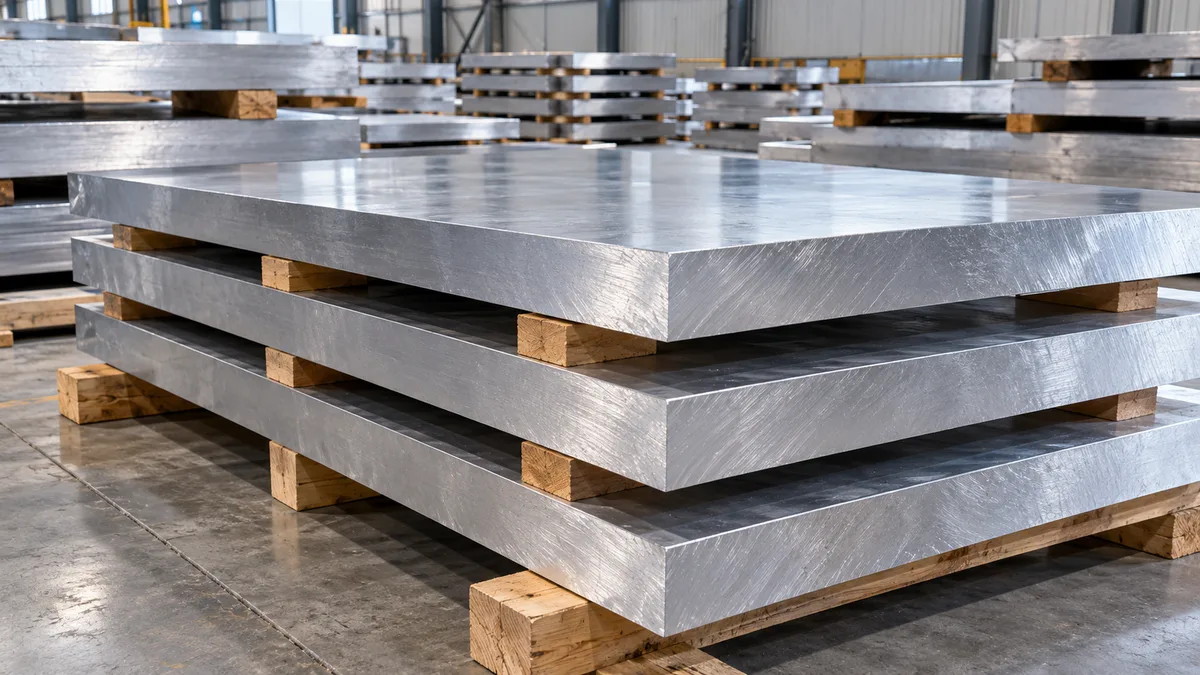
5454 is the aluminium-magnesium plate grade tank builders choose when the cargo is hot: asphalt, bitumen, heated emulsions and warm chemicals. Its magnesium content is held below 3 %, which keeps it resistant to the sensitisation that makes higher-magnesium 5083 and 5182 unsuitable above about 65 °C. This guide explains the grade, its properties and tempers, how to weld it and how to specify plate for a tanker build.
Most aluminium road tankers are built from 5083 or 5182, both of which contain 4 – 5 % magnesium. That magnesium gives high strength without heat treatment, but it has a weakness: held for long periods between roughly 65 °C and 200 °C, the excess magnesium migrates to grain boundaries and forms a continuous film of the β-phase (Al3Mg2). The alloy is then "sensitised" and can suffer intergranular corrosion and stress-corrosion cracking.
Asphalt and bitumen are hauled hot, commonly at 140 – 180 °C, so that they stay pumpable. Heated emulsions, molasses, waxes, some resins and many chemicals also travel warm. A tank shell that sits at those temperatures for thousands of hours over its life must not sensitise, and that is the job 5454 was developed for.
5454 limits magnesium to 2.4 – 3.0 % and adds 0.5 – 1.0 % manganese for strength. With magnesium below about 3 %, there is too little excess magnesium to form a continuous β-phase network, so the alloy stays resistant to intergranular attack at elevated temperature. Strength at room temperature is lower than 5083, but it is still well above 3003 or 5052, and 5454 welds and forms just as easily.
Limits follow the Aluminum Association registration, which ASTM B209 and EN 573-3 (EN AW-5454, AlMg3Mn) share. The actual analysis of each lot appears on the mill test certificate.
| Element | Limit | Why it matters for a hot tank |
|---|---|---|
| Magnesium (Mg) | 2.4 – 3.0 | Solid-solution strength; the 3.0 % cap is what keeps the alloy stable when hot |
| Manganese (Mn) | 0.50 – 1.0 | Adds strength without raising sensitisation risk |
| Chromium (Cr) | 0.05 – 0.20 | Grain-structure control and stress-corrosion resistance |
| Silicon (Si) | ≤ 0.25 | Impurity |
| Iron (Fe) | ≤ 0.40 | Impurity |
| Copper (Cu) | ≤ 0.10 | Kept low for corrosion resistance |
| Zinc (Zn) | ≤ 0.25 | Impurity |
| Titanium (Ti) | ≤ 0.20 | Grain refiner |
| Others each / total | ≤ 0.05 / 0.15 | |
| Aluminium (Al) | Remainder |
Tank calculations use the specified minimum values from the order standard. The table shows typical values alongside the O/H111 limits that most tanker plate is bought to.
| Temper | Tensile strength | Yield strength (0.2 %) | Elongation | Notes |
|---|---|---|---|---|
| O / H111, specified (EN 485-2, 3 – 12.5 mm) | 215 – 285 MPa | ≥ 85 MPa | about 17 – 18 % min | The normal tanker shell and head condition |
| O, typical | 250 MPa | 117 MPa | 22 % | |
| H32, typical | 276 MPa | 207 MPa | 10 % | Stronger shells; less formable |
| H34, typical | 303 MPa | 241 MPa | 10 % | Rarely used for tank shells |
Typical values from Aluminum Association / ASM data; specified limits vary with thickness band and are stated on the certificate. Strength falls as temperature rises, so hot-service tanks are designed with temperature-adjusted allowable stresses.
A tanker is not built from one plate specification. Shells need strength and roll well; heads and baffles are pressed or spun and need maximum ductility. The table summarises common practice; your design code and calculations set the final thicknesses.
| Component | Usual temper | Typical thickness | Reasoning |
|---|---|---|---|
| Shell (barrel) | H111, or H32 for higher design stress | 5 – 8 mm | Rolled into the barrel shape; H111 forms easily, H32 allows thinner walls |
| Heads (end caps) | O | Equal to or thicker than the shell | Dished or spun; the soft temper avoids cracking at the knuckle |
| Baffles / surge plates | O or H111 | Often about 1 mm thinner than the shell | Pressed with flanges and manholes; limit surge without adding much weight |
| Bulkheads (compartment walls) | O or H111 | 5 – 8 mm | Must hold a full compartment against an empty one |
| Stiffening rings, sub-frame | 5454 or 6xxx extrusions | By design | Profiles welded to the shell |
Wide plate saves welding. With plate up to about 2,500 – 2,600 mm wide and long lengths, a typical barrel can be formed from fewer pieces, which means fewer longitudinal seams to weld, inspect and potentially leak.
5454 is readily welded by MIG and TIG. The point that is often missed is the filler. The common 5xxx fillers, ER5356 and ER5183, contain about 5 % magnesium. Using them on a hot tank puts a high-magnesium weld bead into exactly the temperature range where it can sensitise, which defeats the reason for choosing 5454.
For service above about 65 °C, the recommended filler is ER5554, which matches the magnesium level of the base metal (about 2.7 %). It gives slightly lower weld strength than ER5356 but keeps the joint resistant to intergranular corrosion when hot. For ambient-temperature cargo in a 5454 tank, ER5356 is acceptable.
Remove oil with solvent and the oxide film with a stainless wire brush just before welding. Keep plate dry; condensation is a source of hydrogen porosity.
Pulsed MIG for long shell seams; TIG for nozzles, manholes and repairs. Back-gouge and seal-weld full-penetration butt joints.
Because 5454 is not heat-treatable, welding an O or H111 plate costs almost no strength. Welding H32 plate softens the heat-affected zone back to near O-temper values, which design codes account for.
O and H111 bend comfortably to about 1 – 2 × thickness. Heads are spun or pressed in O temper.
Radiography or ultrasonic testing of shell seams, leak testing and pressure testing as required by the tank code.
Mill finish is normal. Insulated asphalt tanks are clad; bright or mirror sheet is sometimes used for the outer jacket to reflect sunlight.
| Point | 5454 | 5083 | 5182 | 5754 |
|---|---|---|---|---|
| Magnesium | 2.4 – 3.0 % | 4.0 – 4.9 % | 4.0 – 5.0 % | 2.6 – 3.6 % |
| O/H111 yield, min | 85 MPa | 125 MPa | 110 MPa | 80 MPa |
| Sustained service above 65 °C | Suitable | Not recommended | Not recommended | Use with caution above 3 % Mg |
| Typical cargo | Asphalt, bitumen, heated chemicals | Fuel, cryogenic gases, marine | Fuel and ADR dangerous goods | Fuel, food liquids, general |
| Matching filler | ER5554 (hot); ER5356 (ambient) | ER5183 | ER5183 / ER5356 | ER5356 |
For ambient fuel tankers, 5182 or 5083 gives a lighter tank because higher strength allows a thinner shell. For hot loads, or tanks that may later be switched to hot service, 5454 is the safe choice. See our guides to 5083 tanker plate, 5182 tanker sheet and 5754 tanker plate.
Under ADR, shell thickness for an aluminium tank is derived from a reference mild-steel thickness using the alloy's guaranteed tensile strength and elongation, so a plate with a higher strength-times-elongation product can be thinner. That is why the certified Rm and A values on the mill certificate matter to the tank designer, not just the alloy name.
Asphalt is carried at around 140 – 180 °C. 5083 contains more than 3 % magnesium and can sensitise when held above about 65 °C, risking intergranular and stress-corrosion cracking. 5454 keeps magnesium below 3 %, so it stays stable at those temperatures.
For hot service use ER5554, which matches the base metal's magnesium level. ER5356 or ER5183 contain about 5 % magnesium and are better kept to tanks that operate at ambient temperature.
H111 is the usual choice because it rolls and welds easily and its strength barely changes in the weld zone. H32 is stronger and can allow a thinner shell, but it is less formable and the heat-affected zone softens towards O-temper strength.
Shells are commonly 5 – 8 mm, heads equal to or thicker than the shell and baffles slightly thinner. The exact figures come from the tank design code calculation, which uses the certified tensile strength and elongation.
Yes. It performs well, but a 5083 or 5182 tank can be lighter for the same capacity because of their higher strength. Builders often choose 5454 when a tank may carry heated cargo at some point in its life.
Each lot ships with an EN 10204 3.1 mill test certificate showing chemistry, tensile strength, yield strength and elongation against ASTM B209, EN 485 or EN 14286. Third-party inspection can be arranged on request.
Send your plate list, tempers and standard. Metline will confirm availability, certification and delivered pricing worldwide.





