Round tube
The most common shape, from small diameters to large-diameter tube over 300 mm. Specified by OD and wall, or by NPS and schedule for pipe.



Extruded aluminium tube is hollow stock formed by pushing a heated billet through a die around a mandrel, producing round, square, rectangular and shaped tubes in long lengths. The most important choice is the method: porthole (structural) tube is economical and fine for frames and general engineering, while seamless tube is required for pressure, hydraulic and high-strength applications. This guide explains both methods, the alloys, standards, sizes and weights, and how to order the right tube.
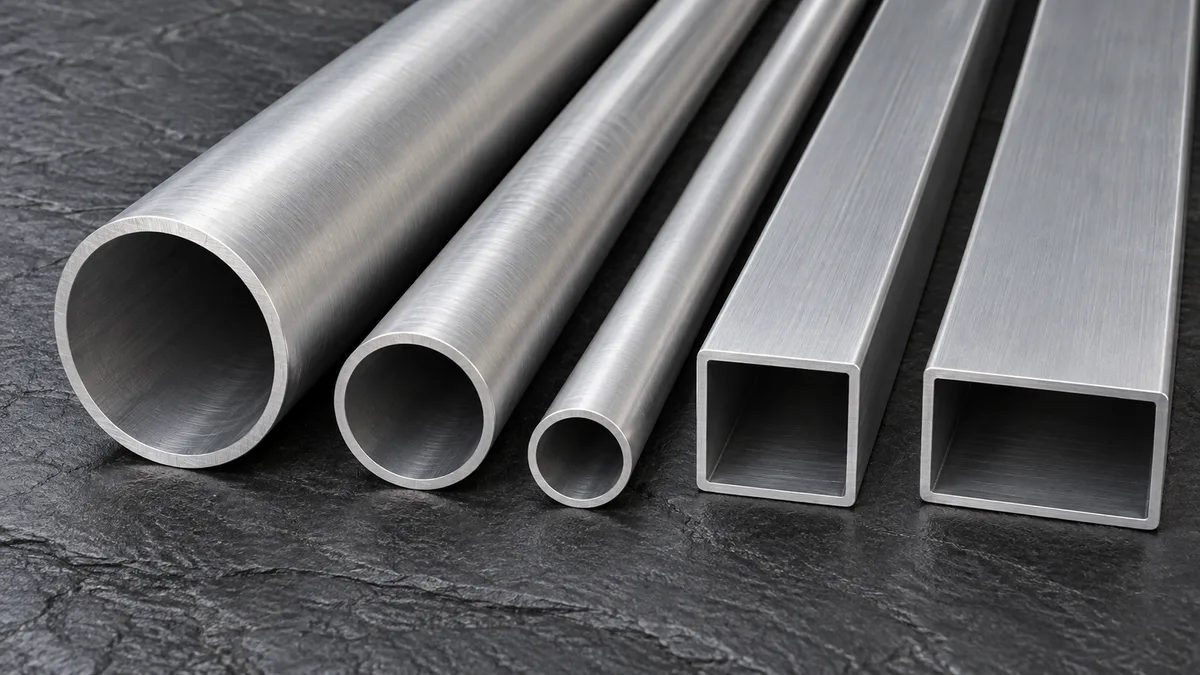
An extruded tube is a hollow section made in a single extrusion pass. The die forms the outside of the tube and a mandrel forms the bore, so the wall thickness is the gap between them. The tube leaves the press as a continuous length, is quenched, stretched straight, cut and aged, exactly like a solid profile.
Extrusion is the most economical way to make aluminium tube in medium and large sizes and in non-round shapes. It produces round tube, square and rectangular hollow sections, oval and streamline tube, and hollows with internal webs, fins or slots, all from relatively inexpensive dies. Smaller, thin-walled and precision tubes are usually extruded first and then cold drawn to size; see the comparison later in this guide.
Tube and pipe are often used interchangeably, but in the aluminium trade "pipe" refers to the standard nominal pipe sizes (NPS) and schedules used in piping systems, while "tube" is specified by actual outside diameter and wall thickness. Both can be extruded, and both can be seamless or porthole, which is the distinction that matters most for performance.
Typical uses include structural frames and handrails, truck and trailer bodies, machine guarding, bicycle and sports equipment, hydraulic and pneumatic cylinders, heat-exchanger and condenser tubes, aerospace and defence components, and pipework for chemical, cryogenic and gas service.
There are two ways to put the hole in an extruded tube, and they produce materially different products.
A solid billet is pushed into a porthole die, where bridges hold the mandrel. The metal splits into streams around the bridges and re-joins in a welding chamber before passing the mandrel and die. The result is a tube with longitudinal weld seams (typically two to four) running its full length. In 6xxx alloys these seams are solid-state welds made under high pressure and temperature and are sound for structural use.
A hollow billet (or a solid billet pierced in the press) is extruded over a mandrel that moves with or is fixed to the ram, so the metal never splits and re-welds. The tube has no longitudinal seams and uniform properties around the circumference. Hard alloys such as 2024 and 7075, which do not weld reliably in a porthole die, are made this way.
| Feature | Porthole (structural) tube | Seamless tube |
|---|---|---|
| Billet | Solid billet | Hollow billet or solid billet pierced in the press |
| Weld seams | Yes, longitudinal | None |
| Typical alloys | 6063, 6060, 6061, 6005A, 6082, 3003, 1xxx | 6061, 6082, 2024, 2014, 7075, 5083, 3003 |
| Shapes | Round, square, rectangular, oval, multi-void, custom | Mainly round; some simple shapes |
| ASTM standard | ASTM B221, B429 (structural pipe and tube) | ASTM B241 (seamless pipe and tube), B345 (gas and oil piping) |
| EN standard | EN 755-8 tolerances (porthole tube) | EN 755-7 tolerances (seamless tube) |
| Typical use | Frames, railings, furniture, machine guarding, architecture | Hydraulic and pneumatic lines, pressure piping, aerospace, cylinders, cryogenics |
| Cost | Lower | Higher |
ASTM B429 makes the point explicitly: structural pipe and tube made through a bridge or porthole die is not for fluid-carrying applications involving pressure; for those, the specification directs users to seamless products under ASTM B241. If your application involves internal pressure, bending to tight radii, flaring, swaging or expansion, specify seamless tube. Our seamless aluminium tube guide goes deeper into seamless production and testing.
The most common shape, from small diameters to large-diameter tube over 300 mm. Specified by OD and wall, or by NPS and schedule for pipe.
Square hollow sections with sharp or radiused corners for frames, furniture, construction and machine structures.
Rectangular hollow sections for frames, rails and beams where bending stiffness in one direction matters.
Oval, elliptical and flat-sided tube for handrails, furniture, ladders, heat exchangers and aerodynamic parts.
Teardrop sections used for struts and fairings where low drag is wanted.
Less common hollow shapes for fittings, lighting, display systems and special structures.
Flat tubes with many small channels, used in automotive and HVAC heat exchangers. See microchannel tooling.
Tubes with integral external or internal fins or ribs for heat transfer or extra stiffness.
Tubes with T-slots for framing systems, and precision-bore tube for pneumatic cylinders.
Non-round tubes are almost always made in porthole dies, since a mandrel shaped like the bore is easier to hold with bridges. Custom hollow sections with internal webs, screw ports or attachment features are covered in our custom extrusion guide.
Large-diameter tube deserves a separate note. Round tube above roughly 300 mm OD needs a large press, and the very largest seamless tubes are made on specialised vertical presses or by alternative routes such as forging and boring, or rolling and welding plate. Lead time, minimum quantities and test requirements all grow with diameter, so it pays to confirm early whether a standard size from stock, a heavier-wall tube machined to size, or a fabricated alternative would serve. For heavy-wall cylinders and sleeves, bored bar or a seamless rolled ring can also be an economical substitute, depending on length.
| Alloy | Common tempers | Character | Typical tube uses |
|---|---|---|---|
| 6063 | T5, T52, T6 | Easiest to extrude, best surface finish and anodising, moderate strength | Handrails, architecture, furniture, irrigation, low-pressure lines |
| 6061 | T4, T6, T6511 | High strength, good corrosion resistance, weldable | Structural tube, pipe, hydraulic lines, bicycle and vehicle frames |
| 6082 | T6 | European structural alloy, similar to or slightly stronger than 6061 | Structural hollow sections, trailers, cranes, offshore |
| 6005A | T5, T6 | Good strength in thin-walled, complex hollows | Rail vehicles, scaffolding, ladders, solar structures |
| 3003 | H112, O, H14 | Excellent formability and brazeability | Heat-exchanger, condenser and refrigeration tube |
| 5083 / 5086 | H112, O | Marine corrosion resistance, good at cryogenic temperatures | Marine piping, LNG and cryogenic lines |
| 2024 | T3, T3511, T8 | High strength and fatigue resistance (seamless only) | Aerospace structural tube |
| 7075 | T6, T6511, T73511 | Highest common strength (seamless only) | Aerospace, defence, high-load sports and machine parts |
Typical properties (Aluminum Association / ASM handbook values) and selected ASTM minimums:
| Alloy and temper | Typical tensile | Typical yield | ASTM B221 / B241 minimum tensile / yield |
|---|---|---|---|
| 6063-T5 | 186 MPa / 27 ksi | 145 MPa / 21 ksi | 150 / 110 MPa (22 / 16 ksi), walls up to 12.5 mm |
| 6063-T6 | 241 MPa / 35 ksi | 214 MPa / 31 ksi | 205 / 170 MPa (30 / 25 ksi) |
| 6061-T6 | 310 MPa / 45 ksi | 276 MPa / 40 ksi | 260 / 240 MPa (38 / 35 ksi) |
| 2024-T3 | 483 MPa / 70 ksi | 345 MPa / 50 ksi | Thickness dependent; see standard |
| 7075-T6 | 572 MPa / 83 ksi | 503 MPa / 73 ksi | Thickness dependent; see standard |
Design to the specified minimums for the actual wall thickness, not to typical values. Mill test certificates report the measured results for each lot.
Welding reduces the strength of heat-treated tube near the weld; 6061-T6, for example, falls to roughly T4-level strength in the heat-affected zone. Structural design codes such as the Aluminum Design Manual and EN 1999 give reduced allowable stresses for welded zones.
| Standard | Scope |
|---|---|
| ASTM B221 / B221M | Extruded bar, rod, wire, profiles and tube (seamless or porthole) |
| ASTM B241 / B241M | Seamless pipe and seamless extruded tube, including pressure applications |
| ASTM B429 / B429M | Extruded structural pipe and tube in 6061 and 6063 (rails, posts, handrails, sign structures); not for pressure |
| ASTM B345 / B345M | Seamless extruded pipe and tube for gas and oil transmission and distribution piping |
| ASTM B210 / B483 | Drawn seamless tube, and drawn tube for general purposes (for comparison) |
| ASME SB-241 | ASME boiler and pressure vessel code version of B241 |
| SAE AMS-QQ-A-200 series and AMS specifications | Aerospace extruded tube and shapes by alloy |
| EN 755-1 / 755-2 | Delivery conditions and mechanical properties for extruded tube |
| EN 755-7 / 755-8 | Tolerances for seamless and porthole extruded tube respectively |
| ISO 6362, JIS H4080, GB/T 4437.1 | International, Japanese and Chinese extruded tube standards |
EN 755-7 and EN 755-8 cover the same size ranges (round tube about 8 – 450 mm OD, and shaped tube within a circumscribing circle of about 10 – 350 mm), but each applies only to its own production method. If a European drawing calls up EN 755-7, porthole tube is not acceptable even if it meets the dimensions.
Much of the small-diameter tube on the market is extruded and then cold drawn over a mandrel or plug through a sizing die. The drawing step changes the product significantly.
| Feature | Extruded tube | Extruded and drawn tube |
|---|---|---|
| Size range | Medium to very large diameters; thicker walls | Small diameters and thin walls |
| Tolerances | Commercial extrusion tolerances | Tighter OD, ID and wall tolerances |
| Surface | Mill finish | Smooth, bright surface inside and out |
| Concentricity | Good; seamless tube may show some wall eccentricity | Improved by drawing |
| Typical standards | ASTM B221, B241, B429; EN 755 | ASTM B210, B483; EN 754 |
| Typical uses | Structural tube, pipe, large tube, shaped hollows | Hydraulic and instrument tube, precision parts, bicycle tubing |
| Cost | Lower per kg | Higher (extra operations) |
A useful rule: if you need tight tolerances or thin walls on a tube under about 50 – 75 mm OD, ask for drawn tube; for larger diameters, heavy walls, non-round shapes or structural use, extruded tube is usually the right and cheaper answer. See our guide to drawn tube and wire.
Weight per metre of round tube in kg = π × (OD − wall) × wall × 0.0027, with OD and wall in mm (density 2.70 g/cm³ for 6061 and 6063). The tables below use that formula; 7075 and 2024 are about 3 – 4 % heavier. Use the tube weight calculator for other sizes, including square and rectangular tube.
| OD × wall (mm) | kg per metre | kg per 6 m length |
|---|---|---|
| 20 × 2 | 0.305 | 1.83 |
| 25 × 2 | 0.390 | 2.34 |
| 30 × 3 | 0.687 | 4.12 |
| 40 × 3 | 0.942 | 5.65 |
| 50 × 3 | 1.196 | 7.18 |
| 50 × 5 | 1.909 | 11.45 |
| 60 × 5 | 2.333 | 14.00 |
| 80 × 5 | 3.181 | 19.09 |
| 100 × 5 | 4.029 | 24.17 |
| 100 × 10 | 7.634 | 45.80 |
| 150 × 10 | 11.875 | 71.25 |
| 200 × 10 | 16.116 | 96.70 |
| 250 × 15 | 29.900 | 179.40 |
| 300 × 20 | 47.501 | 285.01 |
Aluminium pipe uses the same nominal sizes and schedules as steel pipe (ANSI H35.2 references ASME B36.10 dimensions). Weights below are calculated for 6061 from the nominal OD and wall:
| NPS (in) | OD (mm) | Sch 40 wall (mm) | Sch 40 kg/m | Sch 80 wall (mm) | Sch 80 kg/m |
|---|---|---|---|---|---|
| 1/2 | 21.3 | 2.77 | 0.44 | 3.73 | 0.56 |
| 3/4 | 26.7 | 2.87 | 0.58 | 3.91 | 0.76 |
| 1 | 33.4 | 3.38 | 0.86 | 4.55 | 1.11 |
| 1-1/2 | 48.3 | 3.68 | 1.39 | 5.08 | 1.86 |
| 2 | 60.3 | 3.91 | 1.87 | 5.54 | 2.57 |
| 3 | 88.9 | 5.49 | 3.88 | 7.62 | 5.25 |
| 4 | 114.3 | 6.02 | 5.53 | 8.56 | 7.68 |
| 6 | 168.3 | 7.11 | 9.72 | 10.97 | 14.64 |
| 8 | 219.1 | 8.18 | 14.63 | 12.70 | 22.23 |
Extruded tube is supplied to the tolerance tables of its order standard: ANSI H35.2 for ASTM orders, EN 755-7 or EN 755-8 for EN orders. Tolerances are set on OD (or width across flats), wall thickness, ovality, straightness, twist (for shaped tube), corner radii and cut length.
The most frequent ordering error with tube is mixing up dimensions: specifying OD and ID and wall together over-defines the tube, and specifying ID tolerance on porthole tube when the standard controls OD and wall. Specify two of the three (normally OD and wall) and name the standard.
Seamless tube bends more predictably because it has no seams. 6063 bends best; 6061-T6 needs generous radii or bending in T4 followed by ageing. Mandrel bending prevents ovality and wrinkling on thin walls.
6xxx tube welds by TIG or MIG with ER4043 or ER5356 filler; 5083 tube welds with ER5183 or ER5356. 2024 and 7075 tube are generally not fusion welded.
Flaring, swaging, compression fittings, threaded ends on heavy-wall pipe, clamps and adhesives are all used; seamless tube is preferred where ends are expanded or flared.
Tube can be cut, drilled, slotted, threaded and end-machined. For cylinder bores, honed or drawn tube gives the required finish.
6063 gives the most uniform decorative anodising; weld seams in porthole tube can show faintly after bright anodising. Powder coating hides seams completely.
Aluminium tube resists atmospheric and fresh-water corrosion well; 5xxx and 6061 perform well in marine air. Avoid direct contact with copper or carbon steel in wet conditions to prevent galvanic corrosion.
| Industry | Typical alloys | Tube type | Typical uses |
|---|---|---|---|
| Building and construction | 6063, 6061, 6082 | Porthole round, square and rectangular tube | Handrails, balustrades, frames, scaffolding, sign structures |
| Automotive and EV | 6061, 6082, 3003 | Porthole structural tube; seamless and microchannel tube | Frames, crash structures, cooling lines, radiators and condensers |
| Transport and trailers | 6061, 6082, 6005A | Structural tube and hollow sections | Trailer and truck body frames, bus structures, rail interiors |
| Aerospace | 2024, 7075, 6061 | Seamless tube | Structural tube, hydraulic and fuel lines, ground equipment |
| Marine | 5083, 5086, 6061 | Seamless and structural tube | Rails, stanchions, masts, piping and offshore structures |
| Defence | 7075, 7050, 6061 | Seamless tube | High-strength structural and machined components |
| Compressed gas and cryogenics | 6061, 5083 | Seamless tube | Gas lines, cryogenic and LNG piping, cylinder blanks |
| HVAC and heat transfer | 3003, 1xxx, 6063 | Seamless, porthole and microchannel tube | Heat exchangers, evaporators, condensers |
| Machinery and sport | 6061, 7075, 6063 | Structural and seamless tube | Machine guards, rollers, bicycle frames, tent poles, ladders |
For industry-specific details see the automotive, aerospace and marine pages.
Structural (porthole) tube is extruded through a bridge die, so the metal splits and re-welds, leaving longitudinal seams. Seamless tube is extruded from a hollow or pierced billet over a mandrel and has no seams. Seamless tube is required for pressure service and for hard alloys such as 2024 and 7075.
No. ASTM B429 states that structural tube made through a porthole or bridge die is not for fluid-carrying applications involving pressure. Use seamless pipe or tube to ASTM B241 or EN 755-7 instead.
Weight per metre in kg = π × (OD − wall) × wall × 0.0027, with dimensions in mm. A 50 × 3 mm tube in 6061 weighs about 1.20 kg/m; NPS 2 schedule 40 pipe weighs about 1.87 kg/m.
6061-T6 is the general-purpose choice for strength and pressure tube, 6063 for architectural and decorative tube, 6082 in Europe for structural hollows, 3003 for heat exchangers, 5083 for marine and cryogenic service and 7075 for maximum strength.
No. Drawn tube has tighter OD, ID and wall tolerances and a smoother surface. Extruded tube is less expensive and is available in larger diameters, heavier walls and non-round shapes.
Yes. Square, rectangular, oval and custom hollow sections are produced in porthole dies in 6063, 6061, 6082 and 6005A, with sharp or radiused corners, mill or anodised finish.
Tell us the alloy, seamless or structural, size, length and quantity. Metline will confirm availability, testing, certification and delivery worldwide.





