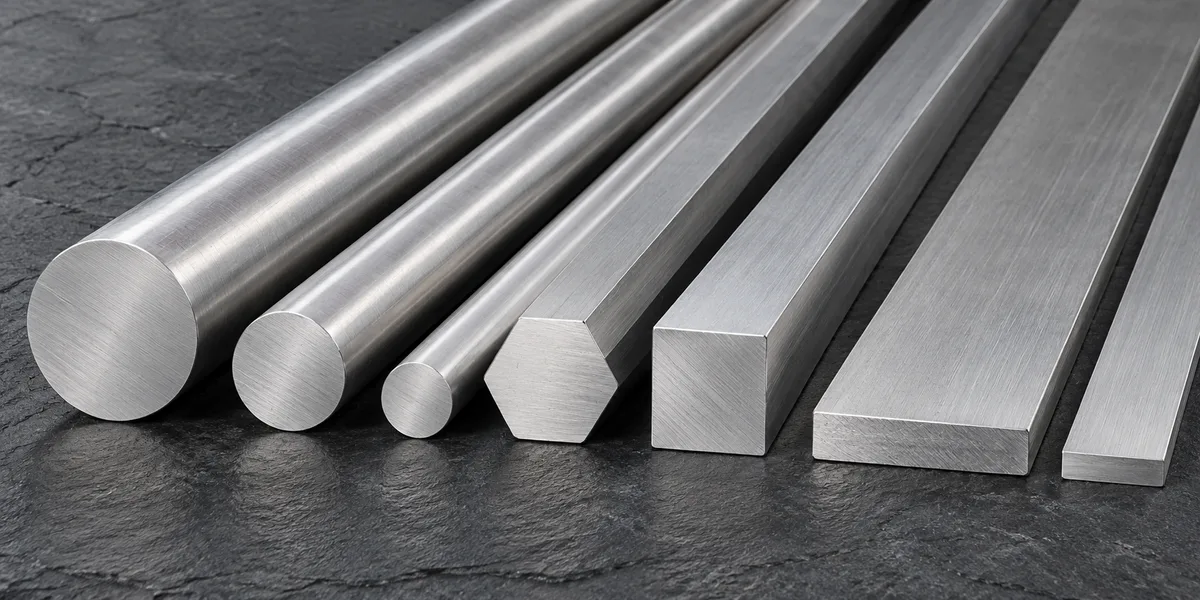
Extruded Aluminium Bar & Rod: Shapes, Alloys and Specifications
Extruded aluminium bar is solid stock made by pushing a heated billet through a die, which gives round, square, hexagonal, flat and shaped sections in long lengths at low tooling cost. This guide explains which alloys and tempers to choose, the standards that govern extruded bar, how it compares with drawn and rolled bar, and how to specify sizes, tolerances and certificates when you buy. Metline supplies extruded bar in every common alloy to customers worldwide.
An extruded bar is a solid aluminium section produced in one pass through an extrusion die. A cylindrical billet is heated to roughly 400 – 500 °C, loaded into a press container and pushed by a ram through a steel die whose opening has the shape of the finished bar. The metal emerges as a continuous length with that cross-section, is cooled, stretched straight, cut and, for heat-treatable alloys, aged to its final temper.
Because the shape comes from the die opening rather than from rolls or machining, extrusion can make almost any solid cross-section: plain rounds, squares and hexagons, flat bars with sharp or rounded corners, and shaped bars such as angles, tees, channels, half-rounds and triangles. Die cost for a simple solid section is low, so even non-standard sizes are economical once quantities reach a few hundred kilograms.
The term "rod" is normally used for round solid sections and "bar" for square, rectangular, hexagonal or octagonal ones, although buyers and catalogues use the words loosely. ASTM B221 covers extruded bar, rod, wire, profiles and tube under one specification, while the European EN 755 series splits the same products into separate parts for round bar, square bar, rectangular bar, hexagonal bar, tube and profiles.
Extruded bar is the starting stock for a huge range of parts: turned shafts and fittings, CNC-machined brackets, fasteners, busbars, frames, rails and trim. Choosing well means getting four things right: the alloy, the temper, the production route (extruded, drawn or rolled) and the tolerance standard. The sections below cover each one.
Cross-sections
Standard and shaped extruded bar sections
Extruded bar falls into two groups: standard geometric bars that are used as machining stock, and shaped (structural or decorative) bars that are used close to their extruded form.
Round bar / rod
The most common form. Small diameters are often drawn after extrusion for tighter tolerance; large diameters (above about 100 mm) are usually supplied as extruded. Used for shafts, pins, turned fittings, hydraulic parts and fastener blanks.
Square bar
Sharp-cornered or radiused squares, typically 6 – 150 mm across flats. Used for machined blocks, frames, spacers and fixtures.
Hexagonal bar
Hex bar reduces machining for nuts, couplings, fittings and fastener heads because the flats are already formed. Sizes are specified across flats (A/F).
Flat / rectangular bar
Rectangular sections from thin strips to heavy bars, with square or rounded edges. Used for busbars, wear strips, framing, brackets and base plates. See our flat bar range.
Half-round and oval
Semi-circular and half-oval bars used for edging, handrails, trims and decorative details.
Triangle and octagon
Less common geometric bars for special supports, tooling and decorative work, produced from simple solid dies.
Angle (L) and tee (T)
Equal and unequal angles and tee bars for frames, edge protection, supports and stiffeners.
Channel (U, C, J, F)
Open channel sections for tracks, glazing, edging and pipe supports. Channel guide.
Z, H and Y sections
Special connection, framing and support sections, often produced to the customer's drawing.
Beyond plain geometry, extrusion also makes functional bars: T-slot framing bars for machine guarding and automation, conductive bars in 1350, 6101 or 6060 for electrical busbars, and precision ground rods for bushings and guides. Each is described in the related pages at the end of this guide.
Alloy selection
Which alloys are used for extruded bar?
Almost every wrought alloy can be extruded, but they differ greatly in extrusion speed, achievable shape complexity and cost. Soft 6xxx alloys flow easily and can be pushed fast through complex dies; hard 2xxx and 7xxx alloys need slower speeds, higher pressures and simpler shapes, which is why they cost more per kilogram.
Group
Typical alloys
Character
Typical uses
General purpose
6060, 6063, 3003, 1100
Very easy to extrude, excellent surface and anodising, moderate strength
Lead-free or low-lead chip-breaking additions for automatic lathes
High-volume turned parts, screw-machine products
Conductor
1350, 6101, 6060
High electrical conductivity
Busbars, connectors, earthing bars
For most engineering buyers the decision comes down to three candidates. 6061 is the default in the Americas and Asia; 6082 fills the same role in Europe and is slightly stronger in thick sections; and 7075 is chosen when strength matters more than weldability or cost. 6063 is not a machining alloy, but it is the right choice for bars that will be anodised for appearance or bent.
Mechanical properties
Mechanical properties of common extruded bar alloys
The table lists typical room-temperature values from the Aluminum Association and ASM handbooks. Typical values show what material usually achieves; for design, use the specified minimums in ASTM B221 or EN 755-2, which vary with temper and section size. Every Metline delivery carries a mill test certificate with the actual results for the lot.
Alloy and temper
Typical tensile strength
Typical yield strength
Typical elongation
Brinell hardness
6063-T5
186 MPa / 27 ksi
145 MPa / 21 ksi
12 %
60 HB
6063-T6
241 MPa / 35 ksi
214 MPa / 31 ksi
12 %
73 HB
6061-T6 / T6511
310 MPa / 45 ksi
276 MPa / 40 ksi
12 – 17 %
95 HB
2024-T3 / T3511
483 MPa / 70 ksi
345 MPa / 50 ksi
18 %
120 HB
7075-T6 / T6511
572 MPa / 83 ksi
503 MPa / 73 ksi
11 %
150 HB
ASTM B221 specified minimums for common grades: 6061-T6 extrusions 260 MPa (38 ksi) tensile and 240 MPa (35 ksi) yield; 6063-T6 205 MPa (30 ksi) tensile and 170 MPa (25 ksi) yield; 6063-T5 up to 12.5 mm 150 MPa (22 ksi) tensile and 110 MPa (16 ksi) yield. Higher-strength alloys have thickness-dependent minimums; check the standard or the certificate.
Two points are often missed. First, the extrusion minimums in ASTM B221 are lower than the typical values, so a bar can pass the specification while testing well below the handbook figure; if your design relies on higher strength, write it into the order. Second, large-diameter bars cool more slowly at the centre during quenching, so strength falls as diameter rises, especially in 7xxx and 2xxx alloys. For critical parts above about 150 mm diameter, ask for test results taken from the bar centre or consider a forged bar instead.
Tempers
Tempers for extruded bar explained
Extruded bar is supplied in a smaller set of tempers than sheet and plate. The suffix tells you how the bar was cooled, treated and stress-relieved, which affects strength, straightness and how it behaves when machined. Our temper designation guide explains the full system.
Temper
What it means
When to order it
F / H112
As extruded, no controlled treatment; H112 has minimum properties guaranteed
Non-heat-treatable bars (5083, 3003) and stock for later forging
O
Fully annealed, softest condition
Severe bending, cold heading or forming before heat treatment
T4
Solution heat-treated and naturally aged
Parts that will be formed and then aged to T6
T5
Cooled from the extrusion temperature and artificially aged
Economical 6060/6063 bars where moderate strength is enough
T6
Solution heat-treated and artificially aged
Full strength in 6061, 6082, 7075 and 2014
T6511 / T6510
T6 plus controlled stretching to relieve stress (T6511 allows minor straightening)
Bar that will be heavily machined; stays straight and dimensionally stable
T3511
2024 solution treated, stretched, naturally aged
Aerospace and high-fatigue 2024 parts
T73511 / T76511
Over-aged 7xxx tempers, stretched
Aerospace parts needing resistance to stress-corrosion cracking
For machined parts, the stretched tempers (T6511, T3511, T73511) are worth the small extra cost. Stretching by 1 – 3 % after quenching removes most of the residual stress that otherwise makes long parts bow when one side is machined away.
Production route
Extruded bar vs cold-drawn and rolled bar
The same alloy and temper can reach you by three routes, and the route affects tolerance, surface, straightness and price. ASTM B221 covers extruded products; ASTM B211 covers cold-finished (drawn) and rolled bar, rod and wire; in Europe, drawn bar falls under EN 754 and extruded bar under EN 755.
Feature
Extruded bar
Cold-drawn (cold-finished) bar
Rolled bar
Process
Hot extruded through a die, stretched straight
Extruded, then drawn cold through a finishing die
Hot rolled from ingot or cut from plate
Diameter tolerance
Commercial extrusion tolerances (wider)
Tight; typically a fraction of the extruded tolerance
Variable; often sawn from plate
Surface
Mill finish, may show light die lines
Bright, smooth, sharp corners
Rolled or sawn surface
Size range
Small to very large (over 300 mm)
Small sizes, usually up to about 75 – 100 mm
Large square and rectangular sizes
Shapes
Any solid section, including angles, tees, custom
Round, square, hex, rectangle
Mainly rectangular
Typical use
General machining stock, large parts, shaped sections
Screw-machine parts, precision pins, fasteners
Large blocks and thick flat bar
Relative cost
Lowest
Higher (extra operation)
Depends on size
The practical rule: if the bar goes into an automatic lathe or collet chuck, or needs a finished surface without machining, buy cold-drawn bar. If it will be machined all over, or the size or shape is beyond the drawing range, extruded bar does the job at lower cost. For very large solid sections where through-thickness properties matter, compare extruded bar with rolled or forged bar.
Standards
Standards for extruded aluminium bar
Quote the governing standard on every order. It defines chemistry, minimum properties, tolerances and testing, so it is the basis for acceptance. The main ones are listed below; projects in a given region usually follow that region's system, and one bar can be certified to several standards when the limits overlap.
Standard
Scope
ASTM B221 / B221M
Extruded bar, rod, wire, profiles and tube: chemistry, tempers, mechanical properties
ANSI H35.2 / H35.2M
Dimensional tolerances for aluminium mill products, referenced by ASTM
SAE AMS-QQ-A-200 series, AMS 4150, AMS 4154 and others
Aerospace extruded bar, rod and shapes by alloy and temper
EN 755-1 / 755-2
Technical delivery conditions and mechanical properties of extruded rod, bar, tube and profiles
EN 755-3 / -4 / -5 / -6
Tolerances for round, square, rectangular and hexagonal extruded bar
EN 755-9
Tolerances for extruded profiles (shaped bars)
EN 573-3
Chemical composition of wrought alloys
ISO 6362
International equivalent for extruded rod, bar, tube and profiles
JIS H4040
Japanese standard for aluminium bar, rod and wire
GB/T 3191 and GB/T 3190
Chinese standards for extruded bar and chemistry
IS 733
Indian standard for wrought aluminium bars, rods and sections
EN 755-3 covers round bars from 8 mm to 320 mm diameter and sets tolerances on diameter, ovality and straightness; EN 755-5 covers rectangular bars from 2 mm to 240 mm thick and 10 mm to 600 mm wide, including corner radii, squareness and twist. Tolerances widen as size increases and are tighter for "easy" alloys such as 6060 and 6063 than for hard alloys such as 7075, so the alloy you pick changes the tolerance you get.
Supply range
Typical sizes and theoretical weights
Typical supply range
Round bar
About 6 mm to over 300 mm diameter; large diameters to about 500 mm on request
Square and hex bar
About 6 – 150 mm across flats
Flat bar
Thickness 2 – 100 mm, width 10 – 400 mm and wider on request
Imperial sizes
Rounds 1/4 – 12 in; flats 1/8 × 1/2 in to 2 × 12 in; lengths 12 ft and 20 ft
Length
Standard 3 m, 4 m, 6 m (or 12 ft) random or fixed; cut pieces on request
Surface
Mill finish, anodised, powder coated, polished or brushed
Size availability depends on alloy and temper; very large or very small sections in hard alloys need checking against the mill's range.
Theoretical weight is cross-sectional area × length × density (2.70 g/cm³ for most 6xxx alloys). For a round bar, weight per metre in kg = 0.7854 × d² × 0.0027, with d in millimetres. 7075 (2.81 g/cm³) and 2024 (2.78 g/cm³) are about 3 – 4 % heavier. Use the bar weight calculator for other sizes.
Size (mm)
Round bar kg/m
Hex bar (A/F) kg/m
Square bar kg/m
6
0.076
0.084
0.097
8
0.136
0.150
0.173
10
0.212
0.234
0.270
12
0.305
0.337
0.389
16
0.543
0.599
0.691
20
0.848
0.935
1.08
25
1.33
1.46
1.69
30
1.91
2.10
2.43
40
3.39
3.74
4.32
50
5.30
5.85
6.75
60
7.63
8.42
9.72
80
13.57
14.96
17.28
100
21.21
23.38
27.00
120
30.54
33.67
38.88
150
47.71
52.61
60.75
200
84.82
93.53
108.00
250
132.54
146.14
168.75
300
190.85
210.44
243.00
Quality
Tolerances, straightness and inspection
Commercial extruded bar is supplied to the standard tolerance tables of the order specification. If your drawing needs more, state it explicitly, or allow a machining margin and specify cold-drawn or precision-ground bar.
Cross-section: diameter, across-flats or thickness/width to ANSI H35.2 or EN 755-3/-4/-5/-6; tighter "precision" tolerances are possible on small 6xxx bars
Straightness: controlled by stretching; stretched tempers (T6511) are straighter and stay straighter when machined
Twist and squareness: relevant for square, hex and flat bar; specified per metre of length
Ends: saw cut square; cut lengths to drawing tolerance on request
Testing: chemistry and tensile tests per lot; hardness and conductivity checks; ultrasonic inspection (for example to ASTM B594 or AMS-STD-2154) for aerospace and large-diameter bar
Documents: EN 10204 3.1 mill test certificate; third-party inspection on request
A common source of rejection is ordering bar to "drawing tolerance" when the drawing shows finished-part tolerances. Extruded bar is a raw material; specify the stock size and the standard, and leave the finished tolerance to machining.
Fabrication
Machining, welding and finishing extruded bar
Machining
6061-T6, 6082-T6, 7075-T6 and 2024-T3 all machine well with sharp carbide tools, high speeds and flood coolant. Soft tempers (O, F, 6063-T5) are gummy and form built-up edge; for high-volume turning choose 2011, 6262 or 6026.
Welding
6xxx bars weld readily by MIG and TIG with ER4043 or ER5356 filler, although the heat-affected zone loses part of its T6 strength. 5083 welds without heat treatment. 7075 and 2024 are generally not fusion welded; use mechanical fastening.
Bending
Bend in T4 or O and age afterwards for tight radii. T6 bars need generous radii and are best bent across the extrusion direction with care.
Anodising
6060 and 6063 give the most uniform decorative anodising; 6061 and 6082 anodise well for protection. 7075 and 2024 accept hard anodising for wear surfaces.
Coating and polishing
Powder coating, wet painting, brushing and mirror polishing are all applied to extruded bar; specify the finish standard on the order.
Cutting and processing
Bars can be supplied cut to length, chamfered, drilled or machined to drawing, which reduces handling and scrap at your plant.
Applications
Where extruded bar is used, by industry
Industry
Typical alloys
Typical shapes and parts
Aerospace
2024, 7075, 7050, 6061
Round, square and hex bar for fittings, brackets and machined components; see aerospace
Marine
5083, 5052, 6061, 6082
Round and flat bar, angles and tees for fittings, frames and deck hardware
Defence
7075, 2024, 7050, 2219
High-strength bar for machined components; material certificates to military specifications
Automotive and EV
6061, 6082, 5754, 7075
Bars and shaped sections for brackets, suspension parts, battery structures
Building and architecture
6063, 6060, 6061
Flat, half-round and custom bars for trims, handrails, balustrades and decoration
Power and electrical
1350, 6101, 6063
Flat and rectangular busbars, earthing and connector bars
Machinery and automation
6061, 6082, 7075
Round, square and hex bar for shafts, fixtures and T-slot framing
Rail and road transport
6082, 6061, 6005A
Bars and shaped sections for frames, floors and fittings
Medical equipment
6061, 5052
Round and rectangular bar for equipment frames and machined parts, usually anodised
How to specify
How to specify and order extruded bar
Define the dutyLoad, environment (indoor, marine, chemical), operating temperature, and whether the part is welded, machined, bent or anodised.
Choose alloy and temperUse the alloy table above: 6063 for appearance, 6061/6082 for general engineering, 5083 for seawater, 7075/2024 for high strength. Pick a stretched temper for machined parts.
Choose the routeExtruded for general stock and large or shaped sections; cold-drawn for screw-machine work and tight tolerance.
State size and standardShape, diameter or across-flats, length, tolerance standard (ASTM B221 / ANSI H35.2 or EN 755) and any special straightness or finish.
Specify documents and packingEN 10204 3.1 certificate, ultrasonic test if needed, export packing, and delivery terms (EXW, FOB, CIF or DAP).
Related pages
Related bar products and guides
Extruded bar by alloy and shape, and guides on extrusion, tube and finishing:
ASM Handbook, Vol. 2 – Properties of Wrought Aluminum and Aluminum Alloys
FAQ
Extruded aluminium (aluminum) bar: frequently asked questions
What is the difference between extruded and drawn aluminium rod?
Extruded rod is formed hot through a die and supplied with commercial tolerances and a mill finish. Drawn (cold-finished) rod is extruded first and then pulled cold through a finishing die, which gives tighter diameter tolerances, a brighter surface and sharper corners. Drawn rod costs more and is limited to smaller sizes.
Which aluminium alloy is best for extruded bar that will be machined?
6061-T6511 or 6082-T6 for general engineering parts, 7075-T6511 when high strength is needed, and 2011 or 6262 for high-volume automatic turning. Avoid 6063 and annealed tempers for precision machining, as they are soft and gummy.
How do I calculate the weight of an extruded aluminium bar?
Multiply cross-sectional area by length and density. For a round bar, kg per metre = 0.7854 × d² × 0.0027 with d in mm. A 50 mm round bar weighs about 5.30 kg/m and a 100 mm bar about 21.2 kg/m in 6061.
What is the largest diameter of extruded aluminium bar?
Standard extruded round bar is widely available up to about 300 mm diameter, and large presses can produce bars around 500 mm. Very large diameters are slower to source and have lower centre properties, so forged bar is sometimes preferred for critical parts.
Is extruded aluminium bar weaker than rolled or forged bar?
In the same alloy and temper, extruded bar meets the same type of minimum properties, with some directionality along the extrusion axis. Forging gives better through-thickness properties and grain flow, which matters for highly stressed aerospace or rotating parts.
What does T6511 mean on extruded bar?
T6511 is the T6 condition plus controlled stretching after quenching to relieve residual stress, with minor straightening allowed after stretching. It keeps bars straight and stable during machining.
Need extruded bar or rod?
Tell us the alloy, temper, shape, size and quantity. Metline will confirm availability, certification and delivery to your port or door.