Explosion-bonded clad plate
Thick aluminium (1050A, 1060, 5083) bonded to stainless or carbon steel plate for pressure equipment, cryogenic transitions, electrolytic cells and structural joints.



Aluminium clad stainless steel is a bimetal in which a layer of aluminium is metallurgically bonded to stainless steel, by roll bonding for thin sheet, strip and cookware discs, or by explosion bonding for thick plate and structural transition joints. It combines the heat conduction and light weight of aluminium with the hygiene, strength and corrosion resistance of stainless steel. This guide covers the bonding methods, material combinations, properties, standards, applications and how to specify it.
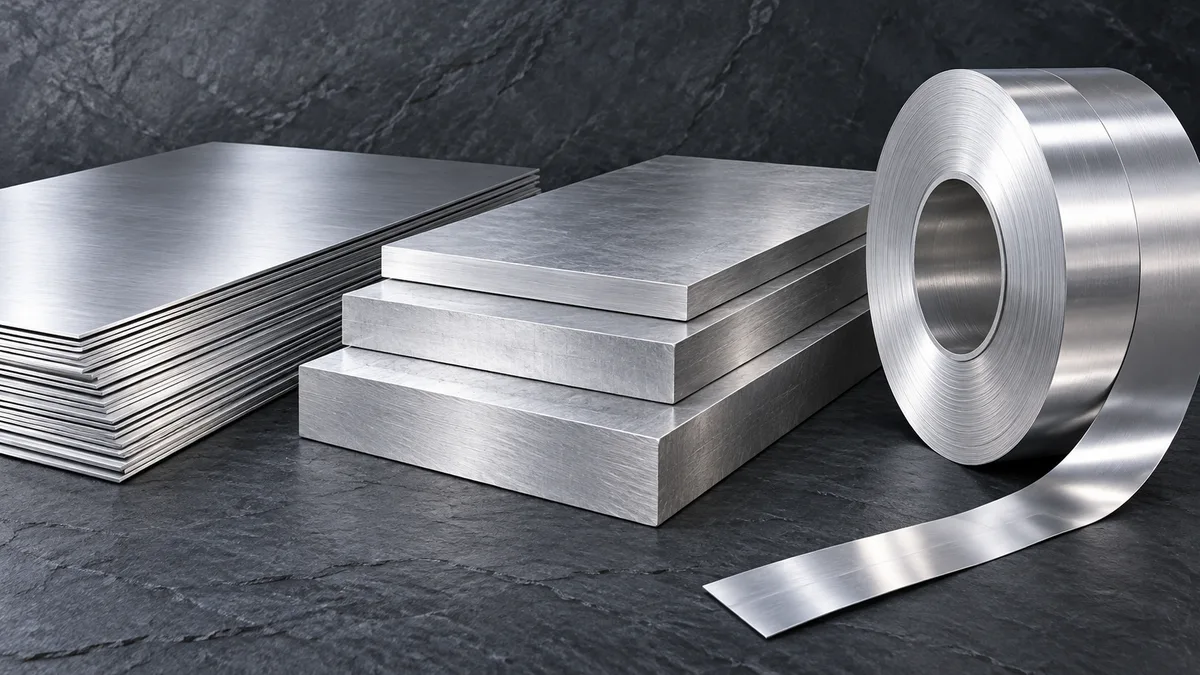
Cladding joins two metals over their whole contact area so that they behave as one sheet or plate. Unlike a painted or plated coating, the bond is metallurgical: atoms of aluminium and steel are brought into direct contact under pressure, with no adhesive between them. The result can be bent, deep drawn, machined and welded on each face with the process that suits that metal.
Aluminium and stainless steel complement each other well. Stainless steel is strong, hard-wearing, hygienic and resistant to many chemicals, but conducts heat poorly: grade 304 has a thermal conductivity of only about 16 W/m·K. Commercially pure aluminium conducts about 220 – 235 W/m·K and weighs roughly one third as much, but is soft and attacked by strong acids and alkalis. A bonded laminate puts each metal where it does most good.
The two metals cannot be joined reliably by ordinary fusion welding: molten aluminium and iron form brittle iron-aluminide compounds. Cladding avoids this by bonding in the solid state. That same property makes clad plate valuable as a transition joint, a strip that is welded to steel on one side and to aluminium on the other.
| Method | How it works | Typical products | Strengths and limits |
|---|---|---|---|
| Roll bonding | Cleaned, scratch-brushed surfaces are stacked and rolled with heavy reduction (often hot), then diffusion-annealed | Sheet, strip, coil, foil, cookware discs; two- or three-layer laminates | Consistent thickness and properties over long lengths; limited to thinner gauges |
| Explosion bonding | A controlled detonation drives the flyer plate onto the base plate at high velocity, forming a wavy metallurgical bond | Thick plate, structural transition joints, tube sheets | Joins very thick sections and dissimilar metals; size limited by the explosive charge and site |
| Friction stir and solid-state welding | A rotating tool or friction process joins the metals below their melting points | Lap and butt joints, tube transitions | Small heat-affected zone; joint geometry is restricted |
| Brazing and diffusion bonding | Heat and pressure, with or without a filler layer | Small precision parts | Precise but slow and costly for large areas |
In explosion-bonded aluminium-steel transition material, a thin interlayer of commercially pure aluminium (for example 1050) is usually placed between the steel and a structural aluminium alloy such as 5083. Pure aluminium bonds more reliably than magnesium-bearing alloys and reduces the formation of brittle compounds at the interface. Some structural joints also use a titanium or other interlayer for higher bond strength.
Thick aluminium (1050A, 1060, 5083) bonded to stainless or carbon steel plate for pressure equipment, cryogenic transitions, electrolytic cells and structural joints.
Two- or three-layer laminates from a few millimetres to around 25 mm, with the cladding typically a defined percentage of total thickness. Used for griddles, steam kettles and heat-transfer surfaces.
Stainless 304 inside, aluminium core, magnetic 430 outside, supplied as circles for deep drawing into pans, pots and kadhais.
Thin aluminium-stainless laminates, single- or double-sided, for stamping, bending and roll forming in appliances, heat exchangers and decorative trims.
Very thin laminates for shielding, heat spreading and specialist packaging.
Strips or rings cut from explosion-bonded plate, welded to the steel hull on one side and the aluminium superstructure or pipe on the other.
| Application | Stainless layer | Aluminium layer | Notes |
|---|---|---|---|
| Tri-ply cookware | 304 (cooking face) + 430 (outer) | 1050, 1060, 1100 or 3003 core | 430 is ferritic and magnetic, so the pan works on induction |
| Two-ply cookware or griddles | 304 or 430 | 1050 / 1060 / 3003 | Aluminium on the heated side spreads heat |
| Marine structural transition joints | 316L or carbon steel (ship steel) | 1050 interlayer + 5083 or 5086 | Welded to steel hull and aluminium superstructure |
| Cryogenic and pipe transitions | 304L / 316L | 5083, 6061, 3003 | Connect aluminium heat exchangers to stainless piping |
| Heat exchangers and appliances | 304, 316 | 1050, 3003, 5052 | Stainless for the wetted side, aluminium for heat spread |
| Electrical and electrochemical | 304, 316 or carbon steel | 1050A, 1060, 1070 | Current paths and anodes in electrolytic cells |
Ferritic grades such as 405, 410S, 429 and 430, and austenitic grades such as 304, 309, 316 and 321, can all be clad with aluminium. The choice depends on whether the face must be magnetic, how corrosive the medium is and whether the part will be deep drawn: 304 draws better than 430, while 430 is cheaper and magnetic.
A clad laminate does not have a single "alloy" property; its behaviour is set by the properties and thickness ratio of each layer. The table shows typical values for the individual metals.
| Property | 1050 / 1060 aluminium | 3003 aluminium | 304 stainless | 430 stainless |
|---|---|---|---|---|
| Density (g/cm³) | 2.70 | 2.73 | 7.9 | 7.7 |
| Thermal conductivity (W/m·K) | About 220 – 235 | About 160 – 190 | About 16 | About 26 |
| Thermal expansion (µm/m·°C) | About 24 | About 23 | About 17 | About 10 |
| Typical tensile strength, annealed (MPa) | About 70 – 80 | About 110 | About 515 min (ASTM A240) | About 450 min (ASTM A240) |
| Magnetic | No | No | No (annealed) | Yes |
The large difference in thermal expansion between aluminium and stainless steel means a two-layer laminate bows when heated. Tri-ply construction, with stainless on both faces, balances these stresses, which is one reason cookware is usually three-layer. For transition joints, the bond is commonly verified by through-thickness tensile and shear tests; supplier data for MIL-J-24445A-type joints often quotes minimums in the region of 75 MPa tensile and 55 MPa shear at the weakest interface. Long exposure above about 300 °C should be avoided, because brittle intermetallic compounds can grow at the interface.
Stainless values from ASTM A240 minimums and typical handbook data; aluminium values from Aluminum Association / ASM typical data. Bond strength must be confirmed by the test certificate of the actual lot.
| Standard | Relevance |
|---|---|
| MIL-J-24445A | US military specification for aluminium-to-steel structural transition joints made by roll or explosion bonding |
| Classification society rules (LR, DNV, ABS, BV) | Approval of transition joints used in ship structures |
| ASTM A240 | Chromium and chromium-nickel stainless steel plate, sheet and strip (stainless layer) |
| ASTM B209 / EN 485 | Aluminium sheet and plate (aluminium layer) |
| ASTM A578 | Ultrasonic examination of plain and clad steel plates; often applied to check bond continuity |
| EN 10204 | Inspection documents (3.1 or 3.2 certificates) |
ASTM A263, A264 and A265 cover stainless and nickel cladding on carbon steel rather than aluminium cladding, so they are sometimes used only as a reference for test methods such as bond shear. For aluminium-stainless products the order should state the test plan directly: ultrasonic scanning of the bond area, shear and tensile tests of the interface, bend or peel tests, and thickness checks of each layer.
Tri-ply pans, pots, pressure cookers and kadhais: a stainless cooking face, an aluminium core that spreads heat and a 430 base for induction.
Transition joints let shipyards weld aluminium superstructures to steel hulls, cutting top weight while avoiding bolted joints that corrode.
Steam kettles, griddles, evaporator pans and heat-transfer plates in food and chemical plants.
Aluminium-stainless pipe transitions connect aluminium cold boxes and heat exchangers to stainless piping in air separation and LNG equipment.
Current-carrying connections and anode assemblies where aluminium meets steel.
Clad strip for heat spreaders, stamped housings and decorative panels.
A typical example: a fast ferry uses a steel hull with an aluminium deckhouse. Strips of explosion-bonded steel/1050/5083 transition material are welded to the steel deck by normal steel welding, and the aluminium deckhouse is welded to the 5083 face with aluminium MIG. The bimetal interface stays below its temperature limit because the welds are made well away from it.
Saw, waterjet or shear. Avoid thermal cutting close to the bond, which can overheat the interface.
Roll-bonded tri-ply discs draw well when the layer ratio and annealing are correct; use lubricants suited to stainless.
Weld steel to steel and aluminium to aluminium only. Control heat input and interpass temperature so the interface stays below its temperature limit; follow the joint maker's and class society's procedure.
Machine each layer with tools and speeds suited to it; stainless work-hardens and aluminium smears.
Stainless faces are polished or brushed; aluminium faces can be left plain, hard anodised or coated depending on the use.
Seal the exposed bimetal edge with paint or sealant in wet service to prevent galvanic attack at the interface.
A three-layer laminate with an aluminium core between two stainless layers, usually 304 on the cooking side and magnetic 430 outside. The aluminium spreads heat evenly while the stainless faces give a durable, hygienic surface and induction compatibility.
Not reliably by fusion welding, because brittle iron-aluminium compounds form. Solid-state methods such as explosion bonding, roll bonding and friction welding, or a bonded transition joint, are used instead.
A strip cut from explosion-bonded plate, with steel on one face and aluminium (often a 1050 interlayer plus 5083) on the other. It is welded steel-to-steel and aluminium-to-aluminium, so the dissimilar joint is never fused.
Roll bonding produces thinner sheet, strip and discs with very consistent thickness over long lengths. Explosion bonding joins much thicker plates and suits structural transition joints and heavy process equipment.
By ultrasonic scanning for unbonded areas, plus shear, tensile, bend or peel tests of samples from the same plate or coil. Results are reported on the inspection certificate.
Normal cooking and process temperatures are fine. For structural transition joints, prolonged heating above about 300 °C should be avoided because brittle compounds can grow at the interface.
Tell us the layers, thicknesses, form and testing you need. Metline will confirm feasibility, certification and a delivered price worldwide.





