Deep drawing
Circles must have a fine, even grain and low earing so the drawn wall height is uniform. Order the O or H12 temper and specify earing limits for deep shapes.



Aluminium is used throughout the kitchen because it spreads heat quickly, weighs a third as much as steel, resists corrosion and is easy to form. Each use calls for a different alloy and product form: 3003 circles for pans, 8011 foil for wrapping and containers, 6063 extrusions for cabinet frames. This guide maps those choices and explains the food-contact rules, for manufacturers sourcing the aluminium stock.
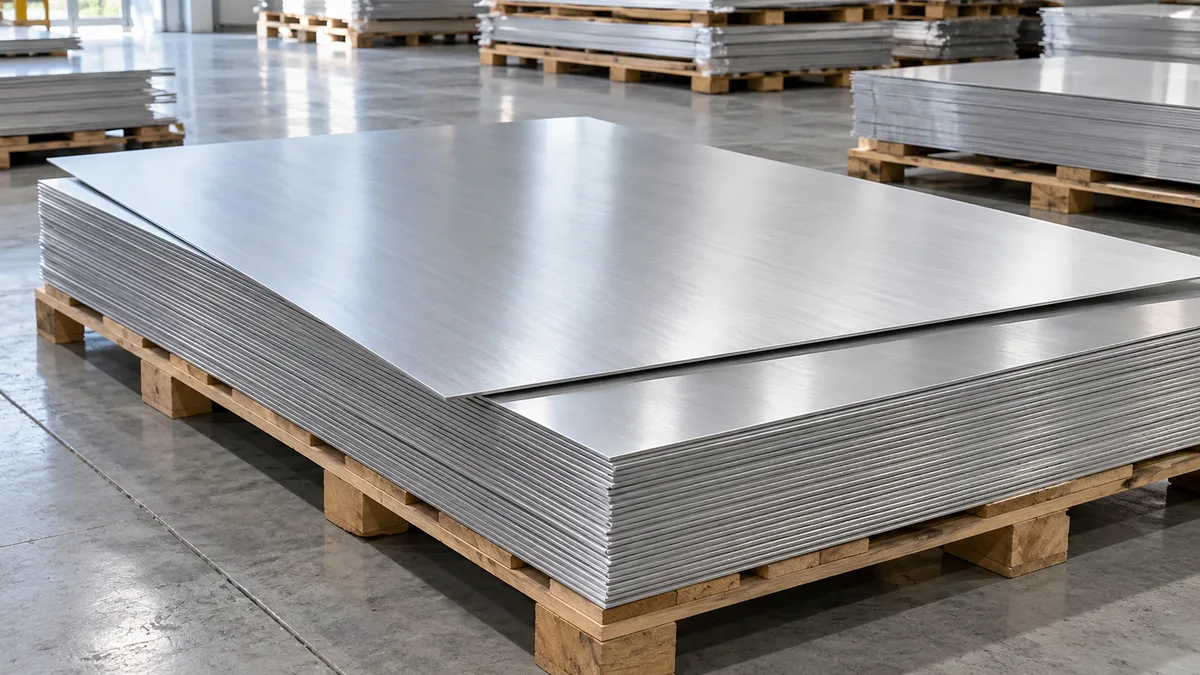
Three properties explain most kitchen uses. Aluminium conducts heat about ten times better than stainless steel, so a pan heats evenly without hot spots. It has a density of only 2.70 g/cm³, so large pots, trays and cabinet doors stay light. And it forms a thin, self-healing oxide film that protects it from moisture and steam.
| Material | Thermal conductivity (W/m·K, approx.) | Density (g/cm³) | Kitchen implication |
|---|---|---|---|
| Aluminium 1050 | 229 | 2.71 | Very even heating; soft, ideal for deep drawing |
| Aluminium 3003 | 193 | 2.73 | Even heating with more strength and dent resistance |
| Copper | 390 | 8.9 | Best conductor, but heavy and expensive |
| Cast iron | about 50 | 7.2 | Holds heat; slow and uneven to heat up |
| Stainless steel 304 | 16 | 8.0 | Durable and inert, but poor heat spreading; often clad with aluminium |
This is why many stainless steel pans have an aluminium disc bonded to the base, or an aluminium layer running through the whole body. The aluminium spreads the heat; the stainless steel gives a hard, inert cooking surface and, if it is a ferritic grade, makes the pan work on induction hobs.
Aluminium is also fully recyclable without losing its properties, and recycling uses only about 5 % of the energy needed to make primary metal. For packaging such as foil trays this is a practical advantage, provided the item is clean enough to enter the recycling stream.
Most wrought aluminium cookware starts as a circle (disc) cut from coil or sheet, which is then deep-drawn, spun or pressed into shape. Choosing the right alloy and temper is a balance between formability, strength and finish.
| Alloy | Typical temper | Properties | Typical products |
|---|---|---|---|
| 1050 / 1060 / 1070 | O, H12, H14 | Purest and softest; best deep-drawing and spinning; brightest anodised finish | Pressure cookers, saucepans, kettles, lids |
| 1100 | O, H14 | Slightly stronger than 1050 with similar formability | Pots, bakeware, utensils |
| 3003 | O, H12, H14 | About 20 % stronger than 1100; good drawing; resists denting | Frying pans, woks, non-stick pans, baking trays |
| 3004 | O, H32 | Higher strength from added magnesium | Heavy-duty pans, large stock pots |
| 5052 | H32 | Higher strength and corrosion resistance; less formable | Commercial trays, sheet pans, lids |
Circles must have a fine, even grain and low earing so the drawn wall height is uniform. Order the O or H12 temper and specify earing limits for deep shapes.
PTFE and ceramic coatings need a clean, degreased surface, often roughened by grit blasting or etching. 3003 is the usual base.
Hard-anodised cookware has a thick, very hard oxide layer that seals the metal from food and resists scratching.
Aluminium is not magnetic, so induction pans have a stainless steel plate impact-bonded or brazed to the aluminium base.
Heavy cast pans use aluminium casting alloys rather than circles; wrought circles give thinner, lighter walls.
Anodised or plain 3003 and 5052 sheet bakes evenly and does not rust in a dishwasher.
Our aluminium circles and deep-drawing sheet pages give sizes and tempers. Metline supplies circles, sheet and coil to cookware makers; we do not make or sell finished cookware.
| Product | Common alloys | Typical gauge | Notes |
|---|---|---|---|
| Household foil | 8011, 8079, 1235 | About 9 – 25 µm | Soft O temper; heavy-duty roll at the upper end |
| Food containers and trays | 8011, 3003, 3004 | About 30 – 120 µm | H22 or H24 for stiffness after pressing; often lacquered |
| Container lids | 8011, 3003 | About 30 – 80 µm | Plain, lacquered or printed; may be laminated to board |
| Cooking and roasting bags | 8011, 8079, 1235 | Thin gauges | Often laminated with paper or film |
| Air fryer and oven liners | 8011, 3003 | Thin to medium gauges | Pressed or perforated shapes |
8011 is the workhorse: its iron and silicon content gives it more strength than pure aluminium at the same gauge, so foil and trays resist tearing. 8079 is softer and very ductile, good for thin household foil. 1235 is a high-purity alloy used for thin foil and for laminating. Lacquered or colour-coated container stock is used when the tray is visible or when the lacquer is required as a barrier against acidic food.
See food container foil, cooking bag foil, 8011 foil and 1235 foil for specifications.
Aluminium cabinets and frames are popular in humid kitchens because they do not swell, rot or harbour termites the way particle board can. Cabinet makers use extrusions for frames, door profiles, handles and slots, and sheet or honeycomb panels for doors, back panels and shelves.
| Part | Material | Finish options |
|---|---|---|
| Carcass and door frames | 6063-T5 or 6063-T6 extrusions | Anodised, powder coated, wood-grain transfer |
| Glass-door and wine-cabinet frames | 6063-T5, 6061-T6 profiles | Anodised gold, black or champagne |
| Handles and finger-pull profiles | 6063 / 6061 profiles | Anodised or brushed; G-profile and edge-pull shapes |
| Door and side panels | 5052-H32 or 3003-H14 sheet; honeycomb panels | Powder coated, film laminated |
| Shelves and drawers | 6063 profiles, 5052 sheet | Anodised or powder coated |
| Slots and accessory rails | 6063-T5 slotted profiles | Anodised |
Extruded profiles are made to the cabinet maker's die drawing and can be cut, drilled and CNC-machined before finishing. For profile designs and more detail see aluminium cabinet materials and cabinet handle profiles. Metline supplies the profiles and sheet; cabinets themselves are built by the furniture maker.
Appliance sheet is usually supplied as coil or cut sheet in 0.2 – 3 mm, mill finish, embossed, pre-painted or anodised, to ASTM B209 or EN 485. See 3003 sheet, 1050 sheet and anodised sheet.
Aluminium cookware and packaging are permitted for food contact throughout the world, subject to the general rules for food-contact materials. A small amount of aluminium can migrate into food, and the amount depends strongly on the food and on whether the surface is protected.
| Rule or reference | What it says |
|---|---|
| EN 602 | Lists the chemical composition limits for wrought aluminium semi-products used to make articles for food contact |
| Regulation (EC) No 1935/2004 | EU framework: materials must not transfer constituents to food in amounts that endanger health or change the food unacceptably |
| Council of Europe CM/Res(2013)9 | Technical guide for metals and alloys; sets a specific release limit for aluminium of 5 mg/kg food |
| EFSA (2008) | Tolerable weekly intake of 1 mg aluminium per kg body weight from all sources |
| US FDA | Aluminium is widely used in food-contact articles under US food-contact rules |
Common mistake: ordering a hard temper for deep-drawn pans. H14 and harder tempers crack or earing becomes excessive in deep draws; use O or H12 unless the drawing ratio is shallow.
3003 is the most common choice for pans because it combines good deep-drawing behaviour with more strength than pure aluminium. 1050 and 1060 are used for deep shapes such as pressure cookers, and 3004 or 5052 for heavier commercial items.
Mostly 8011, 8079 or 1235 in the soft O temper, about 9 – 25 µm thick. Food containers use thicker 8011, 3003 or 3004 foil in H22 or H24.
Yes, within normal use. Regulators set release limits and intake guidance, and migration is low for most foods. Acidic and salty foods pick up more aluminium from bare metal, so anodised, coated or lacquered surfaces are preferred for them.
Stainless steel conducts heat poorly. An aluminium disc or core layer spreads heat across the base so the pan heats evenly, while the stainless surface stays hard and inert.
Yes. 6063 profile frames with anodised or powder-coated finishes do not swell, rot or rust in humid kitchens, and they can be recycled at end of life.
No. Metline supplies the aluminium materials: circles, sheet, coil, foil and extruded profiles, cut or processed to drawing on request, to manufacturers worldwide.
Send the alloy, temper, form, size and quantity for your cookware, foil, container, cabinet or appliance line. We will reply with availability and a delivered price.





