Overlay, one side (Cu/Al)
Copper covers one full face. Used for transition tabs and connectors that join copper on one side and aluminium on the other.



Copper clad aluminium strip is thin roll-bonded Cu/Al laminate supplied in coils or slit widths for high-speed stamping and welding. It gives stamped parts a copper face, stripe or edge exactly where they make electrical contact, and aluminium everywhere else for low weight and cost. Metline supplies overlay, inlay and edge-lay strip, typically 10 – 30 % copper, to battery, connector and electronics manufacturers worldwide.
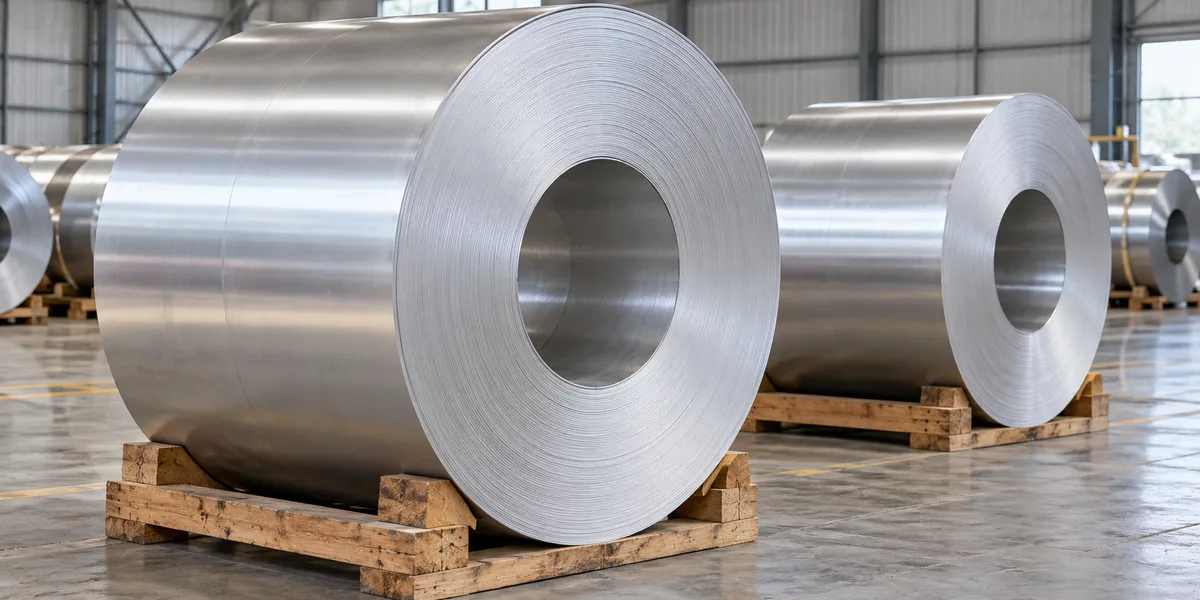
Strip is the form of copper clad aluminium designed for volume manufacturing. Coils feed straight into progressive dies, laser-welding lines and automated assembly, so a manufacturer can produce millions of bimetal tabs, terminals and connectors without handling individual blanks. Because the bond is made in the rolling mill, every part arrives with a permanent copper-aluminium joint already built in.
The economic case rests on putting copper only where it is needed. A battery connector may need copper only at the weld zone that meets a copper terminal; a lead frame may need copper only on its contact fingers. Inlay and edge-lay strip place a narrow copper stripe exactly there, so the copper content of the part can drop to a small fraction of a solid copper design.
Copper covers one full face. Used for transition tabs and connectors that join copper on one side and aluminium on the other.
Copper on both faces with an aluminium core, for conductors that must solder or contact on both sides and stay flat.
One or more copper stripes rolled into the aluminium surface so the strip stays flat and uniform in thickness. Copper appears only where the drawing calls for it.
Copper and aluminium joined edge to edge across the width, so one end of a stamped tab is copper and the other aluminium.
Copper on both faces and edges, used where no aluminium may be exposed on the formed part.
Copper core with aluminium faces, for parts welded to aluminium on both sides that need copper conductivity inside.
Confirm your width, thickness and ratio at enquiry; feasibility depends on structure.
The table gives weight per metre for some common sizes, calculated from the laminate density, so you can estimate coil lengths and part weights.
| Thickness × width (mm) | Area (mm²) | 15 % Cu (g/m) | 30 % Cu (g/m) | Solid copper (g/m) |
|---|---|---|---|---|
| 0.2 × 20 | 4 | 14.5 | 18.2 | 35.6 |
| 0.3 × 30 | 9 | 32.7 | 41.0 | 80.0 |
| 0.5 × 25 | 12.5 | 45.4 | 57.0 | 111.1 |
| 0.5 × 50 | 25 | 90.7 | 113.9 | 222.2 |
| 1 × 30 | 30 | 108.9 | 136.7 | 266.7 |
| 1 × 60 | 60 | 217.7 | 273.4 | 533.4 |
| 1.5 × 50 | 75 | 272.1 | 341.8 | 666.8 |
| 2 × 80 | 160 | 580.6 | 729.1 | 1422.4 |
| 3 × 100 | 300 | 1088.5 | 1367.1 | 2667.0 |
Calculated from rule-of-mixtures densities (3.63 and 4.56 g/cm³) and 8.89 g/cm³ for copper.
| Application | Typical structure | Why clad strip |
|---|---|---|
| Battery cell connectors and module busbars | Cu/Al overlay or edge-lay | Laser or ultrasonic welds copper to copper and aluminium to aluminium, avoiding direct dissimilar welds |
| Battery terminal tabs | Cu/Al or Cu/Al/Cu | Copper surface for nickel plating and welding with an aluminium body |
| Stamped terminals and connectors | Inlay | Copper only at contact points; lighter and cheaper than solid copper |
| Heat spreaders for LED and power electronics | Cu/Al or Cu/Al/Cu | Copper face spreads heat under the device; aluminium sheds it at low weight |
| Cable shielding and EMI parts | Thin overlay | Copper conductivity with aluminium weight |
| Transition washers and shims | Cu/Al overlay | Prevent galvanic corrosion between copper and aluminium conductors |
For EV and stationary battery packs in particular, where cell terminals and module busbars may be in different metals, clad strip has become a standard way to make welded joints reliable. See also our battery bus bar and power battery aluminium pages.
Avoid annealing or brazing finished parts. Long exposure above roughly 200 – 250 °C thickens the Al2Cu-type intermetallic layer at the interface and weakens the bond.
Strip is checked for layer ratio on cross-sections taken from the coil ends, peel and bend tests for bond, thickness and width tolerance, camber and flatness, and surface condition. Conductivity is measured on request. Each delivery comes with an EN 10204 3.1 certificate covering these results, plus coil identification so every part can be traced back to its lot.
Inlay strip has one or more copper stripes rolled into the surface of an aluminium strip, flush with it. Copper is present only where parts need electrical contact or welding, which saves weight and cost.
Typically 10 – 30 % of total thickness for overlay strip. On a 0.5 mm strip with 20 % copper, the copper layer is about 0.1 mm thick.
Yes. Weld the copper face to copper parts and the aluminium face to aluminium parts, with heat input controlled so the bond interface is not overheated.
Strip is thin laminate (up to about 3 mm) supplied in coils or slit widths for automatic stamping. Plate is thicker and supplied as sheets, blanks or machined parts.
It allows copper and aluminium cell terminals and busbars to be joined by welding same metal to same metal, avoiding brittle direct copper-aluminium welds and galvanic corrosion at the joint.
Send the structure, ratio, thickness, width and annual volume. We will reply with feasibility, test plan and pricing.





