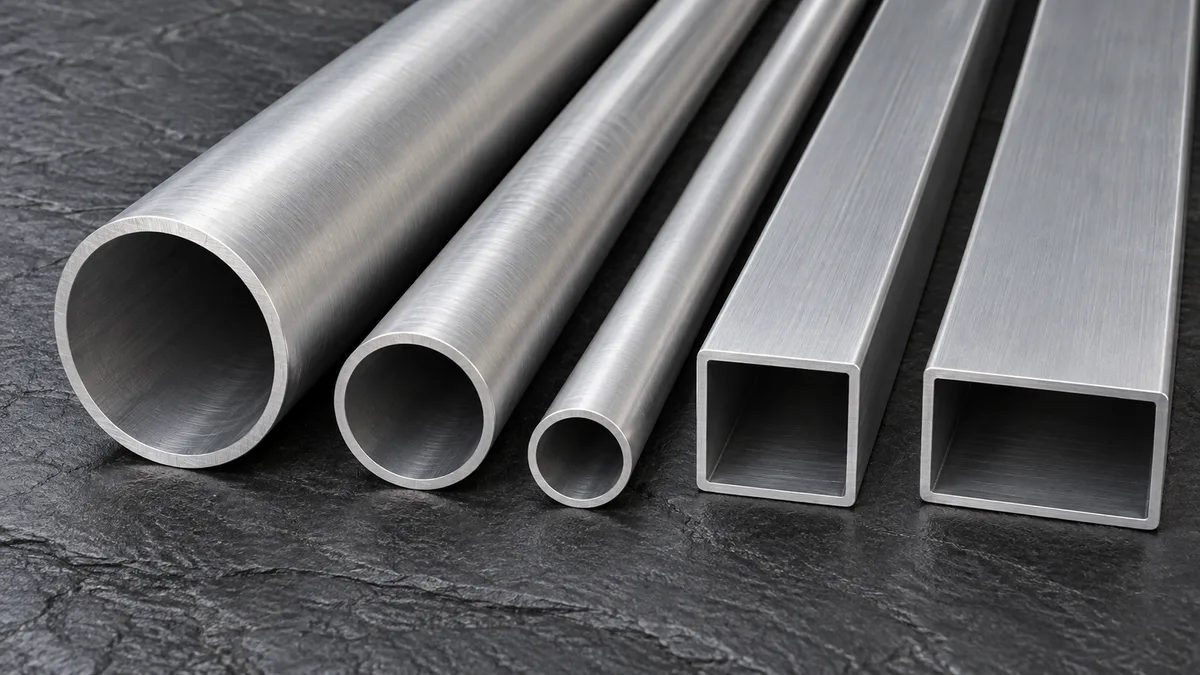
Titanium-Aluminium Composite Tube: Structure, Uses and Limits
A titanium-aluminium composite tube is a bimetallic heat-exchanger tube with a titanium inner tube and a continuous aluminium outer layer. The titanium resists seawater, brine and other corrosive media flowing inside the tube, while the aluminium spreads heat and can be rolled into integral fins on the outside. This guide explains how the tube is built, where it makes sense, where it does not, and how the aluminium side should be specified. Metline supplies the aluminium materials used for the outer layer and fins, and all-aluminium tube alternatives; we do not supply titanium.
The tube is two separate metals, not an alloy. A thin-walled titanium tube (usually commercially pure Grade 1 or Grade 2) forms the bore and touches the tube-side fluid. Around it, a layer of soft, high-conductivity aluminium is pressed or drawn on so tightly that the two act as one tube for heat transfer. The outer aluminium can stay plain or be cold-rolled into helical fins.
The idea is to put each metal where it does best. Titanium is almost immune to chloride corrosion and erosion in seawater, but it conducts heat poorly, is expensive and is hard to form into fins. Aluminium conducts heat about ten times better than titanium, is light, inexpensive and very easy to form, but it would corrode quickly in seawater or brine. A composite tube keeps the corrosive fluid on the titanium and gives the outside of the tube an aluminium surface.
Heat path
Material
Role
1. Tube-side fluid
Seawater, brine, cooling water
Corrosive medium that must stay inside
2. Inner tube
Titanium Grade 1 / 2
Corrosion barrier and pressure boundary
3. Interface
Mechanical or metallurgical bond
Must stay tight for good heat transfer
4. Outer layer
Aluminium 1050 / 1060 / 1070
Spreads heat, forms fins, reduces weight
5. Shell-side medium
Air, refrigerant, mild process fluid
Must be compatible with aluminium
Do not confuse this product with "titanium aluminide" (TiAl) or titanium alloys containing aluminium such as Ti-6Al-4V. Those are single alloys; a composite tube is a layered bimetal.
Supply forms
Composite plain tube and integral-fin tube
Composite plain tube
The aluminium layer is left smooth. Used where the outside is a condensing or boiling refrigerant, or where the tube is later formed, bent or assembled with separate fins. The aluminium gives a surface that is easier to join and expand than titanium.
Integral-fin (extruded-fin) tube
A thick aluminium sleeve is cold-rolled into helical fins, in the same way as the bimetallic extruded-fin tubes long used in air-cooled heat exchangers with steel or copper liners. The fins are part of the sleeve, so there is no fin-to-tube gap to loosen or corrode.
Titanium tube with separate aluminium fins
A bare titanium tube with wound, L-foot, embedded or plate fins attached afterwards. A mature alternative, but the fin root contact is less intimate than an integral fin.
Typical finished outside diameters for composite tubes are around 19.5 – 40 mm, with titanium walls in the region of 0.8 – 1.2 mm. The aluminium layer thickness depends on finished OD and on how much metal is needed to roll the fins. Fin height, pitch (fins per inch), fin OD, effective finned length and the length of plain ends are set by the heat-exchanger design.
Aluminium side
Specifying the aluminium outer layer
The aluminium side is where Metline is involved. It is normally a 1xxx commercially pure grade because these combine the highest thermal conductivity with the ductility needed to roll deep fins without cracking.
Grade
Aluminium content
Typical thermal conductivity (O temper)
Why it is used
1050 / EN AW-1050A
99.5 % min
About 230 W/m·K
Widely available, good fin-forming
1060
99.6 % min
About 234 W/m·K
Common fin and sleeve grade, slightly higher conductivity
1070 / EN AW-1070A
99.7 % min
About 230 W/m·K
Highest purity of the three, very ductile
3003 (for comparison)
Al-Mn
About 190 W/m·K
Stronger fins, used where fin damage is a concern; harder to roll deep fins
Titanium Grade 2 (for comparison)
—
About 16 – 22 W/m·K
Shows why titanium alone makes a poor fin
What to state for aluminium sleeve or fin stock
Grade and temper
For example 1060-O or 1070-O, annealed for maximum ductility
Form
Seamless drawn or extruded tube sleeve, or strip for wound fins
Dimensions
Sleeve OD and wall, or strip width and thickness, with tolerances
Surface
Clean, oil-free bore for bonding; no scratches or inclusions that could split during fin rolling
Certification
EN 10204 3.1 certificate with composition
Selection
When a composite tube makes sense and when it does not
Good fit: corrosive fluid (seawater, brine, chloride-bearing cooling water) inside the tube, and a dry or mild medium (air, refrigerant, steam condensate free of chlorides) outside
Good fit: designs that need a large external surface (fins) but cannot accept a copper-alloy or steel liner because of the tube-side fluid
Good fit: seawater-source heat pumps, marine coolers, industrial refrigeration and condensers using seawater or brine
Poor fit: seawater, salt spray or aggressive cleaning chemicals on the outside of the tube, which attack the aluminium; choose solid titanium instead
Poor fit: high tube-wall temperatures, where the difference in thermal expansion loosens the bond
Poor fit: specifications that require a monolithic titanium tube to a titanium tube standard
Option
Outside surface
External corrosion resistance
Fin forming
Relative titanium use
Titanium-aluminium composite
Aluminium, plain or integral fins
Depends on the aluminium-side environment
Easy (rolled from aluminium)
Liner only
Solid titanium plain tube
Titanium
Excellent
None
Whole tube
Solid titanium integral-fin tube
Titanium fins
Excellent
Difficult, low fins only
Whole tube
Titanium tube + attached aluminium fins
Aluminium fins
Depends on aluminium side
Mature processes
Base tube
All-aluminium tube
Aluminium
Good in air and refrigerants
Easy
None
Engineering
Design and fabrication points to check
Thermal expansion
Aluminium expands about 23 µm/m·K and titanium about 9 µm/m·K. When the tube heats up, the aluminium grows away from the titanium and contact pressure falls. Manufacturers of bimetallic finned tubes therefore state a maximum operating temperature for each construction; confirm it before design.
Bond quality
Heat transfer depends on intimate contact at the interface. Ask how bond integrity is checked, for example by sectioning samples, push-out tests or thermal performance tests.
Tube ends
Where the tube enters the tube sheet, the aluminium is usually removed to expose titanium for expansion or welding. The bare transition must be sealed or kept out of the corrosive fluid.
Galvanic coupling
Titanium is far more noble than aluminium. If both metals are wetted by the same electrolyte, for example at a damaged tube end or by salty condensate, the aluminium will corrode rapidly. Keep the aluminium side dry or in a non-conducting medium and protect transitions.
Bending and forming
U-bending finned tubes requires plain sections at the bend. The aluminium layer can be expanded and bent easily, but the titanium liner sets the minimum bend radius.
Standards
Titanium heat-exchanger tube standards such as ASTM B338 (plain) and ASTM B891 (integral-fin) cover the titanium tube only. Define the complete composite tube by a project specification that references them for the liner and an aluminium standard for the sleeve.
Applications
Typical applications
Seawater-source heat pumps: seawater in the titanium bore, refrigerant evaporating on finned or plain aluminium outside
Marine coolers and condensers: where weight matters and the shell side is clean and dry
Industrial refrigeration: brine or chloride-bearing cooling water in the tube
Air-cooled heat exchangers handling corrosive process fluids: finned composite tubes where the air side is not aggressive
Wastewater and process heat recovery: where fluids would attack copper alloys or stainless steel
A typical example is a seawater-source heat pump evaporator. A copper-nickel tube would be cheaper but can suffer erosion and sulphide attack in polluted harbour water; a solid titanium finned tube would be expensive and has only low fins. A titanium liner with a rolled aluminium fin sleeve gives the corrosion resistance of titanium on the water side with the large external surface of aluminium on the refrigerant side.
All-aluminium options
All-aluminium tubes for less aggressive duties
Where the tube-side fluid is not chloride-rich, an all-aluminium tube is lighter and much cheaper than any titanium construction. Common choices include 3003 and 1xxx seamless tube for refrigerant circuits, inner-grooved tube for evaporators and condensers, microchannel flat tube for compact coils and aluminium finned tube for air coolers. These are aluminium products Metline supplies directly, with mill certificates and export packing.
Is a titanium-aluminium composite tube the same as a titanium-aluminium alloy tube?
No. It is two separate layers, titanium inside and aluminium outside, bonded mechanically or metallurgically. Alloys such as Ti-6Al-4V or titanium aluminide are single materials with completely different uses.
Should seawater flow inside or outside the tube?
Inside. The titanium bore is the corrosion-resistant surface. The aluminium outside suits air, refrigerants and other mild media; seawater, salt spray or chloride-rich condensate on the outside will attack the aluminium.
Why use aluminium instead of titanium for the fins?
Aluminium conducts heat roughly ten times better than titanium, is far easier to roll into tall fins and costs much less. Titanium fins are possible but limited to low fin heights and are expensive.
What limits the operating temperature?
Mainly differential thermal expansion. Aluminium expands about two and a half times as much as titanium, so at high temperatures the outer layer loosens and heat transfer falls. Each manufacturer qualifies a maximum temperature for its construction.
Can ASTM B338 or B891 be applied to the whole composite tube?
Only to the titanium liner. The complete tube needs a project specification covering the aluminium layer, the bond, dimensions, fin geometry and inspection.
Does Metline supply titanium-aluminium composite tubes?
Metline supplies aluminium only. We provide the aluminium side, such as 1050, 1060 or 1070 sleeve tube and fin strip, and all-aluminium heat-exchanger tubes. The titanium liner and composite manufacture are sourced by the tube maker.
Need the aluminium for a heat-exchanger tube?
Tell us the grade, form and size of aluminium sleeve, fin strip or heat-exchanger tube you need. We reply with availability, certification and a delivered price.