Shearing and blanking
Clean shear edges with sharp tools and small clearance. Blank with the copper face toward the punch if burr on the copper side must be minimal.



Copper clad aluminium plate is a laminate in which copper is bonded to one or both faces of an aluminium plate, giving a copper surface for electrical contact or soldering and an aluminium body for low weight. It is supplied as one-side (Cu/Al), two-side (Cu/Al/Cu) and reverse (Al/Cu/Al) constructions, typically 0.5 – 15 mm thick, in sheets, blanks and stamped parts. Metline supplies copper clad aluminium plate to agreed layer ratios with bond and conductivity test certificates to buyers worldwide.
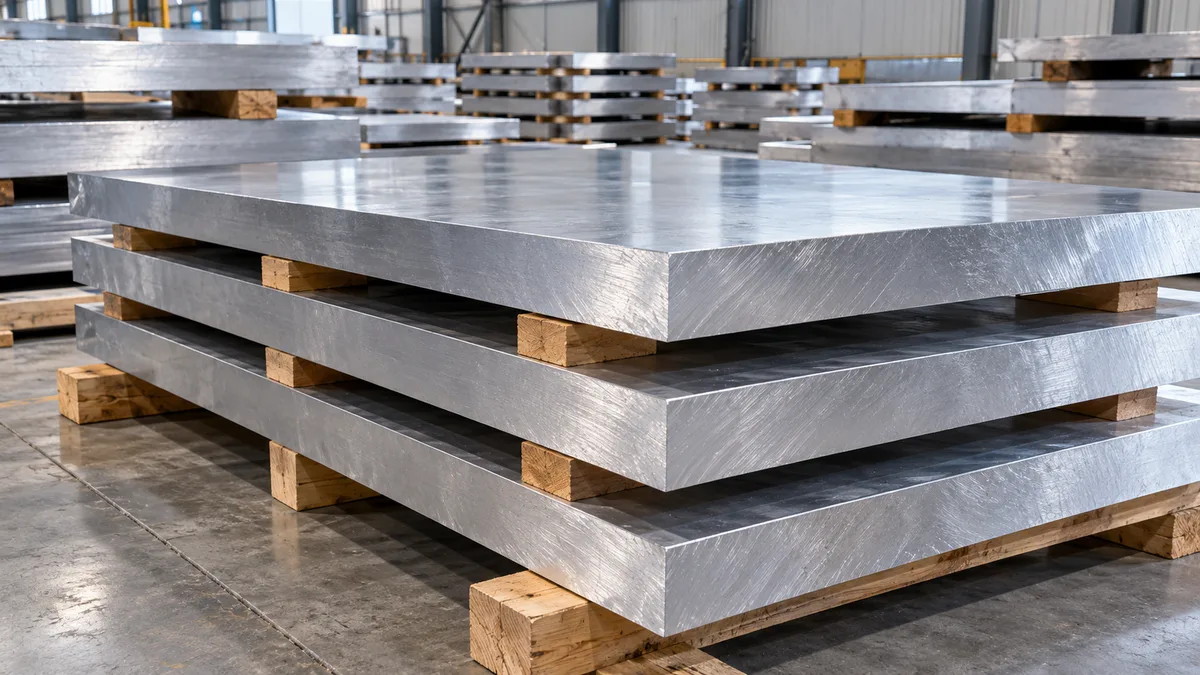
Copper and aluminium are the two metals of electrical engineering, and they are often in the same assembly: copper terminals on equipment, aluminium conductors and housings for weight. Joining them directly causes trouble. They cannot be fusion welded without brittle intermetallics, and a bare bolted joint between them corrodes in damp air. A clad plate solves the problem by doing the difficult joint once, in a controlled rolling mill, so that every part cut from it has a copper face and an aluminium face that can each be joined by ordinary methods.
Copper clad aluminium plate therefore has two main jobs. The first is as a transition material: a washer, block, tab or connector that sits between copper and aluminium conductors. The second is as a lightweight conductor or heat spreader with a copper working surface, where solid copper would be heavier and costlier than necessary.
This page covers plate and sheet. For long rectangular conductors with copper around all four sides, see copper clad aluminium bus bar; for thin coils and slit strip, see copper clad aluminium strip.
| Structure | Layers | Common ratio (by thickness) | Main uses |
|---|---|---|---|
| One-side clad | Cu / Al | 10/90, 15/85, 20/80; up to 50/50 by agreement | Transition washers, battery connectors, terminals, heat spreaders |
| Two-side clad | Cu / Al / Cu | 10/80/10, 15/70/15 | Conductors and contacts needing copper on both faces; balanced against bowing |
| Reverse clad | Al / Cu / Al | 10/80/10 | Copper core for conduction with aluminium faces for welding to aluminium parts |
| Inlay (partial clad) | Copper stripe set into the aluminium surface | Stripe width and depth to drawing | Local copper contact areas on aluminium parts |
| Edge-lay | Copper and aluminium joined side by side along an edge | Widths to drawing | Tabs and connectors with a copper end and an aluminium end |
The ratio is stated as a percentage of total thickness. It sets the conductivity, weight and cost of the plate, and it controls what each face can tolerate: a thin copper layer can be broken through by deep stamping, heavy machining or grinding, so the copper thickness should be chosen with the forming process in mind. Two-side constructions are symmetrical, so they stay flat when heated, whereas a one-side laminate bows slightly with temperature because aluminium expands about 40 % more than copper.
| Layer | Common grades | Reason |
|---|---|---|
| Copper | C11000 (Cu-ETP, T2), C10200 (Cu-OF, TU1) | Highest conductivity and good bonding; oxygen-free copper preferred where parts will be heated |
| Copper alloys (special) | Brass (e.g. C26800 / H65), cupronickel C70600 | Wear or corrosion resistance on decorative or heat-exchanger parts |
| Aluminium | 1050, 1060, 1070 | High conductivity, soft and very formable; the usual choice for electrical parts |
| Aluminium (stronger) | 3003, 5052 | More strength and stiffness for structural or heat-spreader parts, with lower conductivity |
For electrical work the combination of C11000 copper with 1060 or 1070 aluminium is standard: both are soft, conductive and bond well in roll bonding. Alloyed aluminium grades are stronger but bond less readily and conduct less, so they are reserved for parts where mechanical performance comes first.
Density and DC conductivity follow the copper fraction. The first table gives calculated values; the second gives weight per square metre for common thicknesses and copper fractions.
| Copper by volume | Density (g/cm³) | Weight vs copper, same size | Calculated conductivity | Area needed vs copper, same resistance | Weight vs copper, same resistance |
|---|---|---|---|---|---|
| 10 % | 3.32 | 37 % | ≈ 65 % IACS | 1.54 × | 58 % |
| 15 % | 3.63 | 41 % | ≈ 67 % IACS | 1.50 × | 61 % |
| 20 % | 3.94 | 44 % | ≈ 69 % IACS | 1.45 × | 64 % |
| 30 % | 4.56 | 51 % | ≈ 73 % IACS | 1.38 × | 71 % |
| 50 % | 5.79 | 65 % | ≈ 80 % IACS | 1.24 × | 81 % |
Rule-of-mixtures values calculated from copper (8.89 g/cm³, 100 % IACS) and an aluminium core of 2.70 g/cm³ and 61 % IACS. They are upper estimates: hard tempers and 1060/1070 cores conduct slightly less. Guaranteed values are the minimums in the governing standard and on the test certificate.
| Total thickness (mm) | 10 % Cu (kg/m²) | 15 % Cu (kg/m²) | 20 % Cu (kg/m²) | 30 % Cu (kg/m²) | Solid copper (kg/m²) |
|---|---|---|---|---|---|
| 0.5 | 1.66 | 1.81 | 1.97 | 2.28 | 4.45 |
| 1 | 3.32 | 3.63 | 3.94 | 4.56 | 8.89 |
| 1.5 | 4.98 | 5.44 | 5.91 | 6.84 | 13.34 |
| 2 | 6.64 | 7.26 | 7.88 | 9.11 | 17.78 |
| 3 | 9.96 | 10.89 | 11.81 | 13.67 | 26.67 |
| 4 | 13.28 | 14.51 | 15.75 | 18.23 | 35.56 |
| 5 | 16.60 | 18.14 | 19.69 | 22.79 | 44.45 |
| 6 | 19.91 | 21.77 | 23.63 | 27.34 | 53.34 |
| 8 | 26.55 | 29.03 | 31.50 | 36.46 | 71.12 |
| 10 | 33.19 | 36.28 | 39.38 | 45.57 | 88.90 |
| 12 | 39.83 | 43.54 | 47.26 | 54.68 | 106.68 |
| 15 | 49.79 | 54.43 | 59.07 | 68.36 | 133.35 |
Mechanical properties depend on the temper of each layer and on the ratio. Annealed (O) laminates are soft and very formable; hard-rolled laminates (H14 – H18 range for the aluminium) are stiffer and suited to flat parts. Because there is no single product standard that sets mechanical minimums for every combination, the agreed values for tensile strength, elongation and bond strength should be written into the order and reported on the certificate.
Copper and aluminium react above roughly 200 – 250 °C to form intermetallic compounds such as Al2Cu. Research on roll-bonded Cu/Al shows that a thin diffusion layer gives the best bond, while long heating, especially above about 400 °C, produces a thick brittle layer and a sharp loss of peel strength. For users this means: soldering is fine, short laser or ultrasonic welds on one face are fine if heat input is controlled, but brazing, furnace treatments and long service above about 200 °C need to be discussed before ordering.
Ranges are typical of roll-bonded production; confirm your exact size and ratio at enquiry.
Thickness tolerance is normally agreed on the total thickness and on each layer, for example ±0.05 mm on a 2 mm laminate and a layer ratio tolerance of a few percentage points. Flatness and camber are agreed for blanked parts. When a drawing calls for a copper face of minimum thickness after machining, state it explicitly so the laminate is built with enough copper.
Clean shear edges with sharp tools and small clearance. Blank with the copper face toward the punch if burr on the copper side must be minimal.
Annealed laminates bend to 90° and beyond without cracking or separation at sensible radii. Bend with the copper on the outside of the bend only after checking that the copper layer will not thin excessively.
Machines like soft copper and pure aluminium: sharp, polished tools, high rake. Remember the copper layer is thin; facing cuts can remove it.
Solder, bolt, crimp, ultrasonic- or laser-weld to copper. Tin plating improves solderability and long-term contact resistance.
Ultrasonic, laser or resistance-weld to aluminium tabs or bars; TIG/MIG only where heat input is low and far from the interface.
Edges expose the copper-aluminium interface. In damp service, coat or seal edges to stop galvanic corrosion at the boundary.
| Test | What it shows |
|---|---|
| Layer ratio on cross-section | Thickness of each layer and uniformity across the width |
| Peel test | Force needed to separate the copper from the aluminium; checks bond strength |
| Bend test (90° / 180°) | No cracking or separation on bending over a defined radius |
| Shear test | Interface shear strength for thicker plate and transition parts |
| Ultrasonic scan | Unbonded areas in thick or explosion-bonded plate |
| Resistivity / conductivity | Electrical performance against the calculated or agreed value |
| Dimensions and surface | Thickness, flatness, scratches, oxidation and exposed interface |
Each delivery from Metline carries an EN 10204 3.1 certificate listing the layer ratio, dimensions, mechanical results, bond test results and conductivity for the lot. Third-party inspection can be arranged on request.
| Option | Pros | Cons |
|---|---|---|
| Copper clad aluminium plate | Permanent metallurgical bond; copper and aluminium faces both weldable; light | Heat-limited interface; edges need protection in damp service |
| Solid copper plate | Highest conductivity and heat tolerance; simple | Heavy and costly; still needs a transition to aluminium |
| Tin-plated aluminium | Low cost; good contact surface | Thin plating can wear through; does not give a weldable copper face |
| Friction-welded Cu/Al parts | Very strong joint for lugs and bars | Limited to round or small sections; one part at a time |
Cu/Al has copper on one face and aluminium on the other, ideal for transition parts. Cu/Al/Cu has copper on both faces, so both sides can be soldered or bolted to copper, and it stays flat when heated because the structure is symmetrical.
For one-side plate, 10 – 20 % copper by thickness is common; for two-side plate, 10/80/10. Higher copper fractions are used for thicker contact faces or higher conductivity.
Yes. Properly bonded annealed laminate bends to 90° and more without cracking or separation at sensible radii. A bend test is part of normal inspection.
Each face can be joined to its own metal by ultrasonic, laser or resistance welding with controlled heat. Avoid brazing or long heating, which grows brittle intermetallic compounds at the interface.
There is no single international product standard for roll-bonded Cu/Al plate. Orders are placed to an agreed specification covering layer ratio, thickness tolerance, temper, bond and bend tests and conductivity, with the component metals referenced to ASTM B152 and ASTM B209 or their EN equivalents.
Multiply thickness in mm by the laminate density: about 3.32 kg/m² per mm at 10 % copper, 3.63 at 15 % and 3.94 at 20 %, compared with 8.89 kg/m² per mm for solid copper.
Send the structure, ratio, size and quantity, or your part drawing. We will reply with options, test plan and a delivered price.





