Skin effect
At 50 Hz the skin depth in EC aluminium is about 12 mm (about 11 mm at 60 Hz). Walls much thicker than this add weight but little AC capacity, which is why large-diameter, moderate-wall tubes are preferred.



Tubular bus pipe made from 1350 or 1370 electrical-conductor aluminium gives the highest conductivity available in an aluminium tube: about 61–62 % IACS, against 55–57 % for 6101-T6 and about 53 % for 6063-T6. The trade-off is strength, so EC-grade pipe suits short spans, supported runs and bus where current capacity matters more than self-supporting length. This guide explains the choice, the sizes and the design checks.
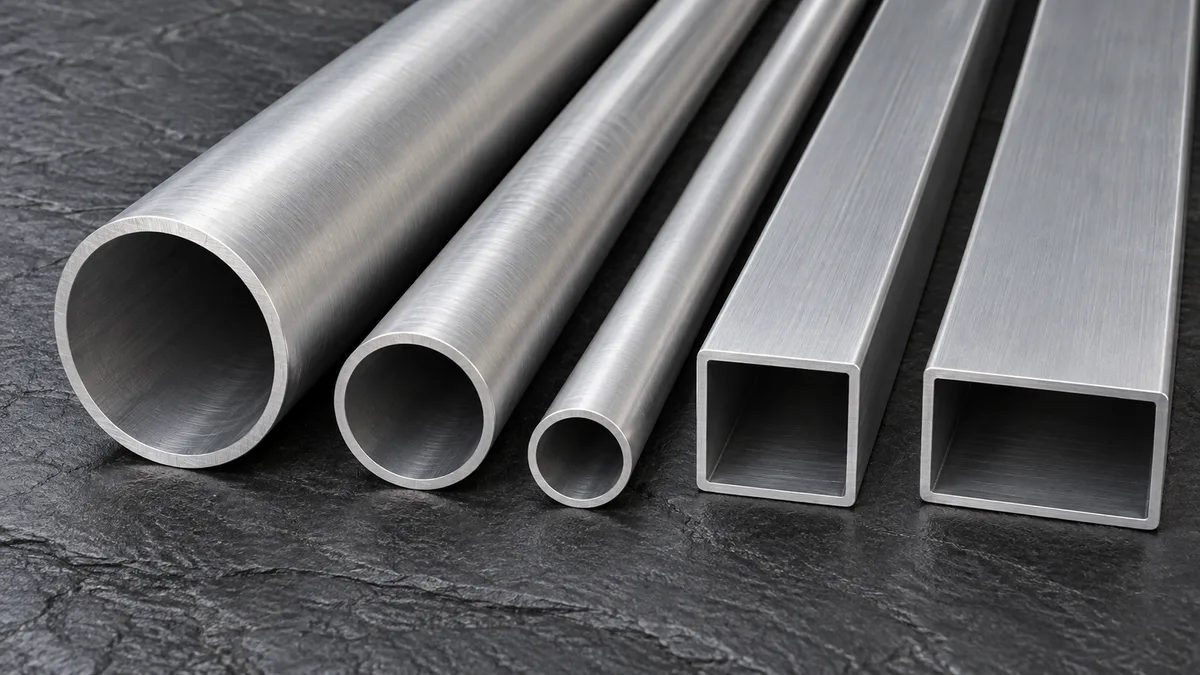
A tubular busbar is a hollow round conductor used to carry large currents between transformers, switchgear and lines, mainly in outdoor substations and generator connections. The tube shape puts metal where alternating current actually flows, gives high bending stiffness for its weight and has a smooth round surface that raises the voltage at which corona starts.
1350 is the Aluminum Association grade for electrical conductors: at least 99.50 % aluminium with tight limits on the elements that hurt conductivity most, namely titanium, vanadium, chromium and manganese. 1370 tightens these further and requires 99.70 % aluminium. Both are known as EC (electrical conductor) aluminium.
Most rigid substation bus, however, is made from 6063-T6 or 6101-T6, because heat-treated Al-Mg-Si alloys are three to four times stronger and can span between insulators without excessive sag. EC-grade pipe is chosen when conductivity is the priority, for example in short, well-supported runs, generator and furnace connections, high-current DC bus, and where the tube is bent or welded heavily.
| Property | 1350 (O / H111 / H112) | 1370 | 6101-T6 | 6063-T6 |
|---|---|---|---|---|
| Aluminium content | ≥ 99.50 % | ≥ 99.70 % | Al-Mg-Si alloy | Al-Mg-Si alloy |
| Conductivity, typical | ≈ 61 – 62 % IACS | ≈ 62 % IACS | ≈ 55 – 57 % IACS | ≈ 53 % IACS |
| Resistivity at 20 °C | ≈ 0.0280 Ω·mm²/m | ≈ 0.0278 Ω·mm²/m | ≈ 0.031 Ω·mm²/m | ≈ 0.033 Ω·mm²/m |
| Tensile strength | Low (≈ 60 – 100 MPa) | Low | ≈ 200 MPa min | ≈ 205 MPa min |
| Yield strength | Low (≈ 30 – 70 MPa) | Low | ≈ 170 MPa min | ≈ 170 MPa min |
| Self-supporting span | Short | Short | Long | Long |
| Welding effect | No temper to lose | No temper to lose | HAZ softens | HAZ softens |
Values are indicative and vary with temper and standard. The 6xxx minimums reflect ASTM B317 (6101) and ASTM B241 / B429 (6063) for T6 pipe; EC-grade strength depends on the as-extruded or annealed condition. Use certified values for design.
| Element | 1350 | 1370 |
|---|---|---|
| Silicon (Si) | ≤ 0.10 | ≤ 0.10 |
| Iron (Fe) | ≤ 0.40 | ≤ 0.25 |
| Copper (Cu) | ≤ 0.05 | ≤ 0.02 |
| Manganese (Mn) | ≤ 0.01 | ≤ 0.01 |
| Magnesium (Mg) | — | ≤ 0.02 |
| Chromium (Cr) | ≤ 0.01 | ≤ 0.01 |
| Zinc (Zn) | ≤ 0.05 | ≤ 0.04 |
| Boron (B) | ≤ 0.05 | ≤ 0.02 |
| Gallium (Ga) | ≤ 0.03 | ≤ 0.03 |
| Vanadium + titanium (V + Ti) | ≤ 0.02 | ≤ 0.02 |
| Others, each / total | ≤ 0.03 / ≤ 0.10 | ≤ 0.02 / ≤ 0.10 |
| Aluminium (Al) | ≥ 99.50 | ≥ 99.70 |
Boron is added to precipitate titanium and vanadium as borides, which removes them from solid solution and restores conductivity. This is why EC-grade metal can contain boron while ordinary 1050 or 1060 does not specify it.
Pipe built to ANSI schedules is the most common format for substation bus. Weights below use the 1350 density of 2.705 g/cm³; multiply by 0.672 for lb/ft.
| NPS (in) | OD (mm) | Wall Sch 40 / 80 (mm) | kg/m Sch 40 / 80 |
|---|---|---|---|
| 1 | 33.4 | 3.38 / 4.55 | 0.86 / 1.11 |
| 1.5 | 48.3 | 3.68 / 5.08 | 1.40 / 1.86 |
| 2 | 60.3 | 3.91 / 5.54 | 1.88 / 2.58 |
| 2.5 | 73.0 | 5.16 / 7.01 | 2.97 / 3.93 |
| 3 | 88.9 | 5.49 / 7.62 | 3.89 / 5.26 |
| 3.5 | 101.6 | 5.74 / 8.08 | 4.68 / 6.42 |
| 4 | 114.3 | 6.02 / 8.56 | 5.54 / 7.69 |
| 5 | 141.3 | 6.55 / 9.52 | 7.50 / 10.67 |
| 6 | 168.3 | 7.11 / 10.97 | 9.74 / 14.67 |
| 8 | 219.1 | 8.18 / 12.70 | 14.66 / 22.27 |
At 50 Hz the skin depth in EC aluminium is about 12 mm (about 11 mm at 60 Hz). Walls much thicker than this add weight but little AC capacity, which is why large-diameter, moderate-wall tubes are preferred.
Current rating depends on diameter, emissivity, wind, solar gain and allowable temperature rise. IEEE 605 gives the method for air-insulated substations.
EC aluminium has low yield strength. Check deflection under self-weight, ice and wind, and keep spans short or add supports. Damping cable inside the tube controls wind-induced vibration.
Electromagnetic forces during faults can bend soft tube. Verify stresses against yield, not tensile strength.
At 23 × 10⁻⁶ /K, a 15 m run heating by 50 K grows about 17 mm. Use expansion fittings or flexible connectors.
Weld with 1100 / 1188-type or 4043 filler, or use bolted compression fittings on plated contact faces. Clean and protect joints to keep resistance low.
For long outdoor spans between post insulators, specify 6101-T6 or 6063-T6 instead; the EC-grade pipe will sag or bend under fault forces.
1350 conducts about 10 % better, but 6101-T6 is several times stronger. Use 6101 or 6063 for long self-supporting outdoor spans and 1350 where spans are short and conductivity or bendability is the priority.
About 62 % IACS, slightly higher than 1350 because the aluminium content is at least 99.70 %.
Alternating current flows mainly near the surface (skin effect), so a tube carries almost as much AC as a solid bar while weighing much less and being stiffer.
Yes. There is no heat-treated temper to lose, so welding with 1100-type or 4043 filler does not reduce strength the way it does with 6xxx alloys.
Typically 40 to 450 mm OD with walls of about 3 to 15 mm, including ANSI schedule 40 and 80 sizes, in lengths up to about 12 m.
Yes. Contact areas can be tin or silver plated, and tubes can be cut, bent and machined to drawing before shipment worldwide.
Send the current rating, span, OD, wall and length. We will advise on 1350, 1370 or 6101 and quote with certificates.





