


3003 and 3A21 Aluminium Tubular Bus Pipe
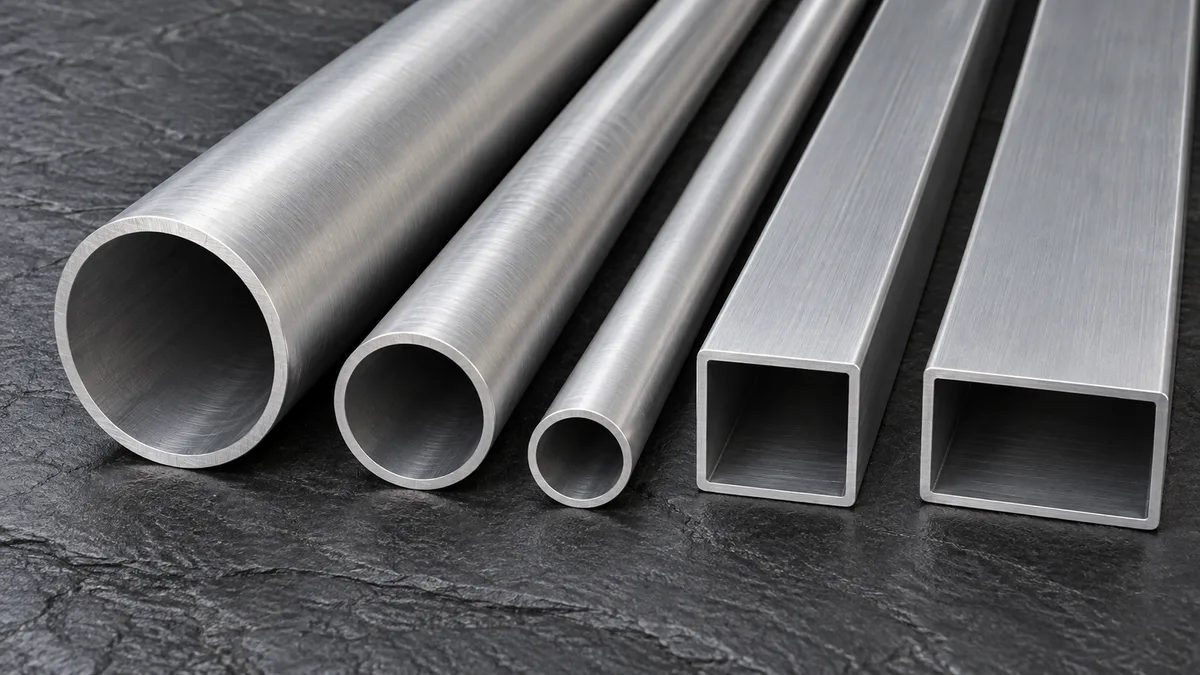
3003 and 3A21 tubular bus pipe is extruded Al-Mn tube in H14 temper, used as rigid conductors in substations, switchyards and high-current DC systems where corrosion resistance and easy bending matter more than peak conductivity. It conducts about 40 – 42 % IACS, so it carries less current than 6063 or 6101 bus tube of the same size. This guide explains where it fits, its properties and how to specify it.
- Alloys
- 3003 · 3A21
- Temper
- H14
- Conductivity
- about 40 – 42 % IACS
- OD range
- about 60 mm and larger
Why tubular conductors, and where 3003 fits
In outdoor switchyards, rigid tubular bus has largely replaced strung conductor for main and transfer buses. A round tube spans long distances between insulators with little sag, has a smooth surface that limits corona at high voltage, and spreads alternating current near its outer skin, where the material is used most efficiently.
Most rigid bus worldwide is made from heat-treatable 6xxx alloys: 6063-T6 and 6101-T6 in North America under ASTM B241 and B317, and similar grades elsewhere. 3003 and its Chinese counterpart 3A21 are non-heat-treatable. They give up some conductivity and strength, but they bend and flatten easily without cracking, weld without losing temper strength the way a T6 tube does, and resist corrosion very well in coastal and industrial air.
In practice 3003/3A21 bus pipe is chosen for jumpers, droppers and short connections that are bent on site, for DC de-icing and high-current DC bus where long-term stability matters, and where a project specification written around GB standards calls for it. For long, highly loaded main bus spans, 6063-T6 or 6101-T6 usually gives a smaller, lighter tube for the same current and span.
3003 and 3A21 composition (wt %)
| Element | 3003 | 3A21 |
|---|---|---|
| Silicon (Si) | ≤ 0.60 | ≤ 0.60 |
| Iron (Fe) | ≤ 0.70 | ≤ 0.70 |
| Copper (Cu) | 0.05 – 0.20 | ≤ 0.20 |
| Manganese (Mn) | 1.0 – 1.5 | 1.0 – 1.6 |
| Magnesium (Mg) | — | ≤ 0.05 |
| Zinc (Zn) | ≤ 0.10 | ≤ 0.10 |
| Titanium (Ti) | — | ≤ 0.15 |
| Aluminium | Remainder | Remainder |
Manganese is the reason for both the strength and the lower conductivity: about 1.2 % Mn, mostly in solid solution and fine particles, roughly halves the conductivity advantage pure aluminium has. That is the basic trade-off with this alloy family.
Electrical, mechanical and physical properties
| Property | 3003 / 3A21-H14 (typical) | Notes |
|---|---|---|
| Tensile strength | about 145 – 160 MPa | Bus tube is commonly specified at ≥ 135 MPa minimum |
| Yield strength (0.2 %) | about 125 – 145 MPa | Commonly ≥ 120 MPa minimum |
| Elongation | about 6 – 10 % | Commonly ≥ 4 % minimum on tube |
| Electrical conductivity | about 40 – 42 % IACS | Annealed (O) temper reaches about 50 % |
| Resistivity at 20 °C | about 0.041 – 0.043 Ω·mm²/m | |
| Temperature coefficient of resistance | about 0.0035 – 0.004 per °C | Lower than for pure aluminium |
| Thermal conductivity | about 155 – 160 W/m·K | |
| Density | 2.73 g/cm³ | |
| Melting range | about 643 – 654 °C | |
| Modulus of elasticity | 69 GPa | Same as other aluminium alloys; sets deflection |
Some sources quote 44 % IACS or more for 3003 bus tube; published data for H14 temper put it closer to 40 – 42 %. Agree a minimum conductivity on the order and ask for it to be measured (for example by eddy current) and reported on the certificate.
3003 compared with other bus tube alloys
| Alloy and temper | Conductivity (typical) | Typical yield strength | Bending on site | Main use |
|---|---|---|---|---|
| 1060 / 1350 | 61 – 62 % IACS | Low (soft to half hard) | Excellent | Indoor bus, short spans |
| 6101-T6 | about 55 – 57 % IACS | about 170 – 195 MPa | Poor (T6) | High-current rigid bus |
| 6063-T6 | about 53 % IACS | about 214 MPa | Poor (T6) | Standard outdoor substation bus |
| 6061-T6 | about 40 – 43 % IACS | about 276 MPa | Poor | Long spans, high mechanical load |
| 3003 / 3A21-H14 | about 40 – 42 % IACS | about 125 – 145 MPa | Good | Jumpers, bends, DC bus, corrosive sites |
Because current capacity at a given temperature rise scales roughly with the square root of conductivity for the same surface area, a 3003 tube carries roughly 10 – 15 % less current than a 6063-T6 tube of identical size. Designers compensate with a slightly larger diameter or thicker wall. Always confirm ampacity with a heat-balance calculation (for example to IEEE 605 or IEC 60865 for short-circuit forces) rather than scaling from another alloy.
Sizes, weights and tolerances
Typical supply range
- Outside diameter
- about 60 mm upward; large sizes to several hundred mm subject to confirmation
- Wall thickness
- about 3 – 15 mm
- Length
- Fixed lengths to suit the span; long lengths up to about 12 – 15 m depending on size and transport
- Straightness
- Agreed per metre and over the full length; important for long spans and appearance
- Temper
- H14 (also O or H112 on request)
- Ends
- Square saw cut, deburred; chamfered or machined for welding on request
Weight per metre is π × (OD − wall) × wall × density. The table uses 2.73 g/cm³ for 3003; cross-section is the conductor area for DC resistance.
| OD × wall (mm) | Cross-section (mm²) | Weight (kg/m) |
|---|---|---|
| 60 × 4 | 704 | 1.92 |
| 80 × 5 | 1178 | 3.22 |
| 100 × 6 | 1772 | 4.84 |
| 120 × 6 | 2149 | 5.87 |
| 130 × 8 | 3066 | 8.37 |
| 150 × 8 | 3569 | 9.74 |
| 170 × 10 | 5027 | 13.72 |
| 200 × 10 | 5969 | 16.30 |
| 250 × 10 | 7540 | 20.58 |
| 300 × 12 | 10857 | 29.64 |
Dimensional tolerances for extruded tube follow EN 755-8 or ASTM B241 / ANSI H35.2, or GB/T 4436 for Chinese specifications. Specify a high-precision grade when tubes will be welded to cast fittings or fitted into clamps with tight bores.
Design and installation points
- Span and deflection: deflection depends on the elastic modulus and the tube moment of inertia, not on the alloy grade, so a larger OD is the most effective way to reduce sag
- Vibration damping: long outdoor spans can oscillate in light wind; damping cable inside the tube is a common remedy
- Thermal expansion: about 23 mm per 10 m per 10 °C of temperature change; use expansion fittings on long runs
- Welding: TIG or MIG with ER1100 or ER4043 filler; non-heat-treatable 3003 loses only cold-work strength near the weld
- Connections: clean the oxide, apply contact grease and use bimetallic fittings when joining to copper
- Corona: keep surfaces smooth and ends capped at high voltages; larger diameters reduce surface field strength
Typical applications
- Substation and switchyard jumpers, droppers and equipment connections
- Connections between transmission conductors and substation bus
- High-current DC bus for line de-icing equipment and electrochemical plants
- Generator and transformer connections in power plants
- Capacitor banks and battery installations
- Coastal or industrial sites where corrosion resistance is a priority
References and standards
- IEEE Std 605 – Guide for Bus Design in Air Insulated Substations
- ASTM B241/B241M – Aluminum and Aluminum-Alloy Seamless Pipe and Seamless Extruded Tube
- ASTM B317/B317M – Aluminum-Alloy Extruded Bar, Rod, Tube, Pipe and Profiles for Electrical Purposes
- EN 755-2 and EN 755-8 – Extruded rod, bar, tube and profiles: properties and tolerances
- IEC 60865-1 – Short-circuit currents: calculation of effects
3003 / 3A21 tubular bus pipe: frequently asked questions
What is the conductivity of 3003 bus pipe?
About 40 – 42 % IACS in H14 temper, rising to about 50 % in the annealed condition. That is lower than 6063-T6 (about 53 %) and 6101-T6 (about 55 – 57 %).
Why use 3003 instead of 6063 for bus tube?
For parts that must be bent or welded on site, for very corrosive locations, or where a specification calls for it. 3003 bends without cracking and does not rely on heat treatment for strength.
Is 3A21 the same as 3003?
Practically yes. 3A21 is the Chinese designation; its chemistry overlaps 3003 and its properties in H14 are the same.
How much current can a 3003 tube carry?
It depends on size, ambient temperature, wind, emissivity and allowed temperature rise. As a rough guide it carries 10 – 15 % less than a 6063-T6 tube of the same size; confirm with an IEEE 605 heat-balance calculation.
How is 3003 bus pipe joined?
By TIG or MIG welding with ER1100 or ER4043 filler, or with bolted clamp fittings. Use bimetallic connectors where it meets copper.
What certificate comes with the tube?
An EN 10204 3.1 mill certificate with chemistry, tensile results and, when ordered, measured conductivity and dimensions.
Planning a substation bus?
Send OD, wall thickness, lengths, conductivity requirement and project standard. We will confirm the right alloy and supply terms.





