Ampacity
Current rating depends on diameter, emissivity, sun, wind and allowable temperature. IEEE 605 gives calculation methods; ratings rise noticeably once the surface weathers and its emissivity increases.



6101 bus pipe is a round aluminium tube used as a rigid conductor in outdoor substations, switchyards and generator connections. In T6 temper it combines a guaranteed minimum conductivity of 55 % IACS with the strength to span between insulators under wind, ice and short-circuit loads. This guide covers tempers, standard pipe sizes, resistance per metre and the design points that matter to substation engineers.
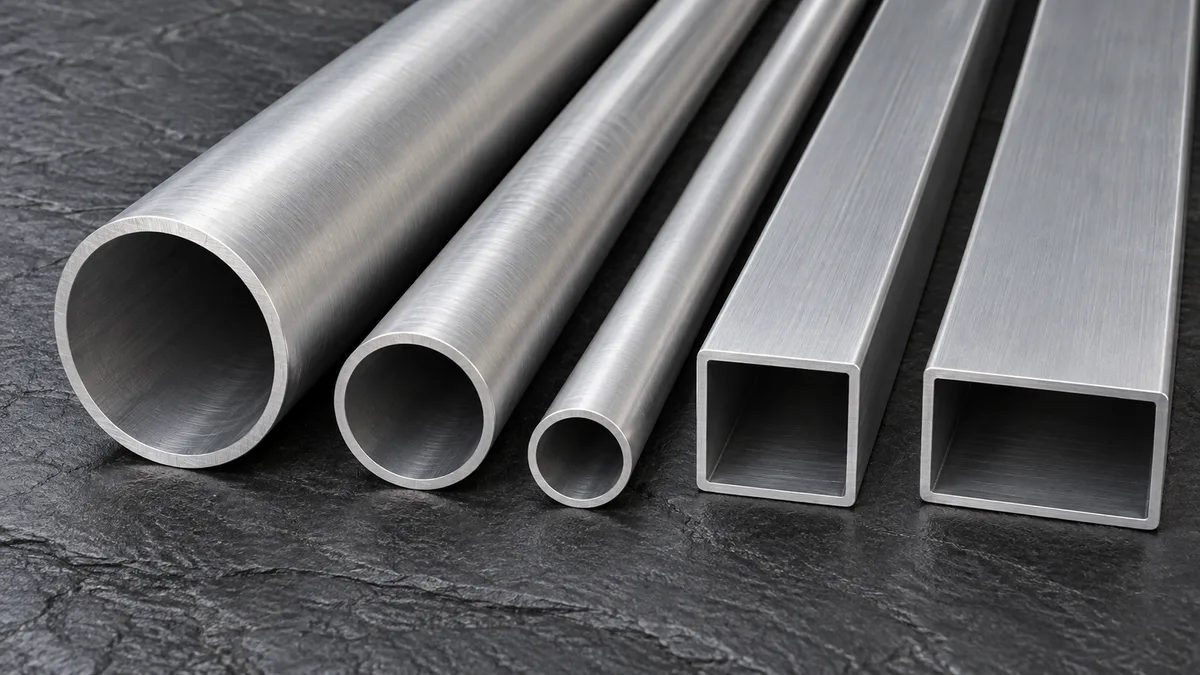
In an air-insulated substation the bus must carry thousands of amperes, span several metres between post insulators and keep its shape in storms and short circuits. A round aluminium tube meets all three needs better than flat bar or stranded cable.
A tube places its metal away from the centre, which gives a high section modulus and moment of inertia for its weight, so it deflects less between supports. For alternating current, skin effect pushes current towards the outer surface of a conductor; a tube has no wasted metal at the centre, so its AC resistance is close to its DC resistance. The smooth, large-diameter surface also lowers the electric-field gradient, which raises the voltage at which corona discharge starts and reduces radio noise and losses at high voltage.
6101 is the alloy designed for this job. ASTM B317 guarantees its conductivity for each temper, which a general structural alloy such as 6063 or 6061 does not. In many markets 6063-T6 pipe is also used for substation bus where a lower, unguaranteed conductivity is acceptable; 6101 is chosen when the current rating must be guaranteed.
Bus pipe is normally ordered in T6 for maximum strength. T63 and T61 trade strength for conductivity and are used where spans are short or current is high. Specified minimums for extruded tube and pipe:
| Temper | Thickness | Tensile min | Yield min | Conductivity min (20 °C) |
|---|---|---|---|---|
| T6 | 3.2 – 12.7 mm | 200 MPa (29 ksi) | 172 MPa (25 ksi) | 55.0 % IACS |
| T61 | 3.2 – 19 mm | 138 MPa (20 ksi) | 103 MPa (15 ksi) | 57.0 % IACS |
| T61 | 19 – 38 mm | 124 MPa (18 ksi) | 76 MPa (11 ksi) | 57.0 % IACS |
| T61 | 38 – 50.8 mm | 103 MPa (15 ksi) | 55 MPa (8 ksi) | 57.0 % IACS |
| T63 | 3.2 – 25.4 mm | 186 MPa (27 ksi) | 152 MPa (22 ksi) | 56.0 % IACS |
| T64 | 3.2 – 25.4 mm | 103 MPa (15 ksi) | 55 MPa (8 ksi) | 59.5 % IACS |
| T65 | 3.2 – 19 mm | 172 – 221 MPa (25 – 32 ksi) | 138 – 186 MPa (20 – 27 ksi) | 56.5 % IACS |
| H111 | 6.3 – 50.8 mm | 83 MPa (12 ksi) | 55 MPa (8 ksi) | 59.0 % IACS |
Specified minimums for extruded rod, bar, tube, pipe and profiles for electric conductors, from the Aluminum Association property-limit table that ASTM B317/B317M follows (inch values converted). T65 has both minimum and maximum limits so that bending behaviour is repeatable. Confirm against the current edition of the standard for contract use.
Some suppliers list T4, T5, O or H-tempers for 6101 pipe. These are not conductor tempers in ASTM B317, so their conductivity and strength are not guaranteed by the standard. If they are offered, agree measured minimums in writing.
| Element | Minimum | Maximum | Why it is limited |
|---|---|---|---|
| Silicon (Si) | 0.30 | 0.70 | Forms Mg2Si with magnesium |
| Iron (Fe) | — | 0.50 | Impurity; lowers conductivity |
| Copper (Cu) | — | 0.10 | Impurity |
| Manganese (Mn) | — | 0.03 | Very strong conductivity penalty, so held far below normal 6xxx limits |
| Magnesium (Mg) | 0.35 | 0.80 | Main strengthening element |
| Chromium (Cr) | — | 0.03 | Very strong conductivity penalty |
| Zinc (Zn) | — | 0.10 | Impurity |
| Boron (B) | — | 0.06 | Added to tie up dissolved Ti, V and Cr as borides, raising conductivity |
| Others, each / total | — | 0.03 / 0.10 | Tighter than the usual 0.05 / 0.15 |
| Aluminium (Al) | Remainder | About 97.9 – 99.4 % |
Substation bus is usually specified in ANSI/ASME nominal pipe sizes, schedule 40 or schedule 80. The table gives cross-section, mass per metre (2.70 g/cm³) and calculated DC resistance per metre at 20 °C for 6101-T6 at its 55 % IACS minimum.
| NPS (in) | Schedule | OD (mm) | Wall (mm) | Area (mm²) | Mass (kg/m) | DC resistance (µΩ/m) |
|---|---|---|---|---|---|---|
| 1 1/2 | 40 | 48.26 | 3.68 | 515 | 1.39 | 60.8 |
| 1 1/2 | 80 | 48.26 | 5.08 | 689 | 1.86 | 45.5 |
| 2 | 40 | 60.33 | 3.91 | 693 | 1.87 | 45.2 |
| 2 | 80 | 60.33 | 5.54 | 954 | 2.57 | 32.9 |
| 2 1/2 | 40 | 73.03 | 5.16 | 1100 | 2.97 | 28.5 |
| 2 1/2 | 80 | 73.03 | 7.01 | 1454 | 3.93 | 21.6 |
| 3 | 40 | 88.90 | 5.49 | 1439 | 3.88 | 21.8 |
| 3 | 80 | 88.90 | 7.62 | 1946 | 5.25 | 16.1 |
| 3 1/2 | 40 | 101.60 | 5.74 | 1729 | 4.67 | 18.1 |
| 3 1/2 | 80 | 101.60 | 8.08 | 2374 | 6.41 | 13.2 |
| 4 | 40 | 114.30 | 6.02 | 2048 | 5.53 | 15.3 |
| 4 | 80 | 114.30 | 8.56 | 2844 | 7.68 | 11.0 |
| 5 | 40 | 141.30 | 6.55 | 2773 | 7.49 | 11.3 |
| 5 | 80 | 141.30 | 9.53 | 3945 | 10.65 | 7.9 |
| 6 | 40 | 168.28 | 7.11 | 3600 | 9.72 | 8.7 |
| 6 | 80 | 168.28 | 10.97 | 5421 | 14.64 | 5.8 |
Metric sizes are also common, for example outside diameters from about 60 to 250 mm with walls of 4 – 15 mm, and larger tubes for generator and high-current buses. Lengths of 6 – 12 m are typical, with longer lengths available by arrangement and limited mainly by transport.
Current rating depends on diameter, emissivity, sun, wind and allowable temperature. IEEE 605 gives calculation methods; ratings rise noticeably once the surface weathers and its emissivity increases.
Span length is often limited by gravity sag rather than stress. A common criterion is sag no more than about 1/150 to 1/200 of the span; check your utility standard.
Peak fault current produces large electromagnetic forces between phases. The tube, insulators and fittings must resist them without permanent set.
Long tubular spans can vibrate in steady wind. A damping conductor (old stranded cable) placed inside the tube or proprietary dampers suppress it.
Aluminium expands about 23 mm per 10 m per 100 °C. Use sliding supports and expansion fittings on long runs.
At EHV, choose a diameter large enough to keep surface gradient below the corona onset; end caps or corona balls finish open tube ends.
| Aspect | 6101-T6 / T63 | 6063-T6 |
|---|---|---|
| Product standard | ASTM B317 (conductor) | ASTM B241 / B429 (general pipe) |
| Conductivity | Guaranteed: 55 % (T6), 56 % (T63) IACS minimum | Not specified by the standard; about 53 % IACS typical |
| Minimum tensile strength | 200 MPa (T6), 186 MPa (T63) | 205 MPa (T6, ASTM B221) |
| Typical use | Utility substations needing guaranteed ampacity | Lower-cost bus where ratings include margin |
Both alloys perform well mechanically. The decision usually comes down to whether the purchaser's specification calls for guaranteed conductivity; if it does, 6101 is the safe choice.
T6 is standard because it gives the highest strength (200 MPa tensile minimum) with 55 % IACS minimum conductivity. T63 is used where slightly higher conductivity is wanted.
A tube is stiffer for its weight, has lower AC resistance because of skin effect, and its smooth round surface resists corona at high voltage.
Nominal pipe sizes from 1 1/2 in to 6 in in schedule 40 or 80 are most common, plus metric ODs of about 60 – 250 mm.
By inserting a length of damping cable inside the tube or fitting dampers, and by limiting span lengths.
Yes, with TIG or MIG and ER4043 filler by qualified welders. Design for the reduced strength of the heat-affected zone.
Send the sizes, temper and lengths. Metline will quote 6101 bus pipe with certificates and export packing.





