O (annealed)
Softest and most ductile. Use for complex or large heads, tubular and semi-tubular rivets and multi-blow heading where the head diameter is more than about twice the shank.



1000 series wire rod is commercially pure aluminium (99.0 % aluminium or more) drawn into coils for cold-headed rivets, light fasteners and conductors. Grades such as 1100, 1050A, 1060 and 1070 head without cracking and resist corrosion, while 1350 and 1370 are chosen where electrical conductivity comes first. This guide compares the grades, tempers, properties and buying checks so you can specify the right wire for your heading or drawing line.
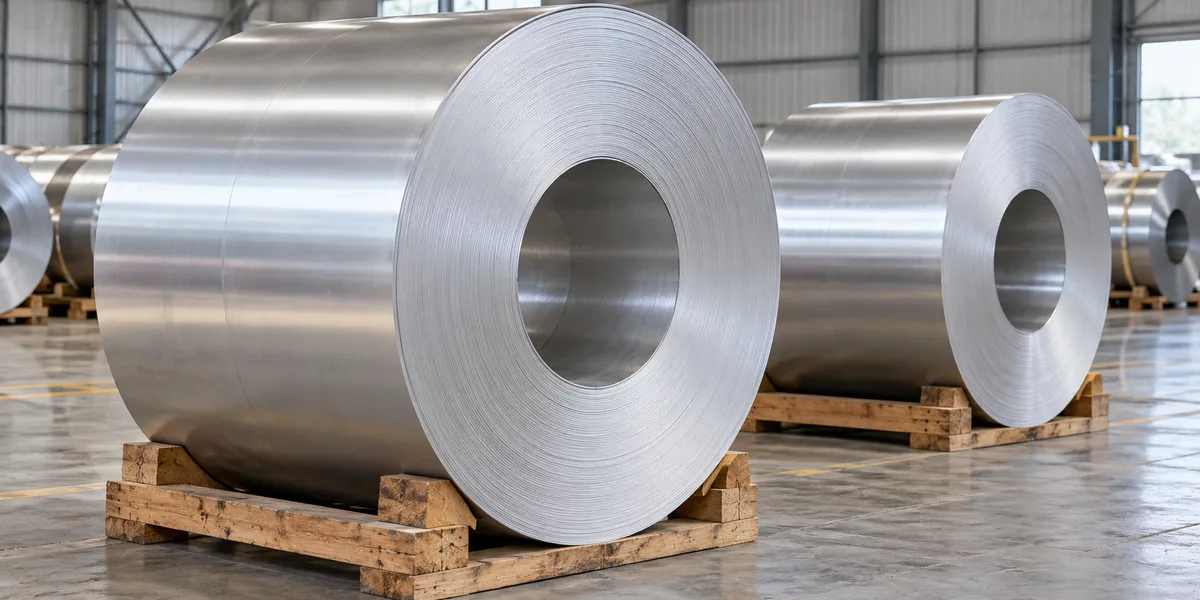
In the international alloy designation system, the 1xxx series is aluminium with no deliberate alloying additions: the last two digits show the minimum purity above 99.00 %. 1050 means at least 99.50 % aluminium, 1070 at least 99.70 %, and 1100 at least 99.00 % with a small, controlled copper content.
Fastener wire rod is the coiled feedstock that rivet and screw makers feed into cold-heading machines. The machine cuts a slug from the wire, then upsets one end in one or more blows to form a head. That operation stretches the outer fibres of the head severely, so the wire must be ductile, free of surface seams and consistent in diameter from the first metre of the coil to the last. Pure aluminium is excellent at this: in the annealed or lightly work-hardened condition it can be headed into flat, countersunk and round heads without cracking.
The trade-off is strength. A 1100 rivet has roughly a quarter of the shear strength of a 2117-T4 aircraft rivet, so 1000 series fasteners are used where loads are light and where low cost, easy setting, corrosion resistance or electrical conductivity matter more. The same coils also go into conductors, earthing wire, welding feedstock and small cold-formed parts.
| Grade | Min. Al % | Common tempers | Main character | Typical use |
|---|---|---|---|---|
| 1050 / 1050A | 99.50 | O, H12, H14, H18 | Good conductivity, easy heading, low cost | Rivets, nails, conductors, heat-exchange wire |
| 1060 | 99.60 | O, H12, H14, H18 | Slightly purer and more conductive than 1050 | Rivets, busbar wire, electrical parts |
| 1070 / 1070A | 99.70 | O, H14, H18 | Very high ductility and conductivity | Precision heading, conductors, welding and spraying wire |
| 1100 | 99.00 (Cu 0.05 – 0.20) | O, H12, H14, H18 | Slightly stronger than higher-purity grades; most common rivet grade | Solid rivets (code "A"), blind rivets, general fasteners |
| 1350 (EC) | 99.50 | O, H12–H19 | Electrical grade with controlled Ti, V, Cr and Mn for conductivity | Overhead conductors, cable cores, electrical fasteners |
| 1370 | 99.70 | O, H14–H19 | Higher-purity electrical grade, conductivity above 1350 | Fine conductors, magnet and winding wire |
For pure fastening work, 1100 is the reference grade in North America and is listed in ASTM B316, the specification for rivet and cold-heading wire. In Europe and Asia, 1050A and 1060 are equally common. Choose 1350 or 1370 only when conductivity is the reason for using aluminium; their tighter impurity limits add cost without improving heading performance.
| Element | 1050A | 1060 | 1070 | 1100 | 1350 |
|---|---|---|---|---|---|
| Si | 0.25 | 0.25 | 0.20 | Si + Fe 0.95 | 0.10 |
| Fe | 0.40 | 0.35 | 0.25 | (see Si) | 0.40 |
| Cu | 0.05 | 0.05 | 0.04 | 0.05 – 0.20 | 0.05 |
| Mn | 0.05 | 0.03 | 0.03 | 0.05 | 0.01 |
| Mg | 0.05 | 0.03 | 0.03 | — | — |
| Zn | 0.07 | 0.05 | 0.04 | 0.10 | 0.05 |
| Ti | 0.05 | 0.03 | 0.03 | — | V + Ti 0.02 |
| Other limits | — | V 0.05 | V 0.05 | — | Cr 0.01, B 0.05, Ga 0.03 |
| Aluminium | ≥ 99.50 | ≥ 99.60 | ≥ 99.70 | ≥ 99.00 | ≥ 99.50 |
Limits from the Aluminum Association registration (1060, 1070, 1100, 1350) and EN 573-3 (1050A). Always check the mill certificate for the actual analysis.
The 1350 limits explain why it conducts better: titanium, vanadium, chromium and manganese, even at a few hundredths of a per cent, scatter electrons strongly, so they are held to very low levels. In 1100, the copper addition gives a small strength gain that helps a rivet resist shear.
| Grade and temper | Tensile strength | Yield strength | Shear strength | Conductivity (% IACS) |
|---|---|---|---|---|
| 1060-O | 69 MPa | 28 MPa | 48 MPa | 62 |
| 1060-H14 | 97 MPa | 90 MPa | 62 MPa | 61 |
| 1060-H18 | 131 MPa | 124 MPa | 76 MPa | 61 |
| 1100-O | 90 MPa | 34 MPa | 62 MPa | 59 |
| 1100-H14 | 124 MPa | 117 MPa | 76 MPa | 59 |
| 1100-H18 | 165 MPa | 152 MPa | 90 MPa | 57 |
| 1350-O | 83 MPa | 28 MPa | 55 MPa | 62 |
| 1350-H19 | 186 MPa | 165 MPa | 103 MPa | 61.8 typical (B230 min. 61.0) |
Typical values from Aluminum Association and ASM data, not specification minimums. 1050A and 1070 behave much like 1060, with 1070 slightly softer in the annealed state.
Two points stand out for fastener designers. First, work hardening roughly doubles strength between O and H18, so the temper of the wire has a large effect on the finished rivet. Second, conductivity falls only slightly as strength rises, which is why hard-drawn 1350-H19 can carry current on overhead lines and still support its own span.
Softest and most ductile. Use for complex or large heads, tubular and semi-tubular rivets and multi-blow heading where the head diameter is more than about twice the shank.
Quarter- to half-hard. The usual compromise for solid rivets and screws: enough ductility to head, with a stronger finished shank.
Fully hard, drawn temper. Used for conductors and straight pins; it is too hard for most heading unless the wire is annealed first.
As-fabricated rod straight from casting-and-rolling or extrusion. Usually redrawn and annealed by the wire maker before heading.
A good rule is to order the hardest temper that heads without cracking on your tooling, because that gives the strongest fastener. Run a heading trial on each new supplier or temper: cut slugs, form heads at production speed and inspect for splits around the head periphery.
State the coil inner and outer diameter and maximum coil weight your pay-off equipment can take.
Tolerance classes in ASTM B316 and EN 1301-3 tighten as diameter falls. For automatic headers, consistent diameter matters more than the absolute value: a coil that drifts by a few hundredths of a millimetre changes the slug volume and the head size.
Where a rivet carries structural load, a heat-treatable grade such as 2117, 2017, 5056 or 6061 is normally specified instead. Compare those options in our guides to 2017, 5056 and 6061 rivet wire.
1100 is the most widely specified because its small copper content adds strength while keeping excellent heading ductility. 1050A and 1060 are close alternatives and are common outside North America.
1100 is a general-purpose grade with at least 99.00 % aluminium and 0.05 – 0.20 % copper. 1350 is an electrical grade with at least 99.50 % aluminium and very tight limits on titanium, vanadium, chromium and manganese, giving about 61 – 62 % IACS conductivity against about 59 % for 1100.
Usually O or H12/H14. Annealed wire suits large or complex heads; half-hard wire gives a stronger shank where the head is simple. Fully hard H18 is normally too stiff for heading.
Typical shear strength is about 62 MPa for 1100-O and 76 MPa for 1100-H14, compared with roughly 260 MPa for a heat-treated 2117-T4 aircraft rivet. Pure aluminium rivets are for light-duty joints.
ASTM B316 in the United States, and EN 1301 (drawn wire) in Europe. Rivet designs themselves are covered by fastener standards such as ISO 1051 and the NAS/MS aerospace series.
Yes. Tell us the coil inner and outer diameter and maximum coil weight, and we will source wire wound to suit your equipment, with an EN 10204 3.1 certificate.
Send the grade, temper, diameter, coil size and quantity. We will confirm availability and a delivered price to your plant.





