


1080, 1070 and 1050 Aluminium Wire Rod for Electrical Use
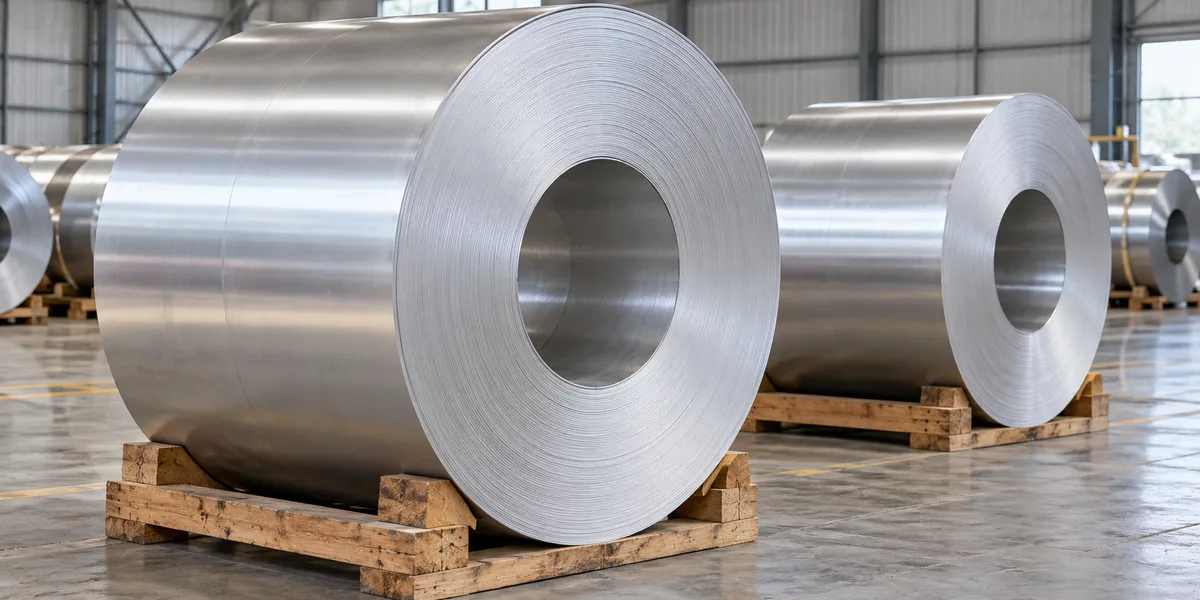
1080, 1070 and 1050 wire rod are high-purity aluminium coils, usually 9.5 – 25 mm in diameter, that wire drawers reduce to conductors, winding wire and thermal spray wire. Purity rises from 99.5 % (1050) to 99.8 % (1080), and conductivity rises with it, from about 61 % to about 62 – 63 % IACS, while strength falls slightly. This guide explains the differences and what to specify.
- Purity
- 99.5 – 99.8 % Al
- Conductivity
- ≈ 61 – 63 % IACS
- Diameter
- about 7.5 – 25 mm
- Tempers
- O, H11 – H18
What is high-purity electrical wire rod?
Wire rod is the semi-finished feedstock for wire drawing. Most electrical aluminium rod is made by continuous casting and rolling: molten metal is cast into a bar on a wheel and immediately hot-rolled to a round rod, typically 9.5 mm, which is coiled in one continuous length. Larger diameters are also produced by extrusion.
The electrical cable industry mainly uses 1350 (EC grade) rod, whose chemistry is tuned for conductivity. The plain high-purity grades 1050, 1070 and 1080 are used where a buyer's standard calls for them, for products that are not covered by conductor specifications, or where very high purity is wanted, for example in fine winding wire, thermal spray wire and some cable and conductor standards in Europe and Asia.
Because conductivity rises with purity, 1080 is the most conductive of the three and 1050 the least. The reverse is true of strength: impurities such as iron and silicon add a little strength, so 1080 is the softest. A common misconception is that 1080 is stronger than 1050; in the same temper, it is not.
1080 vs 1070 vs 1050 wire rod
| Property | 1080 / 1080A | 1070 / 1070A | 1050 / 1050A |
|---|---|---|---|
| Minimum aluminium | 99.80 % | 99.70 % | 99.50 % |
| Conductivity, annealed (typical) | ≈ 62 – 63 % IACS | ≈ 61.5 – 62 % IACS | ≈ 61 % IACS |
| Resistivity at 20 °C (approx.) | ≈ 0.0275 Ω·mm²/m | ≈ 0.0280 Ω·mm²/m | ≈ 0.0282 Ω·mm²/m |
| Strength in a given temper | Lowest | Intermediate | Highest of the three |
| Corrosion resistance | Excellent (best of the three) | Excellent | Excellent |
| Relative cost | Highest | Intermediate | Lowest |
| Typical uses | Fine and winding wire, high-purity spray wire | Conductors, winding wire, spray wire | General conductors, earthing and cable wire |
Typical values; conductivity minimums are set by the purchase standard and checked on each lot.
If your product is an overhead conductor or power cable to an international conductor standard, compare these grades with 1350 and 1370 rod, which are designed for that purpose, and with the 8xxx alloys used in building wire.
Chemical composition (wt %, max unless shown)
| Element | 1080A | 1070A | 1050A |
|---|---|---|---|
| Si | 0.15 | 0.20 | 0.25 |
| Fe | 0.15 | 0.25 | 0.40 |
| Cu | 0.03 | 0.03 | 0.05 |
| Mn | 0.02 | 0.03 | 0.05 |
| Mg | 0.02 | 0.03 | 0.05 |
| Zn | 0.06 | 0.07 | 0.07 |
| Ga | 0.03 | — | — |
| Ti | 0.02 | 0.03 | 0.05 |
| Others, each | 0.02 | 0.03 | 0.03 |
| Al, min. | 99.80 | 99.70 | 99.50 |
Limits per EN 573-3 for the "A" variants, which are the usual European designations. The Aluminum Association grades 1080, 1070 and 1050 have very similar limits.
Mechanical properties by temper
| Temper | 1080 tensile | 1070 tensile | 1050 tensile | Typical elongation |
|---|---|---|---|---|
| O | ≤ 80 MPa | ≤ 85 MPa | ≤ 95 MPa | ≈ 30 – 35 % |
| H11 / H12 | ≈ 80 – 95 MPa | ≈ 85 – 100 MPa | ≈ 90 – 110 MPa | ≈ 15 – 20 % |
| H14 | ≥ 90 MPa | ≥ 95 MPa | ≥ 100 MPa | ≈ 5 % |
| H16 | — | — | ≥ 120 MPa | ≈ 3 % |
| H18 | ≥ 120 MPa | ≥ 125 MPa | ≥ 140 MPa | ≈ 2 – 3 % |
Indicative ranges for rod and drawn wire. The governing standard and certificate define guaranteed values for each lot.
As-rolled rod (often designated H12 or H13, or O after annealing) is the normal starting condition for drawing. Very soft rod draws with few breaks but can be damaged in handling; slightly harder rod handles better. Agree the tensile range with your drawing mill.
Sizes, tolerances and coil packing
| Nominal diameter (mm) | 9.0 | 9.5 | 12 | 15 | 19 | 23 – 25 |
|---|---|---|---|---|---|---|
| Diameter tolerance (±mm) | 0.3 | 0.3 | 0.4 | 0.5 | 0.8 | 1.0 |
| Ovality, max. (mm) | 0.4 | 0.3 – 0.4 | 0.4 – 0.5 | 0.5 | 0.6 | 0.8 |
Typical tolerances for continuously cast and rolled rod; check the purchase standard for exact values.
Packing and marking
- Coil
- Single continuous length per coil, layer-wound; coil weight agreed with the buyer
- Strapping
- Steel or polyester straps at three or more points around the circumference
- Protection
- Wrapped against moisture, on pallets, with desiccant for sea freight
- Tag
- Grade, temper, diameter, lot number and net weight on each coil
- Surface
- Free of laps, slivers, cracks, oxide and oil; no welds or grinding marks
Standards for electrical wire rod
| Standard | Scope |
|---|---|
| ASTM B233 | Aluminum 1350 drawing stock (rod) for electrical purposes |
| EN 1715-2 | Drawing stock for electrical applications |
| EN 573-3 | Chemical composition of 1050A, 1070A, 1080A and 1350 |
| IS 5484 | EC grade aluminium rod produced by continuous casting and rolling (India) |
| GOST 13843 | Aluminium wire rod for electrical purposes (CIS countries) |
| EN ISO 14919 | Wires, rods and cords for thermal spraying |
Many cable and spray-wire buyers write their own specification based on these standards. Send it with your enquiry so chemistry, conductivity and testing are matched exactly.
What the rod is drawn into
- Conductors: wires for stranded conductors (AAC and, with steel or alloy cores, ACSR and ACAR) where the buyer's standard allows these grades
- Insulated cables: low- and medium-voltage cable cores and aerial bundled cable
- Winding wire: round and flat enamelled or paper-covered wire for transformers and motors
- Thermal spray wire: 99.5 – 99.8 % aluminium wire for arc and flame spraying of corrosion-protective coatings on steel
- Earthing and connectors: earthing wire, terminals and cold-formed connector parts
References and standards
- ASTM B233 – Aluminum 1350 Drawing Stock for Electrical Purposes
- EN 1715-2 – Aluminium and aluminium alloys, drawing stock: specific requirements for electrical applications
- EN 573-3 – Chemical composition and form of wrought products
- EN ISO 14919 – Thermal spraying: wires, rods and cords for flame and arc spraying
- The Aluminum Association – Aluminum Electrical Conductor Handbook
1080, 1070 and 1050 wire rod: FAQ
Which is more conductive, 1080 or 1050?
1080. With at least 99.80 % aluminium it reaches about 62 – 63 % IACS annealed, against about 61 % for 1050.
Is 1080 aluminium stronger than 1050?
No. Higher purity makes aluminium softer, so in the same temper 1080 has slightly lower strength than 1050.
What diameter is electrical aluminum wire rod?
The standard continuously cast and rolled size is 9.5 mm. Rod from about 7.5 mm to 25 mm is available for different drawing lines and products.
Should I use 1350 or 1070 for cable?
1350 is the standard electrical conductor grade and is named in most conductor specifications. 1070 has similar conductivity and is used where a buyer or national standard specifies it.
Can the rod be used for thermal spray wire?
Yes. 1050, 1070 and 1080 are drawn into spray wire for aluminium coatings that protect steel from corrosion; higher purity gives a cleaner coating.
Buying wire rod for drawing?
Send the grade, diameter, temper, conductivity requirement and coil weight. We will confirm availability and a delivered price.





