Tensile test
Confirms the wire is within the maximum strength for H14. Too high and heads crack; too low and the coil may be over-annealed.



3A21 is the Chinese designation for an aluminium-manganese alloy that is practically equivalent to 3003, and in H14 temper it is one of the most common wires for solid, non-structural rivets. It heads easily, resists corrosion and needs no heat treatment. This page sets out what a 3A21 rivet wire specification contains and how to check incoming coils.
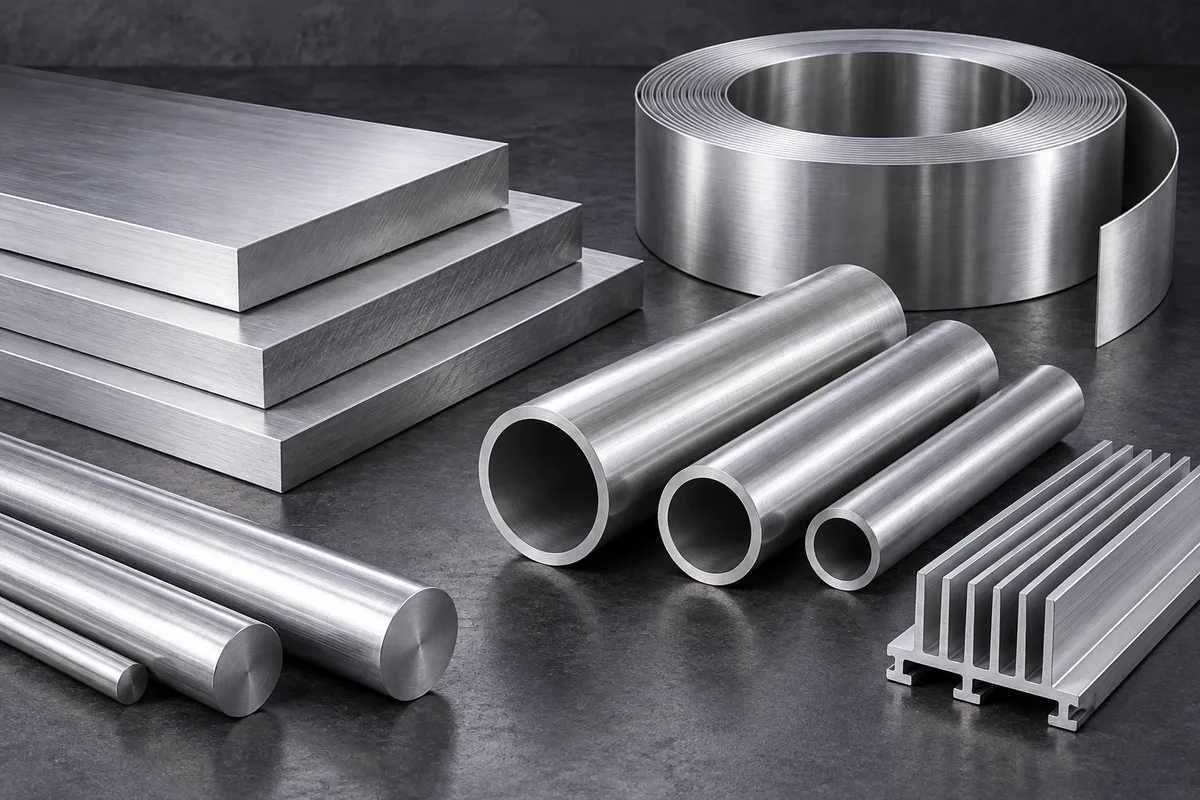
3A21 (formerly LF21 in older Chinese designations) is a non-heat-treatable Al-Mn alloy. Its strength comes from manganese in solution and fine dispersoids, plus cold work from drawing.
As rivet wire it is drawn to final diameter and given an H14 (half-hard) temper. This leaves enough strength for useful shear capacity and enough ductility to upset a head without splitting. Because it never needs solution treatment, 3A21 rivets can be stored indefinitely and driven at any time, unlike 2017 or 2024 "ice-box" rivets.
Buyers in India, the Middle East and Europe often meet 3A21 on drawings from Chinese-designed equipment. In most cases 3003-H14 wire to ASTM B316 or EN 1301 can be supplied against such drawings once the designer agrees; the composition table below shows why.
| Element | 3A21 (GB/T 3190) | 3003 (AA / EN AW-3003) |
|---|---|---|
| Silicon (Si) | ≤ 0.60 | ≤ 0.60 |
| Iron (Fe) | ≤ 0.70 | ≤ 0.70 |
| Copper (Cu) | ≤ 0.20 | 0.05 – 0.20 |
| Manganese (Mn) | 1.0 – 1.6 | 1.0 – 1.5 |
| Magnesium (Mg) | ≤ 0.05 | — |
| Zinc (Zn) | ≤ 0.10 | ≤ 0.10 |
| Titanium (Ti) | ≤ 0.15 | — |
| Aluminium | Remainder | Remainder |
The overlap is almost complete. The practical differences are that 3A21 may contain no copper at all, while 3003 must contain at least 0.05 %, and 3A21 allows manganese up to 1.6 %. Neither difference changes heading behaviour or corrosion resistance in a way that matters for rivets. ISO and EN name the alloy AlMn1Cu (EN AW-3003); Japan uses A3003.
Rivet wire specifications control strength from both sides. A maximum tensile strength stops the wire being too hard to head; a minimum shear strength, tested on the wire or on driven rivets, ensures the joint carries its design load.
| Property | Typical 3A21 / 3003-H14 | How it is specified for rivet wire |
|---|---|---|
| Tensile strength | 145 – 165 MPa | Maximum, about 180 MPa in H14 |
| Yield strength (0.2 %) | about 140 MPa | Usually not specified |
| Shear strength | about 95 – 100 MPa | Minimum per standard and diameter band |
| Elongation | about 8 – 12 % | Usually not specified for wire |
| Hardness | about 40 HB | For information |
Typical values from published 3003-H14 data. Contract limits are those of the standard and edition named in your order; ask for them to be printed on the certificate.
Confirms the wire is within the maximum strength for H14. Too high and heads crack; too low and the coil may be over-annealed.
Double-shear test on wire (ASTM B565 or the national equivalent). The result is sensitive to fixture geometry, so state the method.
A sample, typically 1.5 × diameter long, is compressed to a set fraction of its height. No cracks may appear on the barrel.
Some standards drive a rivet in a test joint and check that the head forms fully with no cracking at a set protrusion ratio.
Diameter and ovality measured along the coil with a micrometer; coil ends sampled.
Visual check for cracks, laps, scratches, inclusions, corrosion and blisters, which are not allowed on rivet wire.
Rivet wire standards offer several tolerance grades, from tight one-sided (minus only) bands for high-speed heading to wider symmetrical bands for general work. For 3A21 in 1.6 – 10 mm, buyers commonly specify around ±0.02 mm on small diameters and up to about ±0.04 – 0.06 mm on larger ones. State the grade or the actual limits on the order.
| Defect | Typical requirement for rivet wire |
|---|---|
| Cracks, laps, peeling, blisters | Not permitted |
| Metallic or non-metallic inclusions pressed in | Not permitted |
| Surface corrosion | Not permitted |
| Light scratches, scuffs, small dents | Permitted if depth is no more than half the minus tolerance |
| Light oil marks | Usually permitted |
Where a joint needs more than about 100 MPa shear, consider 5A02, 5052 or 5056 wire, or a heat-treatable 2xxx grade for structure.
3003 (EN AW-3003, AlMn1Cu, UNS A93003, JIS A3003). The chemistries overlap almost completely and H14 properties match.
H14 balances heading ductility and shear strength. Softer O temper is used for large upsets or tubular rivets; harder tempers tend to crack at the head.
Typically around 95 – 100 MPa in H14. The minimum you can rely on is the value in the governing standard for your diameter band.
No. It is non-heat-treatable; the strength comes from cold work, and the head work-hardens slightly during forming.
Yes, where the designer accepts the equivalent. We can also supply wire certified as 3A21 to GB/T 3195.
Send the diameter, tolerance, coil weight and tests you require. We will confirm grade, certification and shipping to your plant.





