Filler metal
Use 5xxx filler: ER5183 or ER5556 for higher weld strength, ER5356 for general work. Avoid 4xxx fillers.



7020 is a weldable aluminium-zinc-magnesium alloy that gives tube a minimum tensile strength of 350 MPa in T6 and, unlike 6xxx alloys, recovers much of its strength in the weld zone by natural ageing. It is used for welded frames in rail vehicles, military bridges and vehicles, motorcycles and bicycles. Metline supplies 7020 tube extruded or cold-drawn to EN standards, to customers worldwide.
EN AW-7020 is the most widely used weldable 7xxx alloy in Europe. About 4.5 % zinc and 1.2 % magnesium give it T6 strength well above 6082, while copper is held below 0.2 % so it can be fusion welded without the cracking that rules out 7075.
The defining feature of 7020 is what happens after welding. In 6082-T6, the heat-affected zone permanently loses roughly half its proof strength unless the whole structure is re-heat-treated. In 7020, the heat of welding dissolves the strengthening precipitates, but they re-form at room temperature over the following weeks to months. The joint therefore regains a large part of its original strength without further treatment, giving welded structures noticeably higher design values than 6xxx alloys.
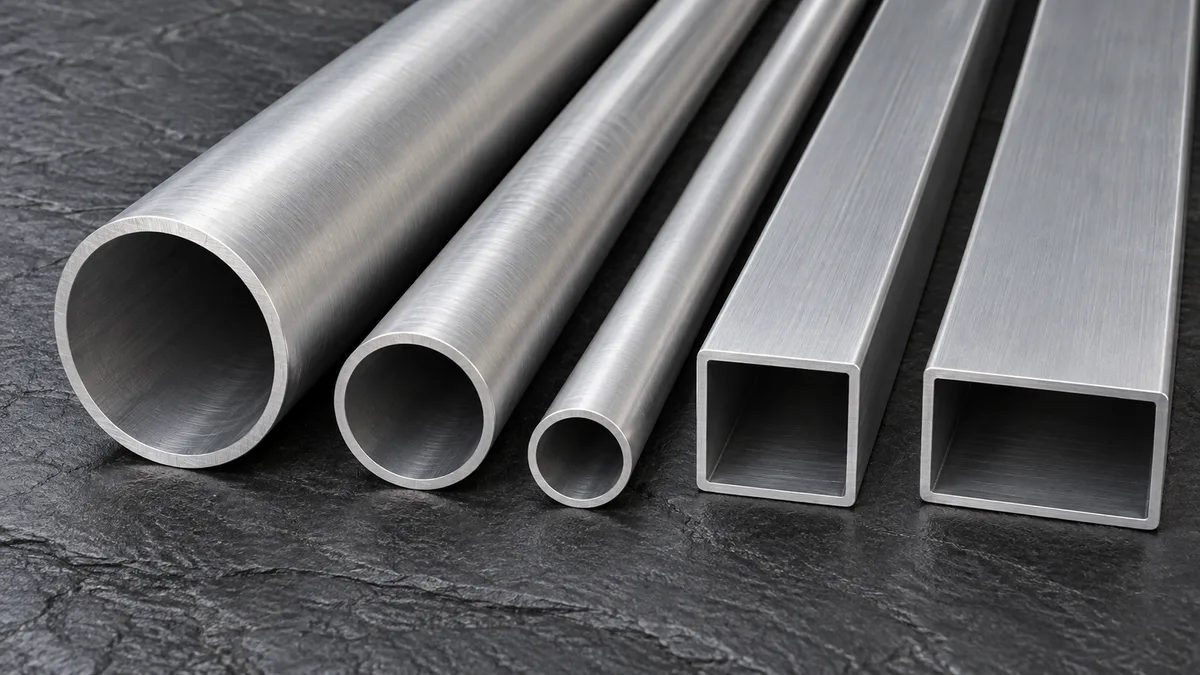
7020 extrudes reasonably well into round tube, square and rectangular hollows and custom profiles, and can be press-quenched. That combination of weldability, recoverable strength and extrudability made it the standard alloy for welded rail vehicle underframes, mobile military bridges, armoured vehicle structures and high-performance motorcycle and bicycle frames.
| Element | Min | Max | Role |
|---|---|---|---|
| Silicon (Si) | — | 0.35 | Impurity |
| Iron (Fe) | — | 0.40 | Impurity |
| Copper (Cu) | — | 0.20 | Held low for weldability |
| Manganese (Mn) | 0.05 | 0.50 | Grain control |
| Magnesium (Mg) | 1.0 | 1.4 | Forms MgZn2 with zinc |
| Chromium (Cr) | 0.10 | 0.35 | Stress-corrosion resistance |
| Zinc (Zn) | 4.0 | 5.0 | Main strengthening element |
| Zirconium (Zr) | 0.08 | 0.20 | Grain structure control |
| Zr + Ti | 0.08 | 0.25 | |
| Others each / total | — | 0.05 / 0.15 | |
| Aluminium | Remainder |
Limits per EN 573-3.
| Condition | Tensile Rm | Proof Rp0.2 | Elongation A / A50 | Hardness |
|---|---|---|---|---|
| T6 extruded tube, EN 755-2 minimum | 350 MPa | 280 MPa | 10 % / 8 % | — |
| T6 drawn tube, EN 754-2 minimum | 350 MPa | 280 MPa | 10 % / 8 % | — |
| T6, typical | about 370 – 400 MPa | about 300 – 330 MPa | 10 – 12 % | about 110 HBW |
| Heat-affected zone after natural ageing | roughly 270 MPa (EN 1999 design order of magnitude) | — | — | — |
The minimums above are the values to design to and are confirmed by the mill certificate; typical values describe what production material usually achieves. Exact EN 755-2 limits depend on wall thickness.
| System | Designation | Notes |
|---|---|---|
| European | EN AW-7020 / EN AW-AlZn4.5Mg1 | EN 755-2 extruded; EN 754-2 drawn; EN 573-3 chemistry |
| Germany | 3.4335 (AlZn4.5Mg1) | DIN EN 755 |
| UK (old) | H17 | BS 1474 (superseded) |
| ISO | AlZn4.5Mg1 | |
| Related alloys | 7005, 7N01 (JIS) | Similar Al-Zn-Mg weldable alloys; not identical |
Tolerances: EN 755-7 (seamless), EN 755-8 (porthole) and EN 754-7 / 754-8 for drawn tube.
Round tube weight in kg/m = π × (OD − wall) × wall × 2.78 / 1000.
| OD × wall (mm) | kg/m | I (cm⁴) | Z (cm³) |
|---|---|---|---|
| 20 × 2 | 0.31 | 0.5 | 0.46 |
| 30 × 3 | 0.71 | 2.3 | 1.56 |
| 40 × 3 | 0.97 | 6.0 | 3.00 |
| 50 × 4 | 1.61 | 15.4 | 6.16 |
| 60 × 5 | 2.40 | 32.9 | 10.98 |
| 80 × 6 | 3.88 | 96.1 | 24.03 |
| 100 × 8 | 6.43 | 246.5 | 49.30 |
| 120 × 10 | 9.61 | 527.0 | 87.83 |
| 160 × 12 | 15.51 | 1537.7 | 192.21 |
| 200 × 15 | 24.24 | 3754.2 | 375.42 |
| 250 × 20 | 40.17 | 9628.2 | 770.26 |
Use 5xxx filler: ER5183 or ER5556 for higher weld strength, ER5356 for general work. Avoid 4xxx fillers.
Weld-zone strength rises for weeks after welding. Many specifications require a minimum ageing period before proof testing or service.
Grind or dress weld toes where specified, avoid cold straightening after T6, and protect welds with coatings.
Bend and flare in a freshly solution-treated or annealed state, then age. T6 needs generous radii.
Good in T6: turning, milling, drilling and threading of connection ends.
Anodising, painting and powder coating are all used; painting is common on rail and defence structures.
| 6082-T6 | 7020-T6 | 7075-T6 | |
|---|---|---|---|
| Minimum tensile (extruded) | 290 – 310 MPa | 350 MPa | about 540 MPa |
| Minimum proof (extruded) | 250 – 260 MPa | 280 MPa | about 480 MPa |
| Fusion weldable | Yes | Yes | No |
| Weld-zone recovery | No (permanent loss) | Yes (natural ageing) | — |
| Stress-corrosion sensitivity | Low | Moderate | High in T6 |
| Typical use | General structures | Welded high-strength structures | Unwelded, highly stressed parts |
Choose 7020 over 6082 when weld efficiency or strength-to-weight decides the design; choose 7075 only for parts that will not be welded.
EN 755-2 and EN 754-2 specify a minimum tensile strength of 350 MPa, 0.2 % proof strength of 280 MPa and elongation of 10 % (A) for T6 tube in the usual wall range.
Yes. It is designed for fusion welding with 5xxx filler such as ER5183, ER5356 or ER5556, and the weld zone regains much of its strength by natural ageing.
Only where the lower strength is acceptable. 7075-T6 is much stronger but not weldable; 7020 is chosen for welded parts. Re-check loads and safety factors before substituting.
General corrosion resistance is good, but 7020 can suffer stress corrosion cracking under sustained tension in corrosive conditions. Correct heat treatment, low residual stress and protective coatings manage the risk.
Most of the recovery happens in the first few weeks, and it continues more slowly for months. Follow the ageing period in your design code or welding specification.
Send OD, wall, temper, length, standard and destination, and we will reply with availability, certification and a delivered price.





