Welding
TIG or MIG with ER5356 or ER5556 filler. Clean thoroughly and control heat input; thin butted walls need careful technique.



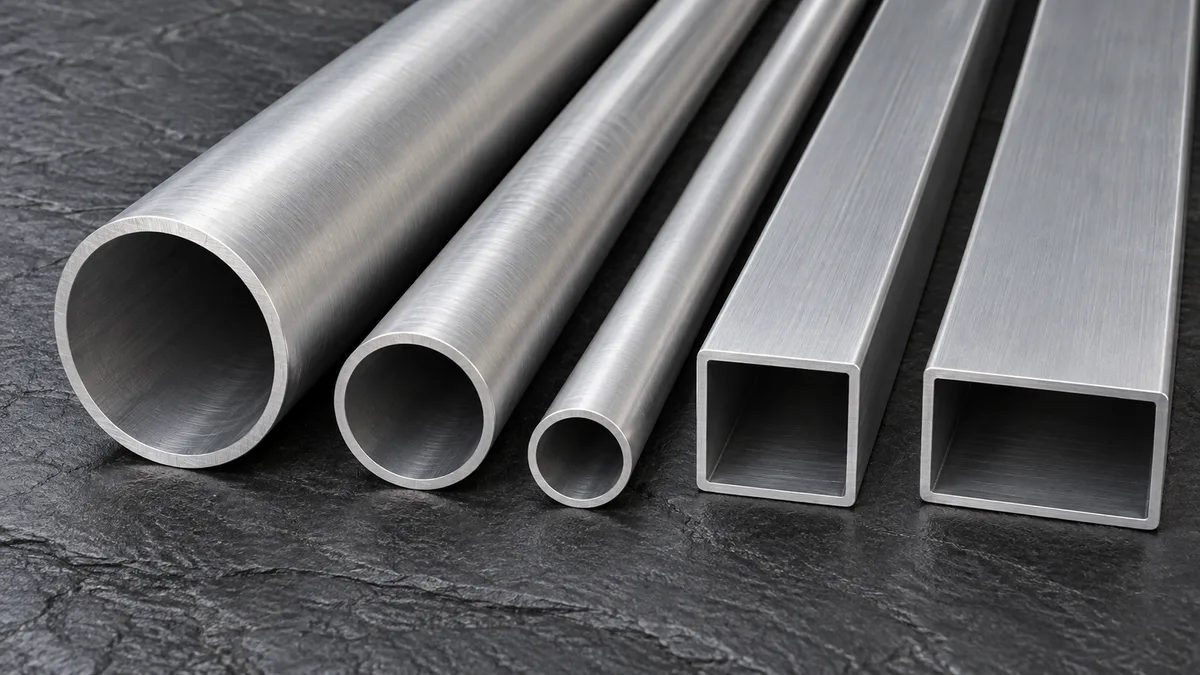
7005 is a weldable aluminium-zinc-magnesium alloy best known for bicycle frames: it is stronger than 6061-T6 and regains much of its strength after welding by natural ageing, so frames need not be fully re-heat-treated. Metline supplies 7005 tube as extruded and drawn round, square and rectangular tube, plus butted and tapered frame tubes, to customers worldwide.
7005 belongs to the weldable branch of the 7xxx family. Its zinc and magnesium form fine MgZn2 precipitates that give high strength, while very low copper keeps it weldable and zirconium helps the weld zone recover.
Unlike 7075, which cracks when fusion welded, 7005 can be TIG or MIG welded with 5xxx filler. After welding, the heat-affected zone softens but then hardens again by natural ageing at room temperature over several weeks, recovering a large share of its original strength. That behaviour is why 7005 became popular for welded bicycle frames: manufacturers can avoid the full solution heat treatment that 6061 frames need after welding (although many still give 7005 frames an artificial ageing cycle to speed up recovery).
The alloy also extrudes into thin-walled hollow sections far more easily than 7075, and its extrusions can be press-quenched. Beyond cycling, 7005 tube is used for sports equipment, wheelchairs, tent and trekking poles, motorcycle and vehicle parts, and structural members in rail and transport where a welded, stronger-than-6061 section is needed.
| Element | Min | Max | Role |
|---|---|---|---|
| Silicon (Si) | — | 0.35 | Impurity |
| Iron (Fe) | — | 0.40 | Impurity |
| Copper (Cu) | — | 0.10 | Kept low to preserve weldability and corrosion resistance |
| Manganese (Mn) | 0.20 | 0.70 | Grain control |
| Magnesium (Mg) | 1.0 | 1.8 | Forms MgZn2 strengthening precipitates with Zn |
| Chromium (Cr) | 0.06 | 0.20 | Improves stress-corrosion resistance |
| Zinc (Zn) | 4.0 | 5.0 | Main strengthening element |
| Titanium (Ti) | 0.01 | 0.06 | Grain refiner |
| Zirconium (Zr) | 0.08 | 0.20 | Inhibits recrystallisation; helps weld-zone properties |
| Others each / total | — | 0.05 / 0.15 | |
| Aluminium | Remainder |
Aluminum Association registered limits; EN AW-7005 (AlZn4.5Mg1.5Mn) in EN 573-3 is aligned.
Published values for 7005 vary between sources and product routes, so treat the figures below as typical guidance and design to the minimums stated on your order and mill certificate.
| Temper | Tensile strength | Yield strength (0.2 %) | Elongation | Note |
|---|---|---|---|---|
| T53, typical | about 390 MPa | about 340 – 345 MPa | 10 – 15 % | Press-quenched, artificially aged; common for extrusions |
| T6, typical | about 350 – 370 MPa | about 290 – 315 MPa | 10 – 12 % | Solution treated and aged; used after frame heat treatment |
| T4, typical | lower; increases with natural ageing | — | higher | Used for forming before final ageing |
| As-welded, after natural ageing | recovers a large part of parent strength | — | — | Recovery takes several weeks at room temperature |
| System | Designation | Notes |
|---|---|---|
| Aluminum Association / ASTM | 7005 | ASTM B221 extruded tube and profiles; ASTM B241 seamless tube on request |
| UNS | A97005 | |
| Europe | EN AW-7005 (AlZn4.5Mg1.5Mn) | Composition in EN 573-3 |
| Japan (similar) | A7N01 | A related Al-Zn-Mg alloy used for rail-car extrusions (JIS H4100); not identical |
| Europe (similar) | EN AW-7020 | Weldable Al-Zn-Mg alloy with lower Mg; see 7020 tube |
7005 is not interchangeable with 7075 or 7020 without engineering review; chemistry, strength and weld behaviour differ.
Typical dimensions for bicycle frame tubes, given as a guide for enquiries (wall figures show end / middle / end thickness for butted tubes):
| Tube | OD (mm) | Wall (mm) | Notes |
|---|---|---|---|
| Top tube | 31.8 – 38 | 1.4 / 1.1 / 1.4 (double-butted) | Round or oval; hydroformed shapes common |
| Down tube | 38 – 50.8 | 1.6 / 1.2 / 1.6 | Largest-diameter frame tube; often oversized or shaped |
| Seat tube | 31.7 – 35 | 2.2 / 1.6 (single-butted) | Thick top end accepts the seat post |
| Chain / seat stays | 16 – 22 | 1.0 – 1.4 | Tapered and bent |
| Head tube | 44 – 56 | 2.0 – 4.0 | Straight or tapered; machined for bearings |
For butted and tapered tubes, send a drawing with the wall profile, transition lengths and overall length.
TIG or MIG with ER5356 or ER5556 filler. Clean thoroughly and control heat input; thin butted walls need careful technique.
The weld zone recovers by natural ageing over weeks. Many builders apply an artificial ageing cycle (or full T6 treatment) to restore strength faster and more uniformly.
Bend, swage or hydroform in a softer condition and age afterwards. Ovalising and tapering are standard for frame tubes.
Machines well; used for head tubes, bottom brackets and dropouts machined from thick tube or bar.
Anodises and powder coats well. Anodised 7005 has a slightly darker tone than 6061.
Less resistant than 6xxx alloys, particularly to stress corrosion under sustained tension. Protect with paint or anodising and avoid residual stress from cold work.
| 6061-T6 | 7005-T6 / T53 | 7075-T6 | |
|---|---|---|---|
| Typical yield | 276 MPa | 290 – 345 MPa | 505 MPa |
| Fusion weldable | Yes (needs re-heat-treatment for full strength) | Yes (natural recovery) | No |
| Density | 2.70 g/cm³ | 2.78 g/cm³ | 2.81 g/cm³ |
| Corrosion resistance | Good | Moderate | Moderate–poor |
| Thin-wall extrusion | Good | Good | Difficult |
| Typical frame use | Most common; heat-treated after welding | Welded frames without full heat treatment | Components, not welded frames |
Yes. Typical yield strength of 7005 in T6 or T53 is about 290 – 345 MPa compared with 276 MPa for 6061-T6, and the gap widens after welding because 7005 recovers strength by natural ageing.
Not necessarily. The weld zone recovers much of its strength at room temperature over several weeks. Many manufacturers still apply artificial ageing or full T6 treatment for consistent properties.
ER5356 or ER5556 are the usual choices. 4xxx fillers are not recommended because the weld metal would be much weaker.
Yes. Single-, double- and triple-butted tubes and tapered or shaped tubes are produced to drawing.
7075 is much stronger but cannot be fusion welded reliably and is harder to extrude into thin tubes. 7005 is the practical choice for welded frames.
Send OD, wall or butting profile, temper, length and destination, and we will reply with availability and a delivered price.





