


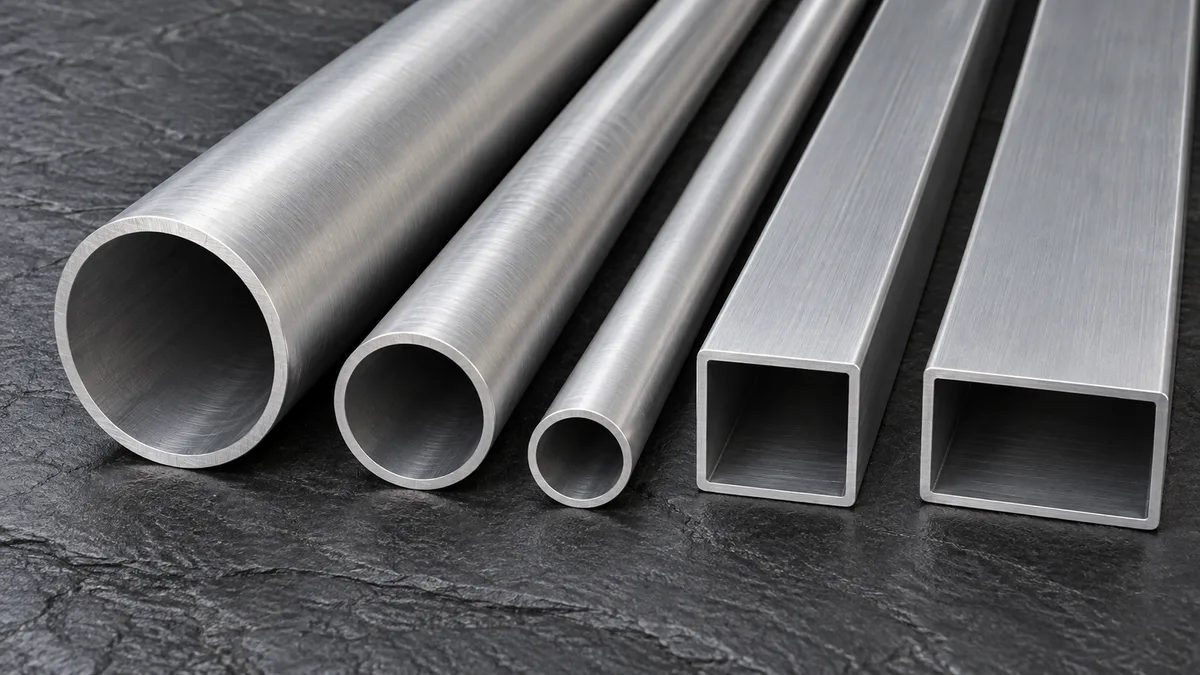
3003 Aircraft Aluminium Tube
3003 drawn seamless tube is the easy-to-bend, easy-to-flare aluminium tubing used in aircraft for low-pressure fluid lines, vent and drain lines, instrument tubing and heat exchangers. Metline supplies 3003 tube in O, H14, H16 and H18 to ASTM B210, which now replaces the cancelled AMS 4065 and WW-T-700/2, shipped worldwide.
- Alloy
- 3003 (Al-Mn)
- Tempers
- O, H14, H16, H18
- Standard
- ASTM B210 (ex AMS 4065, WW-T-700/2)
- Use
- Low-pressure lines, heat exchangers
Why 3003 tube is used in aircraft
Aircraft carry many lines that do not see high pressure: fuel vents, drains, oil and coolant returns, instrument and pitot-static lines, and cabin air systems. For these, formability and corrosion resistance matter more than strength, and 3003 tube in the annealed O temper can be bent tightly, flared and beaded without cracking.
High-pressure hydraulic lines use stronger tubing, typically 6061-T6 or 5052-O at lower pressures, or titanium and stainless steel. 3003 sits below them: cheaper, softer and easier to install, with the manganese giving about 20 % more strength than pure aluminium. Harder tempers (H14 to H18) are used where tube must stay straight or carry modest loads.
Specification history matters for buyers: AMS 4065 (3003-O drawn seamless tubing) and the federal WW-T-700/2 have both been cancelled, with ASTM B210 alloy 3003 in the appropriate temper named as the replacement. AMS 4067 also appears on older drawings and is likewise superseded. We certify to ASTM B210 and cross-reference the legacy specification on request.
3003 chemical composition (wt %)
| Element | Limit | Comment |
|---|---|---|
| Manganese (Mn) | 1.0 – 1.5 | Main alloying element; raises strength about 20 % over 1100 |
| Copper (Cu) | 0.05 – 0.20 | Small addition for strength |
| Silicon (Si) | 0.60 max | Impurity |
| Iron (Fe) | 0.70 max | Impurity |
| Zinc (Zn) | 0.10 max | Impurity |
| Others each / total | 0.05 / 0.15 | |
| Aluminium | Remainder | About 96.8 – 98.9 % |
Mechanical and physical properties
For annealed tube, ASTM B210 sets a tensile range rather than just a minimum, typically about 95 – 130 MPa (14 – 19 ksi) with a minimum yield around 35 MPa (5 ksi), so that tube is guaranteed soft enough to flare and bend.
| Temper | Tensile strength | Yield strength | Elongation | Hardness |
|---|---|---|---|---|
| O | 110 MPa / 16 ksi | 40 MPa / 6 ksi | 30 – 40 % | 28 HB |
| H12 | 130 MPa / 19 ksi | 125 MPa / 18 ksi | 10 – 20 % | 35 HB |
| H14 | 150 MPa / 22 ksi | 145 MPa / 21 ksi | 8 – 16 % | 40 HB |
| H16 | 180 MPa / 26 ksi | 170 MPa / 25 ksi | 5 – 14 % | 47 HB |
| H18 | 200 MPa / 29 ksi | 185 MPa / 27 ksi | 4 – 10 % | 55 HB |
Typical values (Aluminum Association / ASM). Elongation depends on product form and thickness. Specified minimums are those of the ordered standard.
Physical properties
- Density
- 2.73 g/cm³ (0.0986 lb/in³)
- Melting range
- about 643 – 654 °C
- Modulus of elasticity
- about 69 GPa (10,000 ksi)
- Thermal conductivity
- about 190 W/m·K (O) to 155 W/m·K (H18)
- Electrical conductivity
- about 50 % IACS (O) to 40 % IACS (H18)
- Coefficient of thermal expansion
- about 23.2 µm/m·°C (20 – 100 °C)
3003 tube sizes
| Product | Typical range | Notes |
|---|---|---|
| Precision small-bore tube | OD under 1 mm to about 16 mm, wall from about 0.05 mm | Capillary and instrument tubing |
| Drawn seamless tube | OD roughly 3 – 100 mm | ASTM B210, O and H-tempers |
| Extruded tube | Larger diameters | ASTM B221, for less critical uses |
| Coiled tube | Small OD in O temper | Long lengths for lines and heat exchangers |
| Straight lengths | Cut lengths up to about 5 m | Other lengths on request |
Tube weight per metre is π × (OD − wall) × wall × 0.00273 kg (dimensions in mm). A 12.7 × 0.89 mm tube weighs about 0.09 kg/m. The tube weight calculator covers other sizes.
Bending, flaring and joining
- Bending: O temper bends to tight radii; use mandrels on thin walls to prevent kinking.
- Flaring and beading: O temper flares reliably for AN/MS-type fittings; check flare quality on each batch.
- Welding and brazing: excellent; 3003 is a standard core alloy for brazed heat exchangers.
- Corrosion: very good resistance to fuels, oils and atmosphere; anodising or coating adds protection.
- Inspection: dimensional, surface and flare or flattening tests per ASTM B210; eddy-current testing on request.
3003 tube compared with 5052 and 6061 tube
| Factor | 3003-O | 5052-O | 6061-T6 |
|---|---|---|---|
| Typical tensile strength | 110 MPa | 195 MPa | 310 MPa |
| Formability / flaring | Excellent | Very good | Fair |
| Typical aircraft duty | Low-pressure lines | Medium-pressure fuel and oil lines | Hydraulic lines |
Choose by pressure and installation: 3003 for vents and low-pressure lines, 5052 where more burst strength is needed, and 6061-T6 for hydraulic systems.
References and standards
- ASTM B210 – Aluminum and Aluminum-Alloy Drawn Seamless Tubes
- SAE AMS 4065 – Aluminum Alloy Drawn Seamless Tubing, 3003-O (cancelled)
- SAE AMS-WW-T-700/2 – Tube, Aluminum Alloy, Drawn, Seamless, 3003 (cancelled)
- The Aluminum Association – International Alloy Designations and Chemical Composition Limits
3003 aircraft aluminium (aluminum) tube: FAQ
Is 3003 tube suitable for aircraft hydraulic lines?
Not for high-pressure hydraulics. It is used for low-pressure lines such as vents, drains and instrument lines; hydraulic lines use 6061-T6, titanium or stainless steel.
What replaced AMS 4065 and WW-T-700/2?
Both are cancelled; ASTM B210 alloy 3003 in the required temper is the replacement.
Which temper should I order for flared lines?
O (annealed) temper, which has a controlled maximum strength so that it flares and bends without cracking.
Can 3003 tube be brazed?
Yes. 3003 is one of the most common core alloys for brazed heat exchangers.
What sizes are available?
Small-bore precision tube from under 1 mm OD, drawn seamless tube up to about 100 mm OD, in straight lengths or coils.
Need 3003 tubing for aircraft lines?
Send OD, wall, temper and quantity. We will confirm availability, certification and a delivered price.





