Bending
O temper bends to a centreline radius of around 2 – 3 × OD with a mandrel on thin walls. H14 needs larger radii; anneal locally or order O for tight bends.



1100 tube is commercially pure aluminium (99.00 % min) drawn or extruded into round tube and pipe. Aerospace specifications have used it for decades for low-pressure lines, vent and drain tubes, conduits, brackets and heat-transfer coils, where welding, flaring and corrosion resistance matter more than strength. Metline supplies 1100 tube in O, H14, H18 and H112, seamless drawn or extruded, with mill certificates, worldwide.
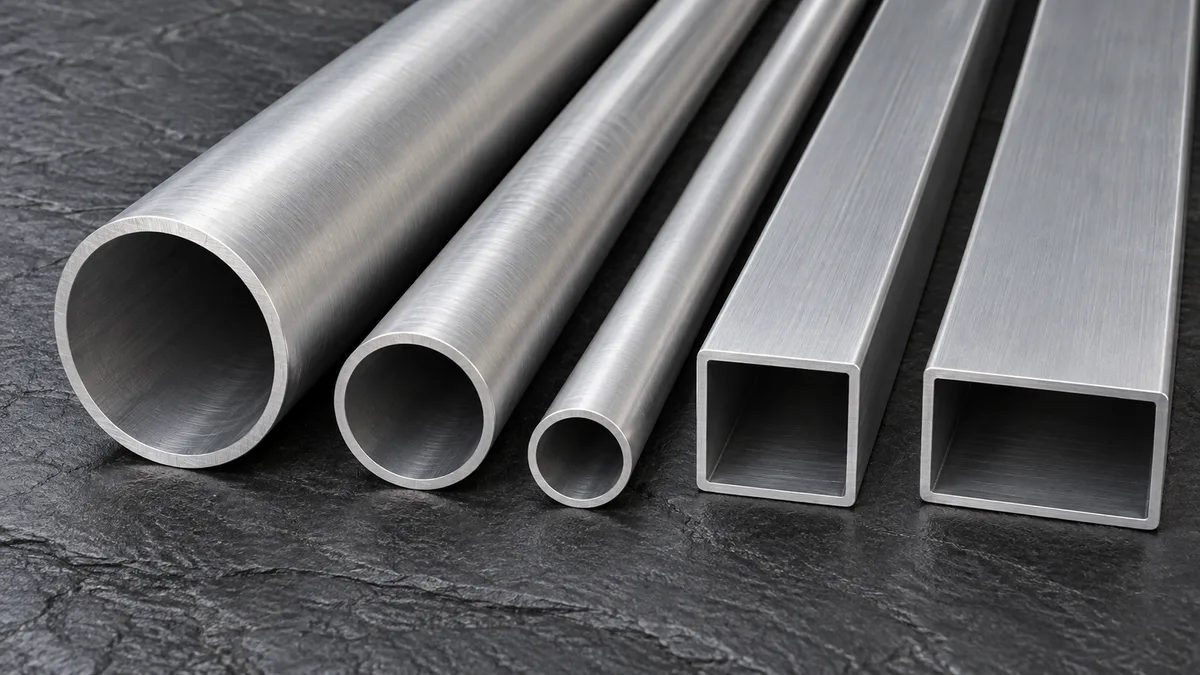
The defining job of 1100 tube is a low-pressure line that must be bent, flared, beaded or welded in place and then left alone for the life of the aircraft without corroding.
Its strength is modest: about 124 MPa tensile in H14 and 90 MPa when annealed, roughly a third of 6061-T6. That rules it out for hydraulic pressure lines, which use 6061-T6, 5052 or 3003 depending on pressure, or titanium and stainless steel at high pressure. What 1100 offers instead is formability and forgiveness. Annealed tube bends to tight radii without wrinkling, accepts 37° flares and beads cleanly, welds with no cracking risk, and resists atmospheric and fluid corrosion well.
Typical aircraft and spacecraft duties are vent, drain and overflow lines, instrument and pitot-static runs at low pressure, electrical conduit, lightly loaded brackets and stand-offs, heat-exchanger and cooling coils, and sleeves and spacers. The former SAE specification AMS 4062 (seamless drawn 1100-H14 tube) described exactly this role: brackets, conduits and low-pressure lines needing weldability and corrosion resistance. AMS 4062 has since been cancelled in favour of ASTM B210, 1100-H14, which is what we certify to today unless your drawing calls for something else.
| Element | Limit (wt %) | Comment |
|---|---|---|
| Silicon + iron (Si + Fe) | 0.95 max combined | The two main impurities are controlled together |
| Copper (Cu) | 0.05 – 0.20 | Deliberate small addition; raises strength slightly over 1050/1060 |
| Manganese (Mn) | 0.05 max | |
| Zinc (Zn) | 0.10 max | |
| Others, each / total | 0.05 / 0.15 max | |
| Aluminium (Al) | 99.00 min | By difference |
Typical values for 1100 in the tempers normally supplied as tube. Minimum properties for drawn tube are set by ASTM B210 and depend on wall thickness; extruded H112 tube has properties close to annealed material.
| Temper | Tensile | Yield (0.2 %) | Elongation | Shear | Typical tube use |
|---|---|---|---|---|---|
| O | 90 MPa / 13 ksi | 34 MPa / 5 ksi | 35 – 45 % | 62 MPa | Coils, tight bends, flared lines |
| H14 | 124 MPa / 18 ksi | 117 MPa / 17 ksi | 9 – 20 % | 76 MPa | Straight lines, conduits, brackets |
| H18 | 165 MPa / 24 ksi | 152 MPa / 22 ksi | 5 – 15 % | 90 MPa | Stiff straight tube, sleeves |
| H112 | close to O | close to O | High | — | Extruded tube for further working |
| Document | Product | Notes |
|---|---|---|
| ASTM B210 / B210M | Drawn seamless tube | Main specification for precision 1100 tube; replaces AMS 4062 (1100-H14) |
| ASTM B221 | Extruded bar, rod, profiles and tube | Extruded H112 / O tube |
| ASTM B241 / B241M | Seamless pipe and seamless extruded tube | Pipe sizes (NPS, schedule) in 1100 |
| AMS-WW-T-700/1 | Tube, 1100 | Successor to Federal WW-T-700/1; still cited on older drawings |
| EN 754-7 / EN 755-7, EN 573-3 | Seamless drawn and extruded tube; chemistry | European route for EN AW-1100 |
| JIS H4080 | Extruded and drawn tube (A1100TD / TE) | Japanese equivalent |
Seamless tube is extruded over a mandrel from a solid or hollow billet, so there is no longitudinal weld or bridge seam. For pressure-bearing or flared lines in aircraft, seamless is the expected product. Porthole (structural) extrusions, which have internal seams, are acceptable only for non-pressure parts such as conduit and brackets; say which you need.
Weight per metre = π × (OD − wall) × wall × 2.71 / 1000, with dimensions in mm. Common aerospace-type sizes:
| OD (mm) | Wall (mm) | OD (in, nominal) | kg per metre |
|---|---|---|---|
| 6.35 | 0.89 | 0.250 | 0.041 |
| 8 | 1 | 0.315 | 0.060 |
| 9.53 | 1 | 0.375 | 0.073 |
| 10 | 1.25 | 0.394 | 0.093 |
| 12 | 1.5 | 0.472 | 0.134 |
| 12.7 | 1.24 | 0.500 | 0.121 |
| 15.88 | 1.65 | 0.625 | 0.200 |
| 16 | 2 | 0.630 | 0.238 |
| 19.05 | 1.65 | 0.750 | 0.244 |
| 25.4 | 1.65 | 1.000 | 0.334 |
| 31.75 | 2.11 | 1.250 | 0.532 |
| 38.1 | 2.41 | 1.500 | 0.732 |
| 50.8 | 3.18 | 2.000 | 1.289 |
O temper bends to a centreline radius of around 2 – 3 × OD with a mandrel on thin walls. H14 needs larger radii; anneal locally or order O for tight bends.
37° and 45° flares and hose beads form cleanly in O and H14. Inspect flares for splits, which usually point to the wrong temper or a damaged tool.
TIG and MIG with 1100 or 4043 filler; furnace or torch brazing with Al-Si fillers for coils and manifolds.
For fluid lines, specify bore cleaning, drying and end caps. Residual drawing lubricant is the most common cause of rejected tube.
Excellent general resistance. Isolate from copper and steel fittings and from carbon-fibre structure.
Calculate allowable pressure from the minimum yield of the ordered temper and wall; 1100 is for low-pressure service only.
| 1100-H14 | 3003-H14 | 5052-O | 6061-T6 | |
|---|---|---|---|---|
| Typical tensile | 124 MPa | 150 MPa | 195 MPa | 310 MPa |
| Formability | Excellent | Excellent | Very good | Fair |
| Weldability | Excellent | Excellent | Excellent | Good |
| Typical aircraft line | Vent, drain, conduit | Low-pressure fluid, fuel vent | Fuel and oil lines | Hydraulic and return lines |
If a line needs more pressure capacity without losing bendability, 3003 or 5052 is the usual upgrade; 6061-T6 is the standard aluminium hydraulic tube.
No. SAE cancelled AMS 4062 (1100-H14 drawn seamless tube) and refers users to ASTM B210, alloy 1100, temper H14. We can certify to B210 and note the AMS 4062 equivalence where a legacy drawing requires it.
Not for normal aircraft hydraulic pressures. Its yield strength is too low. Aluminium hydraulic lines are usually 6061-T6; 1100 suits vent, drain and other low-pressure lines.
O temper. It allows the tightest bend radii and flares without cracking. H14 holds shape better in straight runs.
Seamless tube has no internal weld seam and is preferred for pressure and flared lines. Porthole-extruded tube contains seams and is used for conduit and brackets.
Use π × (OD − wall) × wall × 2.71 / 1000 kg per metre. A 19.05 × 1.65 mm tube weighs about 0.24 kg per metre.
Send OD, wall, temper, length and specification. We reply with availability, certification and freight to your destination.





