Conventional PS plate
Pre-sensitised plates exposed through film. Still used for newspaper and book printing; tolerant substrate requirements.



Almost every offset printing plate in use today is a thin sheet of high-purity aluminium that has been grained, anodised and coated with a light- or heat-sensitive layer. The substrate is 1050, 1060 or 1070 in a hard H18 or H19 temper, typically 0.14 to 0.30 mm thick, with chemistry and surface held far tighter than ordinary sheet. This guide covers what plate makers specify and why, and Metline supplies litho-quality aluminium sheet and coil worldwide.
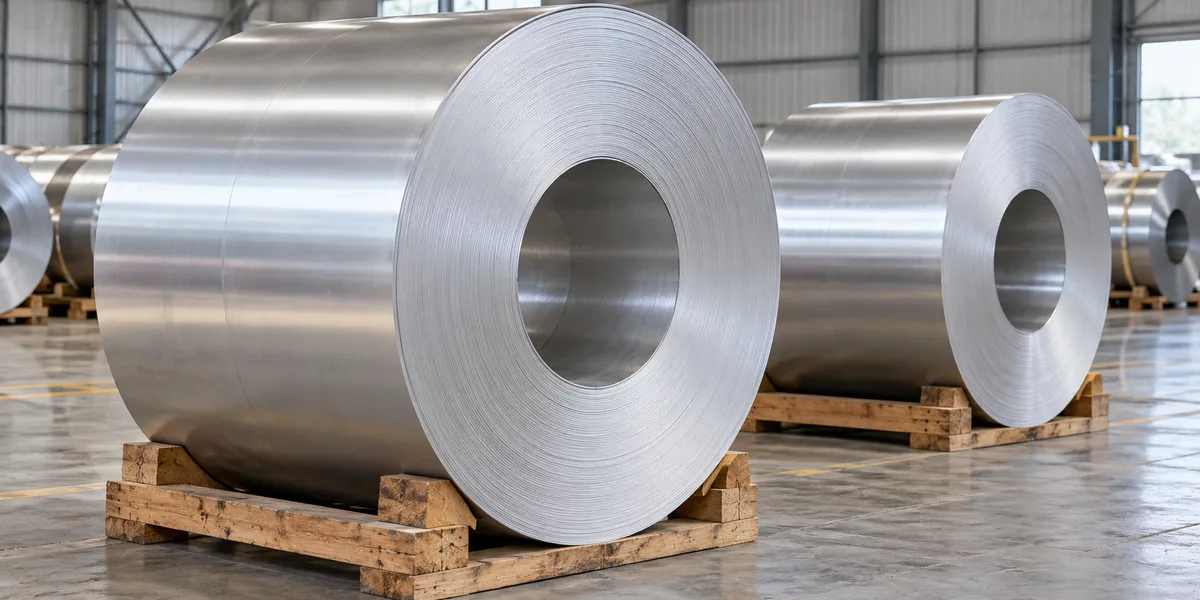
Offset lithography works because the image areas of the plate attract ink and the non-image areas attract water. Aluminium is ideal for the non-image areas: once its surface is roughened and anodised it holds a thin, even film of fountain solution, and the oxide layer is hard enough to survive hundreds of thousands of impressions.
Aluminium also bends around the plate cylinder without cracking, keeps its dimensions so colour separations register, is light enough to handle in large formats and is fully recyclable after the print run. Used plates are one of the cleanest aluminium scrap streams available, which is why plate makers increasingly ask about recycled content.
The substrate therefore has three jobs: respond evenly to electrochemical graining, form a defect-free anodic layer, and stay flat and strong after the coating is baked. Each of these depends on chemistry, grain structure and surface quality that ordinary commercial 1050 sheet does not guarantee.
Pre-sensitised plates exposed through film. Still used for newspaper and book printing; tolerant substrate requirements.
Imaged by an 830 nm infrared laser. Long run lengths, often baked to extend life further, so baking resistance matters.
Photopolymer plates imaged by a 405 nm laser; popular in newspaper production for speed.
Conventional-chemistry plates imaged directly by UV light, a lower-cost route for commercial printers.
Develop on the press with ink and fountain solution. They demand an exceptionally uniform grained surface.
Thin aluminium also serves as base for some gravure, screen-frame and flexographic applications.
Run length, imaging method and whether the plate will be baked all affect which alloy and temper a plate maker chooses. Newspaper plates are often the thinnest and least demanding; long-run commercial and packaging plates need higher strength and better heat resistance.
Registered limits for the base alloys are shown below. Plate makers usually tighten them, specifying narrow ranges for iron and silicon and a low ceiling on copper, because those elements decide how the surface responds to graining.
| Element | 1050 | 1060 | 1070 | Effect on the plate |
|---|---|---|---|---|
| Silicon (Si) | 0.25 | 0.25 | 0.20 | Free Si particles cause pits and defects in the anodic film |
| Iron (Fe) | 0.40 | 0.35 | 0.25 | Controls grain size and graining response; plate makers often target a narrow window |
| Copper (Cu) | 0.05 | 0.05 | 0.04 | Above the limit it creates coarse pits during electrolytic graining |
| Manganese (Mn) | 0.05 | 0.03 | 0.03 | Coarse Fe-Mn compounds harm graining uniformity |
| Magnesium (Mg) | 0.05 | 0.03 | 0.03 | Small, deliberate additions in some litho variants raise strength |
| Zinc (Zn) | 0.05 | 0.05 | 0.04 | Impurity |
| Vanadium (V) | 0.05 | 0.05 | 0.05 | Impurity |
| Titanium (Ti) | 0.03 | 0.03 | 0.03 | Grain refiner added at casting |
| Others, each | 0.03 | 0.03 | 0.03 | |
| Aluminium (Al), min. | 99.50 | 99.60 | 99.70 |
Limits per the Aluminum Association registration and EN 573-3. 1050A (EN AW-1050A) is similar to 1050 with Zn ≤ 0.07 % and Ti ≤ 0.05 %.
Two other substrate families exist. Some plate makers use a 1xxx variant with a small, controlled magnesium addition to raise strength and baking resistance while keeping good graining. Others use 3103 (Al-Mn) where printers need higher strength, accepting that it grains well only in hydrochloric acid electrolytes. Tell us the alloy and any agreed chemistry window when you enquire.
| Form | Alloy | Temper | Thickness | Width / size | Coil ID |
|---|---|---|---|---|---|
| Coil | 1050, 1050A, 1060, 1070 | H18, H19 | 0.13 – 0.30 mm | 388 – 1,600 mm | 150 – 510 mm |
| Cut sheet | 1050, 1060, 1070 | H18, H19 | 0.13 – 0.30 mm | e.g. 830 × 645, 670 × 645, 650 × 550, 450 × 370, 390 × 280 mm | — |
| Characteristic | Representative requirement |
|---|---|
| Thickness tolerance, ≤ 0.20 mm | ±0.005 mm |
| Thickness tolerance, > 0.20 – 0.30 mm | ±0.005 to ±0.010 mm depending on plate category |
| Width tolerance (slit coil) | ±0.5 mm or tighter |
| Tensile strength, H18 | Minimum in the region of 135 – 150 MPa depending on specification |
| Elongation, H18 | ≥ 1 % |
| H19 temper | Higher strength; values reported from actual tests |
Values are typical of plate-maker and industry specifications for lithographic strip; the agreed values for your order are set in the purchase specification and reported on the certificate.
Plate production begins with degreasing, then electrochemical graining in hydrochloric or nitric acid, desmutting, anodising and coating. Anything in the substrate that disturbs the graining shows up as a visible defect on the finished plate, and often as a print fault that only appears on press.
This is why litho substrate is cast with in-line degassing and filtration, rolled on dedicated work rolls with controlled roughness, and inspected over the full coil width. Plate makers usually qualify a substrate with a trial graining run before approving it for production.
| Plate requirement | Substrate choice | Reason |
|---|---|---|
| Short-run newspaper plates | 1050 / 1060, H18, 0.14 – 0.20 mm | Lowest cost; graining response is excellent |
| Commercial thermal CTP, baked | Litho 1xxx with Mg addition or 3103, H18/H19 | Holds strength and flatness after baking |
| Process-free and high-resolution plates | Tight-chemistry 1050A / 1070 | Most uniform graining and anodic film |
| Large-format packaging plates | Higher gauge, 0.24 – 0.30 mm | Stiffness for handling and press clamping |
Agree the chemistry window, mechanical properties after a simulated bake, flatness, surface acceptance criteria and coil build (ID, OD, maximum weight, splice policy) in writing before the first shipment. A good substrate specification avoids disputes later and makes it possible to qualify a second source.
Mostly 1050, 1050A, 1060 and 1070 in H18 or H19 temper, chosen for their excellent response to electrochemical graining. Stronger 1xxx variants with a small magnesium addition, or 3103, are used where the plate must be baked or run very long.
Most are 0.14 to 0.30 mm. Small-format and newspaper plates sit at the thin end; large-format and packaging plates use 0.24 to 0.30 mm for stiffness.
Copper creates coarse pits during electrolytic graining and silicon particles leave defects in the anodic film. Both cause scumming or toning in non-image areas on press.
Both are fully hard, cold-rolled tempers. H19 has been rolled further and is stronger, which helps plates hold their shape and resist stretching on long runs.
Yes. Substrate can be supplied as slit coil or cut to sheet sizes such as 830 × 645 mm or 650 × 550 mm, interleaved and packed flat.
Yes. Used plates are a clean, high-purity scrap stream and are widely remelted, often back into litho or other 1xxx products.
Send alloy, temper, gauge, width and volume. We reply with the substrate specification, certification and a delivered price.





