Solid round wire
The most common form. 8 mm (≈ 50 mm²) round in 1070 or AlMgSi alloy is the standard catalogue down conductor in IEC markets; 10 mm (≈ 78 mm²) is used where larger sections are required.



Aluminium is one of the standard conductor materials for lightning protection systems: an 8 mm 1070 round wire weighs about a third as much as the same copper conductor, costs less and resists atmospheric corrosion well. This guide covers the grades, sizes, standards, installation limits and inspection checks for aluminium air-termination and down-conductor wire, and how Metline supplies it in coils to installers and kit makers worldwide.
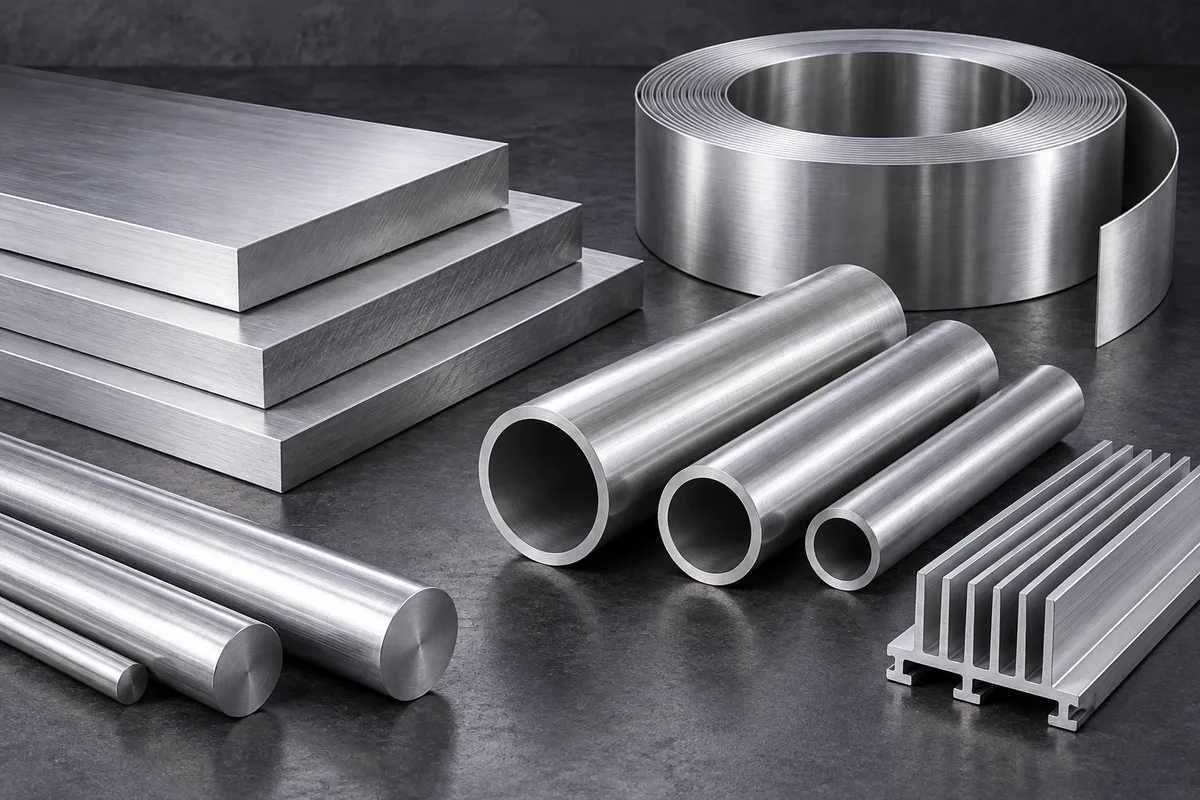
A lightning protection system has three parts: air terminals that intercept the strike, down conductors that carry the current to ground, and an earth-termination system that disperses it. Aluminium is accepted for the first two by IEC 62305 / EN 62561 and by NFPA 780 and UL 96 in North America.
A lightning stroke is a very short, very high current pulse, typically tens of kiloamps lasting tens of microseconds. What the conductor must survive is the heating and electrodynamic force of that pulse, plus decades of weather. High-purity 1070 aluminium handles this well: its conductivity of about 61 % IACS means a modest temperature rise, its natural oxide film protects it in most atmospheres, and its softness makes it easy to dress along roofs and facades with neat bends.
Weight and cost are the practical drivers. Aluminium has roughly 30 % of the density of copper, so even after allowing for the larger cross-section that standards require, a run of aluminium down conductor is much lighter to lift onto a roof and cheaper per metre. On large commercial and industrial buildings that difference adds up quickly.
The most common form. 8 mm (≈ 50 mm²) round in 1070 or AlMgSi alloy is the standard catalogue down conductor in IEC markets; 10 mm (≈ 78 mm²) is used where larger sections are required.
Rectangular section lies flat against roofs and walls, presents more surface for heat dissipation and is easy to clamp. Typical sizes are 20 – 30 mm wide and 2.5 – 4 mm thick.
Multiple aluminium strands (for example 24 strands of 14 AWG) give flexibility for long runs, NFPA 780 Class I main conductors and bonding jumpers.
Short lengths of larger-diameter aluminium rod (typically 10 – 16 mm) are cut and pointed or rounded as air terminals. Rod is supplied in straight lengths rather than coils.
A steel core with a metallurgically bonded aluminium layer combines steel strength with aluminium surface protection and is used for guy wires, overhead earth wires and some down conductors.
An aluminium core with a bonded copper layer, used where installers want a copper surface at terminations with a lighter, lower-cost conductor.
| Standard | Region | What it covers |
|---|---|---|
| IEC 62305-3 / EN 62305-3 | International / Europe | Design of protection for structures, including minimum conductor cross-sections by material |
| IEC 62561-2 / EN 62561-2 | International / Europe | Requirements and tests for conductors and earth electrodes: dimensions, resistivity, tensile strength, elongation |
| NFPA 780 | USA | Installation standard; Class I and Class II minimum aluminium conductor sizes by building height |
| UL 96 / UL 96A | USA | Lightning protection components and installation requirements |
| ASTM B211 / B230 / B231 | USA | Aluminium bar, rod and wire; EC-grade wire and stranded conductors |
| EN 573-3 | Europe | Chemical composition of EN AW-1070A and other wrought alloys |
Minimum cross-sections for aluminium are larger than for copper in every standard, to keep heating comparable. As a guide, many IEC-market systems use 8 mm solid round aluminium (about 50 mm²), and IEC 62305-3 lists its own minimum areas for each material and use; under NFPA 780, aluminium Class I main conductors are about 98,600 circular mils and Class II (for structures over 75 ft) about 192,000 circular mils. Always check the current edition of the standard that applies to your project.
Limits follow the registered composition for 1070 (EN AW-1070A is almost identical). Low iron, silicon and transition elements are what give the grade its conductivity.
| Element | Limit (%) |
|---|---|
| Silicon (Si) | 0.20 max |
| Iron (Fe) | 0.25 max |
| Copper (Cu) | 0.04 max |
| Manganese (Mn) | 0.03 max |
| Magnesium (Mg) | 0.03 max |
| Zinc (Zn) | 0.04 max |
| Titanium (Ti) | 0.03 max |
| Vanadium (V) | 0.05 max |
| Others, each | 0.03 max |
| Aluminium (Al) | 99.70 min |
Each delivery is certified with the actual analysis of the cast; see the mill test certificate.
Lightning conductor wire is normally supplied soft (O) or semi-hard. Soft wire bends easily by hand and can be straightened on site; semi-hard wire holds a straight line between clips and resists sagging on long vertical runs. Typical supply specifications for 1070 wire call for roughly 150 – 160 MPa minimum tensile strength in the hard-drawn condition and about 75 MPa in the annealed condition, with annealed elongation of 10 – 18 % depending on diameter. EN 62561-2 sets its own tensile and elongation tests for conductors, so specify the standard and temper on the order.
| Grade | Typical conductivity | Strength | Notes |
|---|---|---|---|
| 1070 | ≈ 61 % IACS | Low | Default for down conductors; easy to bend |
| 1060 | ≈ 61 – 62 % IACS | Low | Close alternative to 1070 |
| 1350 (EC) | ≥ 61 % IACS | Low – medium (temper) | Electrical-conductor grade with controlled impurities |
| AlMgSi (6101 / 6201 type) | ≈ 52 – 57 % IACS | Higher | Stiffer, holds shape on long free runs; listed in EN 62561-2 |
Round wire is available from about 0.8 mm up to heavy rod sizes; lightning protection mostly uses 6 – 10 mm. The table shows calculated values for 1070 at 2.70 g/cm³ and 61 % IACS.
| Diameter (mm) | Area (mm²) | kg per metre | Metres per 20 kg coil | DC resistance (mΩ/m, 20 °C) |
|---|---|---|---|---|
| 3 | 7.1 | 0.019 | 1048 | 4.00 |
| 4 | 12.6 | 0.034 | 589 | 2.25 |
| 6 | 28.3 | 0.076 | 262 | 1.00 |
| 8 | 50.3 | 0.136 | 147 | 0.56 |
| 10 | 78.5 | 0.212 | 94 | 0.36 |
| 12 | 113.1 | 0.305 | 65 | 0.25 |
| Diameter (mm) | Typical tolerance (mm) |
|---|---|
| 0.80 – 0.99 | ± 0.02 |
| 1.00 – 1.99 | ± 0.03 |
| 2.00 – 2.99 | ± 0.04 |
| 3.00 – 5.00 | ± 0.05 |
| Over 5.00 | Per order standard, typically ± 0.1 |
Aluminium must not be laid directly on, in or under plaster, mortar or concrete, nor buried in soil. Alkaline and wet environments attack it. Use stand-off clips and switch to a suitable earth electrode material at a test joint above ground.
Where aluminium meets copper, use bimetallic connectors or tinned fittings and keep copper downstream (below) aluminium so copper-bearing run-off does not drip onto it.
Standards recommend clip spacing of roughly 1 m on horizontal and vertical runs; allow for thermal movement on long straight runs.
Avoid sharp bends; lightning current follows the conductor, and tight bends raise inductance and the risk of side-flashing. Gentle radii of 200 mm or more are typical design guidance.
Use tested connectors, clean the contact surfaces and keep the number of joints low. Welded joints or compression fittings perform best long term.
In heavy salt or sulphur exposure, consider AlMgSi alloy or a protective coating and inspect more often.
| Material | Corrosion behaviour | Advantages | Limitations |
|---|---|---|---|
| Aluminium (1070, AlMgSi) | Good in most atmospheres | Light, low cost, easy to form | Not in soil, concrete or mortar; larger section needed |
| Copper | Good; attacked by sulphides and ammonia | High conductivity; can be buried | Heavy, expensive, theft target |
| Hot-dip galvanised steel | Moderate; poor in chloride environments | Strong, cheap; common for earthing | Low conductivity; zinc layer wears away |
| Stainless steel | Excellent | Long life in aggressive atmospheres | Low conductivity, high cost |
Many systems combine materials: aluminium roof and down conductors, a test joint above ground, and copper, copper-bonded steel or stainless earth electrodes below ground. Metline supplies the aluminium parts of such systems; the earthing materials are sourced separately.
In IEC and EN markets the usual size is 8 mm solid round (about 50 mm²); 10 mm is used where a larger section is required. In the US, NFPA 780 sets aluminium Class I and Class II main-conductor sizes in circular mils. Check the edition of the standard that applies.
1070 has higher conductivity (about 61 % IACS) and is easier to bend. AlMgSi alloys such as 6101 are stiffer and hold a straight line better on long runs, with slightly lower conductivity. Both are accepted conductor materials.
No. Aluminium must not be installed in soil, or directly on or in concrete, mortar or plaster. Transition to a suitable earth electrode material at a test joint above ground.
About 0.136 kg per metre, so a 20 kg coil holds roughly 147 m.
Yes, with bimetallic connectors, and with the copper placed below the aluminium so run-off from copper does not cause galvanic corrosion of the aluminium.
An EN 10204 3.1 mill test certificate with chemistry and mechanical results; conductivity, bend and dimensional reports on request.
Send the grade, size, temper and quantity. We will confirm availability, coil packing and a delivered price.





